Use metric signature throughout this solution. Stress-energy conservation for the perfect fluid is . Expanding it and using metric compatibility givesThe normalization of the four-velocity implies . Contracting with therefore gives the relativistic perfect-fluid energy equation,while subtracting the component parallel to gives the relativistic Euler equation,Equivalently, apply the orthogonal projection to the conservation equation. This form makes clear that a pressure gradient orthogonal to the four-velocity supplies the fluid's four-acceleration.
Let on the fluid region and choose the Killing vector field to be future-directed. The normalized four-velocity isThe Killing equation implies both andConsequently its Killing-flow four-acceleration isFor a scalar, the Lie derivative is . Thus the assumed stationarity of the pressure gives . These are the ingredients needed for hydrostatic equilibrium along a Killing vector; hypersurface orthogonality of is not needed.
Substitute the Killing-flow four-acceleration and stationary pressure into the relativistic Euler equation. It givesFor the equation of state of blackbody radiation, , this becomes . The barotropic hydrostatic first integral therefore gives, on each connected nonvacuum fluid region,This is the stationary radiation density law. Combining it with the Stefan–Boltzmann law also gives the Tolman–Ehrenfest relation .
At a regular finite free surface, a smooth Killing vector field has finite norm. Hence cannot approach zero there. More globally, its norm has a finite upper bound on a compact regular fluid closure, which bounds the density away from zero whenever . If the timelike norm instead tends to zero, the density diverges. Thus a radiation fluid has no regular free surface: a finite radiation-filled cavity needs a material wall supporting nonzero pressure, rather than an unsupported radiation-vacuum interface.
Take positive outward and define the separation as upper minus lower position. The Newtonian potential of a point mass gives the acceleration . Expanding its difference across a separation gives the tidal force equationThe upper particle falls slightly less rapidly, so the separation increases. If the upper particle carries the electric charge and the electric field points outward, the extra relative acceleration is . Reversing the field or placing the charge on the lower particle changes its sign. Write this signed acceleration as and put . With initial relative velocity zero and nearly constant and , the ordinary differential equation has solutionFor , the leading changes due to the tidal force and electric field are respectivelywith the stated sign convention. Thus, for a nonzero fixed electric acceleration,A laboratory of size has , so this ratio tends to zero as . This is local tidal acceleration scaling: gravitational relative acceleration is proportional to separation, whereas the electric difference persists even at coincident positions.
The duration also matters. At fixed time, in absolute size, but need not tend to zero. To keep the electrically displaced particles in the shrinking laboratory, take ; then . Alternatively a stationary terrestrial laboratory has a free-fall time of order , giving . Both make precise the small spacetime-region limit. An extended, long-running experiment can still measure arbitrarily small tidal forces.
The weak equivalence principle says that freely falling test particles with the same initial data have composition-independent motion. In particular, a freely falling frame removes the common gravitational acceleration of both particles. The electric accelerations depend on charge and cannot be removed for charged and uncharged particles simultaneously by the same change of frame.
The Einstein equivalence principle extends the freely falling laboratory statement to all local nongravitational experiments: their outcomes obey special relativity, with local Lorentz invariance and local position invariance. The strong equivalence principle also includes local gravitational experiments and bodies with significant gravitational binding energy. It asserts universality of their free fall and independence of local experimental outcomes from the laboratory's location and velocity. The two-particle experiment illustrates the local distinction between gravity and a nongravitational force; by itself it does not establish this stronger claim about self-gravitating bodies.
In a metric theory, the common freely falling trajectories are timelike geodesics of a Lorentzian metric. Normal coordinates make and the Christoffel symbols zero at one point. Fermi normal coordinates do the same along a reference timelike geodesic. The residual effects are controlled by the Riemann curvature tensor through geodesic deviation, and enter the local metric at quadratic order in distance. Curvature is a physical tidal field, so no coordinate choice removes it over a finite region.
A relativistic theory should consequently couple matter universally to the metric tensor, recover nongravitational laws in local inertial frames and recover the Newtonian limit. General relativity implements this with the Einstein field equations; the contracted Bianchi identity is consistent with stress-energy conservation. The equivalence principle motivates this geometric description but does not alone uniquely determine the field equations. Extra gravitational fields may satisfy the Einstein equivalence principle for ordinary matter while failing the strong equivalence principle because local gravitational measurements or self-gravitating trajectories depend on those fields.
Let , using spatial indices . Stress-energy conservation, symmetry of the stress-energy tensor and integration by parts giveand a second derivative givesAll boundary terms vanish by compact support. This proves the stress-energy quadrupole identity,The support is understood to remain bounded over the time interval used for differentiating these integrals.
For the radiation calculation set , write and use the trace-reversed metric perturbation in Lorenz gauge in linearized gravity. With the curvature and field-equation signs in this paper, the linear equation isThe retarded solution with no incoming radiation is consequentlyLet be the distance from the source's centre of mass, and let be its size. In the radiation zone, . The leading multipole expansion additionally assumes slow internal motion, or small compared with the radiation wavelength. These assumptions allow in the denominator and the common retarded time at leading quadrupole order. ThusDefine the trace-free mass quadrupole moment byTo make the requested normalization explicit, write the trace-free spatial metric coefficient as . Trace reversal only adds a spatial trace, so the preceding equations give the far-zone quadrupole strain coefficientThe supplied scan does not contain the referenced perturbation handout. The definition above fixes the normalization of directly. If denotes the physical transverse-traceless tensor in that handout, the right-hand side is also to be transversely projected for the observation direction. Trace-free alone does not imply transverse. With , putThe transverse-traceless projector gives and the physical spatial strain is . This also states the result without relying on omitted handout notation. The retarded construction and direction-dependent transverse projection are described in Carroll's general relativity lectures, with the appropriate changes of metric-sign convention.
For the equal-mass binary star, its centre of mass is at the origin and the separation is . The gravitational force on either star is , while its centripetal force is . HenceAt leading Newtonian order, is the sum of the two point-mass densities. Its moments areso the trace-free mass quadrupole moment isThe Newtonian bound system is treated in the usual leading weak-field quadrupole approximation; an exactly conserved effective source also includes the interaction stresses. Accelerated point-mass dust alone would not satisfy the conservation hypothesis.
Differentiating twice and evaluating at givesFor an observer on the axis this is already transverse and traceless. Its alternating plus polarization and cross polarization have a phase difference of , giving circularly polarized gravitational radiation at twice the orbital frequency. The amplitude decays as , as expected for outgoing radiation in three spatial dimensions.
More generally take the line of sight in the plane at inclination to the orbital angular-momentum axis. In the transverse basis , , define . Projection gives the physical gravitational wave polarizationsThus a generic view is elliptically polarized, the face-on view is circularly polarized and the edge-on view is linearly polarized. This is circular-binary quadrupole radiation; an overall sign or transverse-axis rotation only changes the polarization convention.
For the full unit-radius two-dimensional de Sitter spacetime, the coordinate ranges areOne can use with endpoints identified. If the identification is omitted, the same line element describes the universal covering spacetime instead. The periodicity follows from the hyperboloid embeddingThe induced ambient Minkowski metric is precisely the given Lorentzian metric.
Using an affine parameter , the geodesic Lagrangian is . The nonzero Christoffel symbols areThus the geodesic equations and their first integrals areHere for unit-speed timelike geodesics, for null geodesics and for unit-speed spacelike geodesics. The conserved is the geodesic conserved quantity from a Killing vector for the angular symmetry.
All geodesics of two-dimensional de Sitter spacetime can be written especially simply in the embedding. If is the initial point and the initial tangent, with , , , the geodesic has normal ambient acceleration . ThereforeThese curves stay in the two-plane spanned by and , preserve both constraints and have no tangential acceleration. They consequently solve the geodesic equation and exhaust all initial directions.
An isometry can move the chosen point to , namely . For future-directed timelike geodesics take , obtainingThe continuous angular branch has , and every real gives a distinct timelike direction. The two null geodesics have andFor spacelike geodesics take , givingThey are closed with period in affine arclength and . In particular, is the equatorial geodesic . These three families, with reversals of parametrization allowed, are the requested complete set through the chosen point.
The conformal time substitution givesHenceMultiplying by gives the regular conformal cylinder of two-dimensional de Sitter spacetime. Adding completes the conformal compactification; both boundary circles are spacelike. Null geodesics are straight lines through the origin. The other families have the useful diagram equationsThe image sketches representative directions from each family; the formulas allow all intermediate directions.
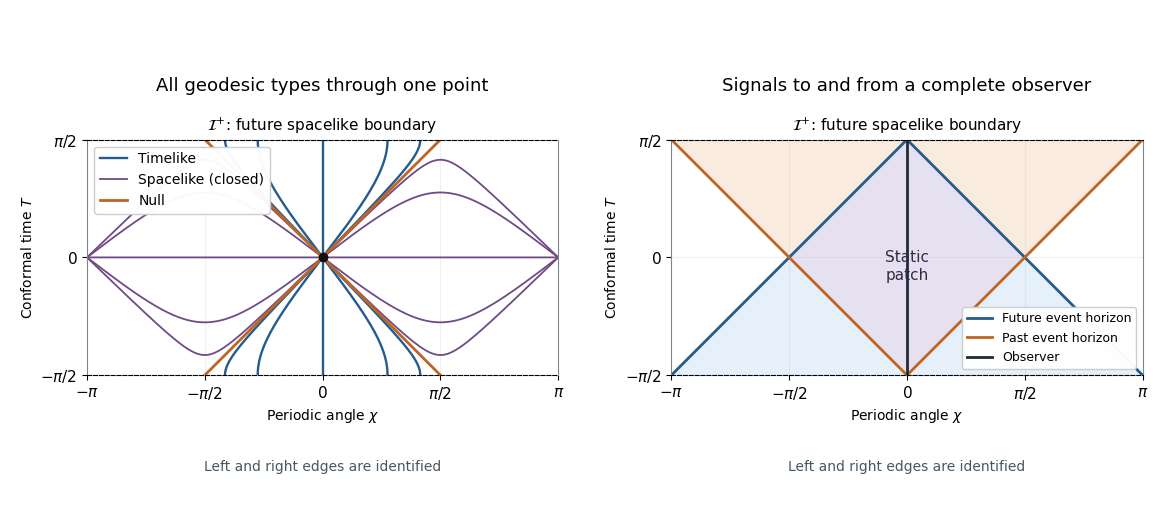
Geodesics through one point and observer horizons on the two-dimensional de Sitter conformal cylinder
. Details. 
For the complete observer , let be the shortest angular distance on the circle. Since light travels one unit of angular distance per unit conformal time, an event at can signal to the observer at some finite future time precisely whenEquality defines its future observer event horizon. Likewise an event can receive a signal emitted by the observer precisely whenand equality defines the past horizon. In the lift , their branches are and . The common communication region is the diamond , the observer's static patch of de Sitter spacetime. These are the observer horizons in two-dimensional de Sitter spacetime. Every complete timelike observer has analogous horizons after a de Sitter isometry; they depend on the observer, rather than enclosing an intrinsic black-hole region.
Despite these horizons, each constant- circle is a Cauchy hypersurface of the full spacetime: any inextendible causal curve crosses it exactly once. The global spacetime is therefore globally hyperbolic and has no Cauchy horizons. The conformal boundaries lie at infinite proper time for complete timelike geodesics and infinite affine distance for complete null geodesics, so their finite height in the diagram is not a physical incompleteness.
Articles by others on the same topic
There are currently no matching articles.