Let and count the available neutrons and protons immediately before their incorporation into nuclei. In the usual neutron-limited helium synthesis approximation, all surviving neutrons go into and the remaining protons form . Each helium nucleus contains two neutrons and two protons, soUsing the equal-nucleon-mass approximation and neglecting trace nuclei and binding-energy corrections, the primordial helium mass fraction isThe ratio is the pre-assembly nucleon ratio, not the number ratio of free hydrogen nuclei to helium nuclei afterward. The derivation assumes enough protons to bind all the neutrons, as in standard Big Bang nucleosynthesis. The familiar gives and hydrogen mass fraction .
Under the usual interpretation that the extra force simply slows otherwise adiabatic expansion, without changing reaction rates or injecting particles, the primordial hydrogen mass fraction would be larger. A smaller Hubble parameter makes cooling slower, delays the end of the deuterium bottleneck, and permits more free-neutron decay after freeze-out before nuclear assembly. If the reduced expansion also keeps weak conversions effective longer, the lower eventual cosmological weak freeze-out temperature further reduces the neutron-to-proton ratio. Both effects lower the primordial helium mass fraction and raise the remaining hydrogen mass fraction.
For fixed initial neutron fraction , the post-freeze-out estimate is , where is the onset of efficient nuclear assembly. Thus decreases when cooling delays . The extra time is the time to reach the nuclear-assembly temperature, not an increase in the specified clock interval seconds. An unspecified force that also reheats the plasma, changes weak rates or causes recollapse would require additional information; the simple expansion-only interpretation is essential to this expectation.
A primordial light-element abundance determination seeks gas or stars with little subsequent chemical processing. The three abundances require different observations and corrections.
For helium, measure helium and hydrogen recombination emission in metal-poor extragalactic ionized regions. Correct line ratios for electron temperature, density, extinction, collisional excitation, underlying stellar absorption and unobserved ionization stages. Convert the number ratio to helium mass fraction , allowing for heavy elements when necessary. Since stars produce helium and metals, extrapolate a sample toward zero gas-phase metallicity to infer . The sensitivity to atomic data and these corrections is illustrated by Peimbert and collaborators' helium determination.
For deuterium, fit isotope-shifted hydrogen and deuterium absorption lines in relatively simple, metal-poor quasar absorption systems. The deuterium feature is displaced by about from the corresponding hydrogen line. Multiple transitions and velocity components help distinguish deuterium from unrelated hydrogen contamination. The fitted neutral-column ratio estimates D/H in predominantly neutral gas. Since stellar processing destroys deuterium, low-metallicity, minimally processed absorbers are favored; the technique is exemplified by Pettini and collaborators' deuterium measurement.
For lithium, measure the absorption feature near in warm, old, metal-poor halo stars. Stellar-atmosphere models convert line strength to Li/H. The Spite plateau supplies a nearly constant low-metallicity level, but stellar metallicity trends, atmospheric temperature scales, departures from local thermal equilibrium and stellar lithium depletion must be considered. Thus the photospheric level is not automatically the initial abundance. Ryan and collaborators' halo lithium measurements illustrate the measured abundance and chemical-evolution corrections.
In standard Big Bang nucleosynthesis, with the radiation content and reaction rates fixed, the main adjustable abundance parameter is the baryon-to-photon ratio . The baryon-density consistency between nucleosynthesis and the microwave background usesIncreasing cosmological baryon density makes deuterium burn more efficiently, so D/H falls steeply. The primordial helium mass fraction grows only slowly, because its dominant control is the surviving neutron fraction. Near the observationally favored density, lithium-7 production, much of it initially as beryllium-7, rises with density. At lower densities the full lithium curve has a valley; the sketch focuses on the branch relevant to the baryon-density comparison.
For the historical meaning of “current” in this 2008 paper, representative 2007–2008 fits near areThese local fits, with nuclear-rate uncertainties, and representative D/H and lithium ranges are documented in Steigman's 2007 nucleosynthesis analysis. They are not a replacement for a nuclear network outside their calibrated range.
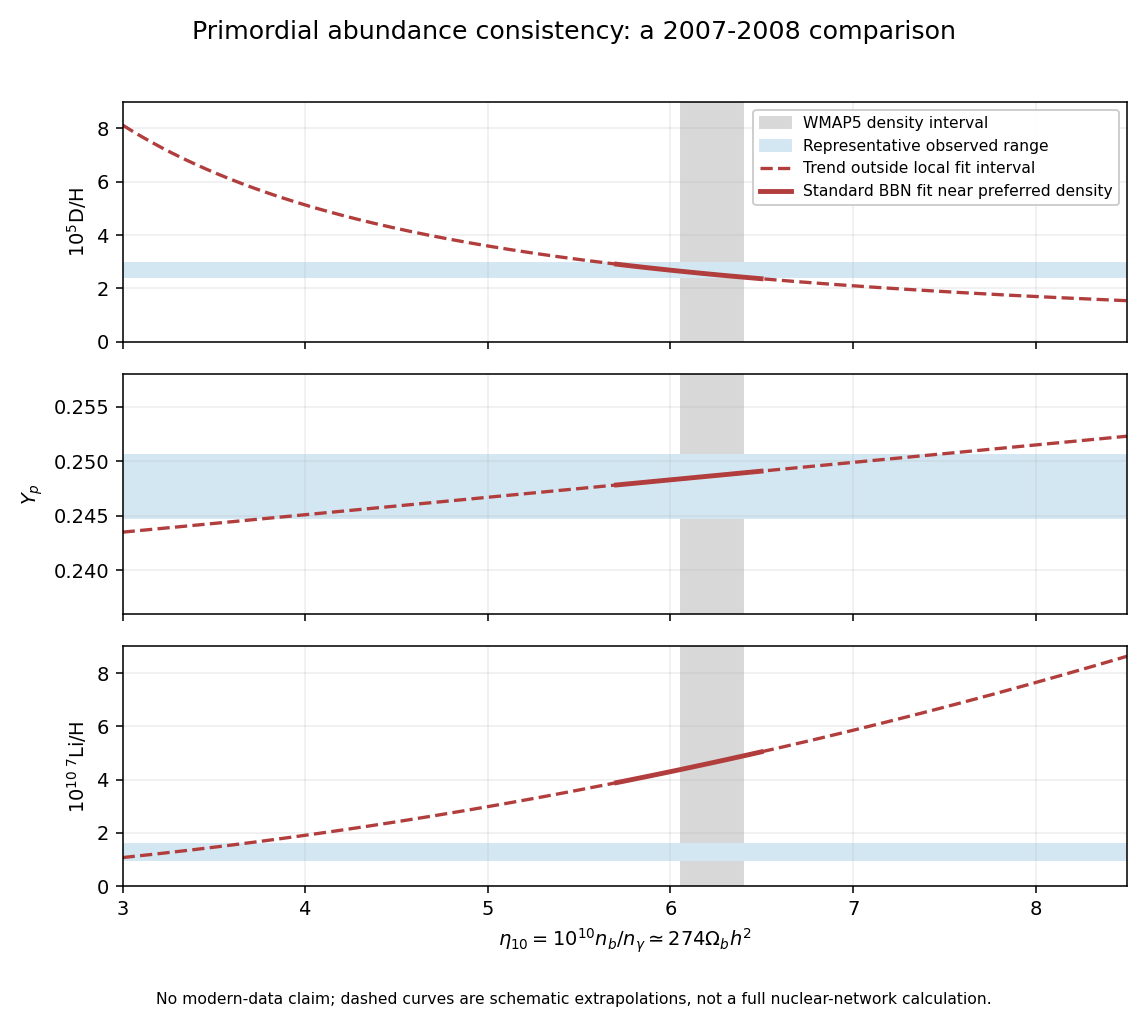
2007–2008 primordial abundance trends and observational ranges compared with the WMAP baryon density
. Details. 
The cosmic microwave background acoustic peak pattern measures baryon loading at recombination, independently of the abundance measurements. For example, the five-year WMAP cosmological analysis gives from WMAP alone, corresponding to . For , this is . Galaxy-cluster baryon fractions combined with independent total-matter density provide another, more astrophysically model-dependent cross-check.
At , the fitted predictions are D/H , , and . A representative observed D/H range around overlaps the prediction; its inferred density is compatible with the cosmic microwave background. The helium result from the 2007 helium analysis also agrees. Other helium analyses had lower central values, illustrating why ionization and temperature systematics matter.
In contrast, a representative plateau estimate corresponds to roughly –, a factor of several below the prediction at the same density. This is the cosmological lithium problem. The three abundance ranges therefore should not all be described as exact simultaneous agreement: deuterium and helium broadly support the independently measured baryon density, while lithium has a substantial discrepancy. The plotted ranges explicitly refer to the 2007–2008 comparison, not present-day parameter estimates.
The agreement of the main light-element abundances with a hot early nuclear-burning phase, and the independent baryon-density consistency between nucleosynthesis and the microwave background, gives strong support to the hot Big Bang framework. These measurements connect the first minutes to recombination, despite their very different temperatures, densities and observables. In particular, the large primordial helium mass fraction and residual deuterium are natural outputs of Big Bang nucleosynthesis, rather than arbitrary products of subsequent star formation.
The cosmological lithium problem prevents claiming that the simplest abundance calculation explains every observation without qualification. One must distinguish nuclear-rate uncertainties, stellar depletion, atmosphere and abundance systematics, and possible new particle physics. Thus the broad hot Big Bang framework is strongly supported, while lithium tests the completeness of its simplest nucleosynthesis and stellar-abundance interpretation. An unresolved lithium discrepancy alone does not erase the independent successes of deuterium, helium and the cosmic microwave background.
Articles by others on the same topic
There are currently no matching articles.