Work locally where the needed derivatives of the level set can be represented by the implicit function theorem. Differentiating while holding the indicated coordinate fixed givesMultiplying the three implicit differentiation formulas provesThis cyclic partial derivative identity is asserted where all three finite coordinate derivatives exist, in particular when . It is not a globally defined product at points where one of the necessary coordinate parametrizations is singular.
The partial derivatives of are , and . Therefore the three implicit differentiation formulas areTheir product is wherever . The excluded factors identify exactly where these quotient formulas cannot all represent finite partial derivatives.
At the gradient is . The outward radial unit vector is when . Taking its scalar product with the gradient gives the radial directional derivativeEquivalently, on this plane . At the origin the radial unit vector is undefined, but every unit directional derivative is zero. Differentiating along the unnormalized scaling path instead gives at ; that is a rate per scaling parameter, not per unit radial distance.
A stationary point requires and . The Hessian matrix is diagonal:For , the origin has positive definite Hessian matrix, hence is a strict local minimum, with value zero. The two additional stationary points have value and Hessian matrix ; both are saddle points.
For , the origin is the only stationary point and has an indefinite Hessian matrix, so it is a saddle point. For , the Hessian matrix test is inconclusive, but takes positive values along the -axis and negative values along the -axis arbitrarily near zero. Thus the origin is a degenerate saddle point. There are no local maxima in any case: varying or away from a stationary point increases .
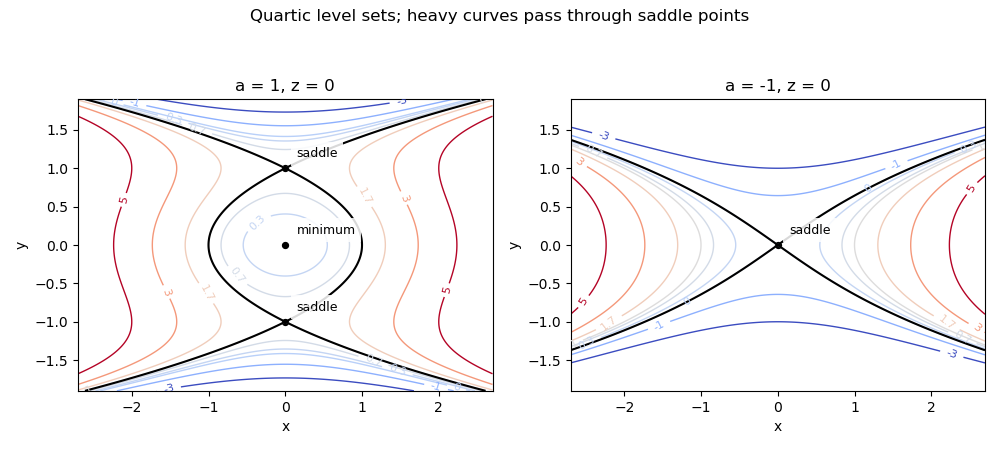
In the -plane take ; holding another fixed merely shifts all contour labels by . The level sets satisfyFor , the origin is a local minimum and are saddle points of a scalar function at contour value . For , a closed contour around the origin is accompanied by unbounded outer components. At the contour satisfies and crosses at the two saddle points of a scalar function. For , two unbounded components remain; negative contours have only outer components.
For , the origin is a saddle point of a scalar function, and the zero contour is , with tangent lines . Positive contours form two components extending on opposite sides of the -axis; negative contours form upper and lower components. These level sets are illustrated below.

Articles by others on the same topic
There are currently no matching articles.