Write and . In this geometry the Lorentz force density is purely longitudinal and equals . The ideal magnetohydrodynamic induction equation becomes . Together with the continuity equation and adiabatic pressure evolution, the four primitive-variable equations areThey have the required quasilinear form withHere the notation in derivatives means , whereas denotes the longitudinal velocity. Spatial dependence is one-dimensional; time dependence is allowed in the wave problem.
Put , and assume and . Expansion of the characteristic polynomial givesTwo independent eigenvectors for can be chosen as and . For the two propagating branches, useful eigenvectors areThe repeated branch advects an entropy disturbance and a disturbance with unchanged total gas-plus-magnetic pressure. The branches are perpendicular fast magnetosonic waves, with speed relative to the fluid.
On a uniform background, a Fourier amplitude obeys . Thus the eigenvalues are the phase velocities for , and the four dispersion branches are twice and . The reduced geometry retains neither an independent transverse velocity nor an additional propagating Alfvén wave.
To construct each finite-amplitude simple wave in magnetohydrodynamics, trace a state-space curve with tangent , using as its parameter. Integrating the pressure and magnetic components givesThe constants and are the entropy and transverse magnetic flux freezing invariants along this state curve. HenceSince , substituting this curve into the original system reduces it to . By the chain rule,Thus the characteristic speed itself satisfies the Inviscid Burgers equation. For initial speed , its smooth solution is along , until the characteristic curves intersect. This derivation supplies genuine state curves for simple waves, not merely a linear dispersion relation.
Let for accretion. The steady spherical continuity equation and radial Euler equations for an inviscid fluid giveFor a barotropic fluid, . Dividing continuity equation by gives . Eliminating this derivative yieldsAt a smooth transonic critical point, the coefficient of vanishes. A finite derivative then requires the right side to vanish simultaneously:These are the sonic and regularity conditions. Otherwise the derivative is singular and the proposed smooth transonic passage fails. The local slope must also be a real root compatible with the desired branch. For example, defining at the point and differentiating both sides givesThis explains why simultaneous vanishing is a necessary regularity condition, rather than an automatic proof that every potential admits a critical crossing.
Define the barotropic enthalpy function by . The momentum equation integrates to the Bernoulli equationChanging the reference mass density in changes only the constant . For an isothermal closure this logarithmic function is a barotropic barotropic pressure potential; it should not be confused with the constant thermodynamic specific enthalpy of an ideal gas held at fixed temperature.
For isothermal transonic accretion in the Paczyński-Wiita potential, assume and , and define and . The critical equation iswhose two roots are . Only the plus root lies outside . ThereforeFor this isothermal case , and the slope relation reduces toThe positive slope is the inward-accretion solution connecting a small inward speed at large radius to the supersonic inward branch. Thus the exterior critical point is a genuine nondegenerate transonic point.
Choose the reference mass density as , so and from the conditions at infinity. At ,Substitution into givesThis is the rate selected by the smooth transonic accretion solution. Arbitrary static or subsonic formal solutions are not assigned this rate merely by specifying conditions at infinity. As , the result tends to the isothermal Bondi accretion rate , a useful normalization check.
The flux representation gives and . Therefore and . With magnetohydrodynamic mass loading ,Thus the steady continuity equation is satisfied.
The cross product in the ideal magnetohydrodynamic induction equation simplifies toHence steady induction requires . On a regular connected poloidal flux surface, this integrates locally toThis is the field-line angular velocity of an axisymmetric wind. It need not equal the gas angular velocity when , because . The regular-surface qualification matters: if is constant and the field is purely toroidal, induction alone cannot turn an arbitrary into a function of .
Put and . Dot the pressure-free momentum equation with . Since , axisymmetry givesThe azimuthal momentum equation in cylindrical coordinates similarly givesSubtracting times the second relation from the first, and using , proves that is constant along a flowing regular poloidal flux surface. For nonzero mass loading its corotating energy invariant of an axisymmetric magnetic wind isThis is the invariant labeled in the question. It is a corotating mechanical energy, distinct from the total magnetohydrodynamic Bernoulli invariant, which includes electromagnetic energy flux. In standard notation it equals total specific energy minus times the total specific angular-momentum invariant.
Near the footpoint, negligible gives , while the poloidal velocity is parallel to the poloidal magnetic field. The gas approximately corotates and slides along a rotating field line as a bead on a wire, with effective potentialA decreasing effective potential converts corotating potential energy into poloidal kinetic energy. This is the mechanism of magnetocentrifugal acceleration; local launching does not alone guarantee global escape.
For an attractive point mass, take and . Parameterize the outward straight line by , . The first derivative of vanishes at because the footpoint is in circular radial balance. The meridional Hessian there is , soThus the thirty-degree magnetocentrifugal launching criterion in its strict negative-curvature form isAbove this angle the equilibrium is unstable to an outward displacement; below it the near-footpoint potential initially rises. The source's proportionality constant must be negative to describe attraction.
The marginal straight-line launch at thirty degrees has zero quadratic curvature. For precisely the straight line and point-mass potential here, let and . Direct expansion givesAt , this is , so the outward direction is downhill at cubic order. Consequently the strict inequality is the nondegenerate quadratic criterion; it should not be interpreted as excluding every one-sided nonlinear marginal launch at equality. An exactly resting bead remains an equilibrium until displaced.
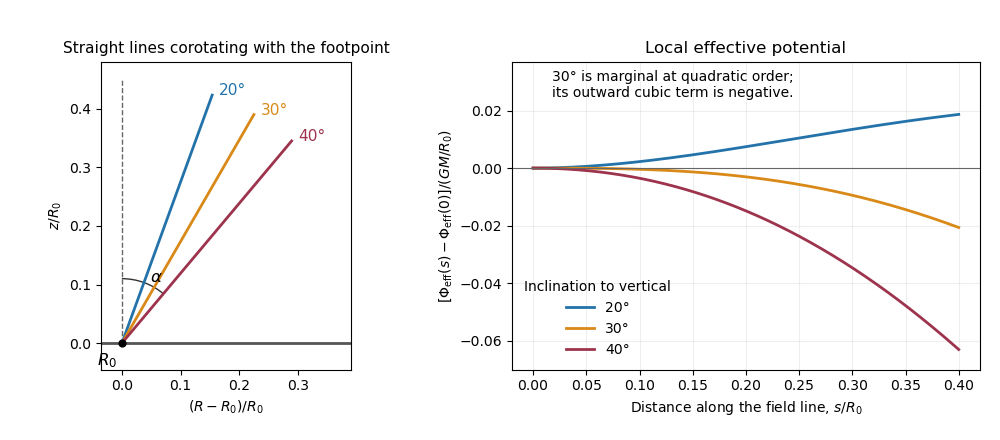
Effective potential along straight magnetic field lines below, at and above the thirty-degree launching threshold
. Details. 
In the inertial frame the steady convective acceleration is . For a barotropic fluid, , where is the barotropic enthalpy function. The equilibrium momentum equation therefore giveson each connected fluid region. Uniform rotation is essential: it makes the centrifugal acceleration derivable from the centrifugal potential .
The Cowling approximation sets the gravitational-potential perturbation to zero while retaining background gravity. The barotropic pressure force linearizes as , with . Denote its mode amplitude by . The advective time derivative on a scalar mode is , so the stated positive-frequency exponential produces with . Linearizing the radial centrifugal term produces , while linearizing the azimuthal convective term produces . ThusThese are the pressure-gradient and Coriolis acceleration terms in the corotating-frame form. Independently, linearizing continuity equation givesThe equilibrium mass density is axisymmetric, so no additional azimuthal background-density derivative appears.
For and , invert the horizontal momentum system:Inserting these into the continuity equation, dividing by and multiplying by givesThe two terms proportional to cancel; this cancellation leaves precisely the background-density derivative in the last term. Since , this is exactlyThe singular frequency cases require the original velocity equations rather than this inversion.
In the low-frequency anelastic approximation for a rotating barotropic star, neglect the left side. Spherical background mass density satisfies , understood by its smooth limiting form on the equatorial plane. For ,The remaining equation reduces toWriting , the bracket factors as . The regular desired branch is thereforeThe other algebraic factor corresponds to , where the eliminated horizontal system is singular; it is not classified by this pressure-equation inversion. A constant-density background makes the bulk factor identically zero but does not invalidate the displayed solution.
For the regular branch, an explicit velocity check is particularly informative. Up to a common mode normalization,It satisfies and . Thus for every spherical mass density profile, directly verifying the anelastic continuity condition. The motion is tangential to spherical shells and is the sectoral inertial mode of a slowly rotating barotropic star. For single-valued azimuthal modes, is a positive integer. With the source's exponential convention,For the pattern is retrograde relative to the star but prograde in the inertial frame. This is a leading slow-rotation anelastic mode, not an exact solution of the compressible equations whose left-hand term was discarded.
Articles by others on the same topic
There are currently no matching articles.