Put , and . To leading order the mean-motion resonance fixes . The specific angular momentum isThe asteroid's instantaneous angular speed is . Thus the high-eccentricity angular-speed crossover satisfies , givingHere , so a parabolic Kepler orbit gives the local motion accurately. Its polar equation is . Write . Since ,This is the outward crossing; the inward crossing has true anomaly modulo .
For the pericentre-to-crossover flight time use . The parabolic Kepler orbit has and , whence direct integration gives the Barker equationAt the crossover . Consequently the planet's angular displacement isThe error tends to zero as at fixed ; it includes the finite binding energy of the elliptic Kepler orbit as well as the subleading term in the Barker equation.
At the th pericentre passage the asteroid's unwrapped mean longitude is . The resonant argument therefore givesThus specifies the planet's direction relative to the asteroid's longitude of pericentre when the asteroid passes pericentre, with branches separated by . It is not the instantaneous true-longitude separation throughout the orbit. At high orbital eccentricity the asteroid quickly sweeps to a direction nearly opposite pericentre, while the planet scarcely moves. During the long outer excursion the asteroid's direction changes slowly and the planet advances substantially. This makes an astronomical conjunction during the outer excursion much more dangerous than an astronomical conjunction close to pericentre.
At the following apocentre, the planet has advanced . The asteroid's direction in the rotating reference frame is consequentlyThese apocentre directions are equally spaced. Phase protection of interior integer resonances places the planet in the largest gap between them, rather than at an apocentre direction. For , puts an apocentre toward the planet, whereas puts the apocentres at . For , puts an apocentre toward the planet, whereas puts the apocentres at . Hence the geometrically favored resonant-argument libration centres in this regime of high orbital eccentricity areThis is an encounter-avoidance argument for likely stability, not a calculation of a resonant Hamiltonian or a claim that every orbit near either centre is stable at arbitrary orbital eccentricity.
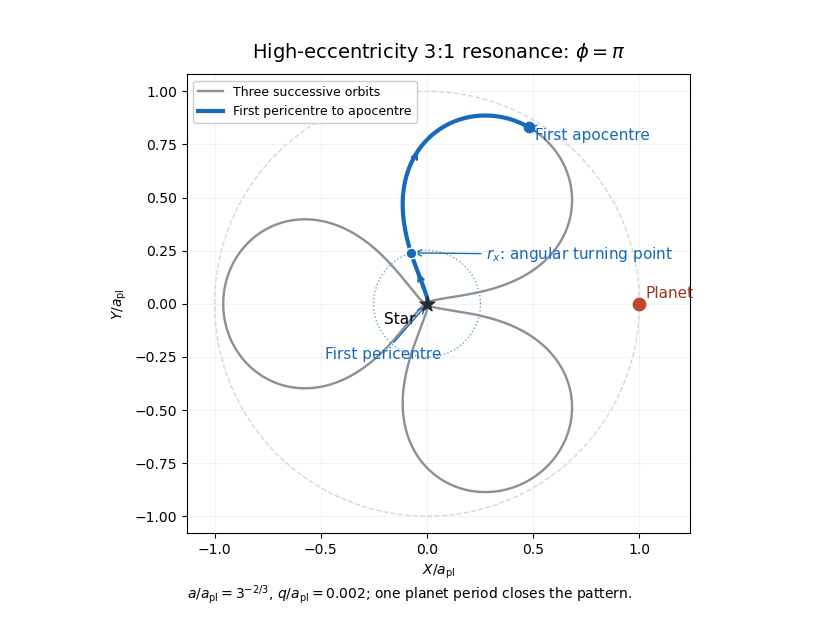
The following rotating-frame drawing uses , , and . It follows three successive Kepler orbits, which fill one planet orbital period and close the pattern. The blue segment is just the first outward half-orbit. The marked crossover is a maximum of its rotating-frame polar angle, since changes from positive to negative there. The planet stays at ; the three apocentres avoid that direction.
To estimate angular-momentum kicks to nearly radial orbits, note that , so an order-one fractional change in requires of order . A characteristic distant encounter at radii of order has tangential acceleration of order and duration of order . Its torque per unit asteroid mass therefore producesWith the most favorable coherent signs, the crude encounter count isOrder-one factors depend on and encounter geometry. Uncorrelated signs instead give a random walk count of order when this is large. A librating phase-protected orbit can suppress the kicks even further.
There is an important limit to calling this a minimum. The question does not specify an encounter impact parameter. For a weak close encounter with impact parameter and relative speed , the impulse estimate gives and hence , capped below by one. In the 2:1 case the Kepler orbit can cross the planet's orbit, so one suitably close encounter can suffice: there is no impact-parameter-independent large lower bound. For , bounds the separation below by , and supplies a geometric factor at fixed . The boxed count is the usual orbital-scale, maximally coherent estimate; the assumptions are essential.
The central equation must be read as ; its printed left-hand expression lacks . Initially is constant. Dotting this equation with the velocity givesTaking its cross product with gives . In the fixed orbital plane the magnitude is . These are conservation of specific orbital energy and specific angular momentum.
Let . Differentiating the polar equation of the Kepler orbit, with its elements initially constant, givesSubstitution into the specific orbital energy yields
For isotropic stellar mass loss with no recoil or drag, the force is still central, so remains exactly constant, although does not. NowThe same algebraic relation between holds for the instantaneous osculating orbital elements. Differentiating it and using givesand, for ,A particularly useful nonsingular description uses the eccentricity vectorThe vector equation remains meaningful at a circular orbit, where a longitude of pericentre is undefined. Its components along and perpendicular to give the scalar formula above and
The osculating pericentre is . ThereforeFor mass loss, , this is nonnegative: pericentre does not decrease. It is positive except at pericentre itself, where and . Thus a strictly opposite sign at every instant is not literally true; a pericentre passage with nonzero mass-loss rate is a counterexample to the strict wording. The intended monotonicity follows exactly, without requiring slow mass loss.
For adiabatic orbital expansion under isotropic mass loss, average over the unperturbed Kepler orbit and hold constant to leading order during that orbit. If is the eccentric anomaly and , thenIt follows immediately thatAveraging with uniform true anomaly instead of uniform time would give the wrong result. Since , conserved and constant secular orbital eccentricity giveThe pericentre and apocentre expand in the same secular proportion. These are leading adiabatic invariants, rather than exact invariants for arbitrary time-dependent .
For the instantaneous precession fraction write and . The adiabatic apsidal condition is controlled byIt is a signed fraction: apsidal advance contributes positively on the outward leg during mass loss, and negatively on the inward leg. Let . Ordinary orbit averaging requires , together with negligible variation of the mass-loss law over one orbit. If the pericentre direction is also to vary negligibly relative to the instantaneous azimuthal motion, the maximum absolute fraction must be small. A precise condition for isThe maximizing cosine is : differentiating the last factor gives . Thus one can evaluate explicitly by putting into the formula. Its useful limits areFor orbital eccentricity of order unity, mass loss much slower than an orbital period suffices; near a circular orbit, keeping the pericentre direction slowly varying additionally requires . The latter divergence is a singularity of the pericentre coordinate, not a divergence of the eccentricity vector dynamics. Indeed, at frozen , integrating the scalar evolution to first order gives up to an integration constant. Its absolute amplitude stays small for slow mass loss even when the scalar longitude of pericentre becomes unsuitable.
Use rotating barycentric coordinates , rotating velocity , and . Multiplying the three equations by the corresponding velocity components and adding cancels the Coriolis force terms:Thus the Jacobi constant is . The inertial barycentric velocity is . If and , thenThe inertial energy and inertial angular momentum need not separately be constant. Their combination is constant because the two gravitational sources rotate steadily at unit angular speed.
For the Tisserand parameter take , and compare the osculating orbital elements well outside a close encounter, where and barycentre-to-primary corrections are negligible. ThenThis requires a circular secondary orbit, the restricted three-body problem approximation, and no dissipative force or other perturber. is conserved to leading order between encounter episodes; the osculating during a close encounter need not be constant. The exact invariant is .
For clarity the exact two-body energy relation is , rather than the printed formula without the numerator . At the leading order used for , the two agree; retaining finite in just part of that formula is inconsistent.
At a close encounter put the secondary radius and speed equal to one at leading order, and denote the particle's incoming relative speed outside the secondary's strong-deflection region by . Conservation of relative speed in the short gravitational encounter givesAn incoming orbit with has at by the vis-viva equation; escape there requires an outgoing speed exceeding . The triangle inequality therefore gives the necessary single-encounter escape velocity boundEquality only gives a marginal parabolic limit. This argument deliberately gives a weak necessary bound, not a sufficient scattering criterion.
The planet-encounter relative velocity is related to the Tisserand parameter byHere at the encounter radius, and the formula also applies to inclined passages at the planet's orbital plane. For the intended prograde coplanar incoming orbit, and , so . Applying the preceding necessary bound givesCoplanar alone also allows . For that retrograde case , and even a circular incoming orbit can be scattered onto an escaping orbit; the orbital eccentricity restriction therefore presumes prograde motion. Also, retaining the outgoing relative-velocity geometry gives the sharper necessary condition , hence and for the same prograde incoming orbit. This stronger bound is consistent with, and implies, the weaker bound above.
For the Tisserand periapsis bound, first writeA bound orbit capable of another close encounter must intersect the secondary's circular radius, so . For fixed , the largest possible occurs at . The remaining expression decreases with , sinceThus every such orbit obeysOn , increases monotonically from to . For the least accessible pericentre is the unique root of : the limiting orbit is prograde and coplanar, with apocentre just at the planet. Introduce . Its tangential speed at this apocentre is , and its vis-viva equation gives the particularly well-behaved answerEquivalently, setting gives and , with . Rationalizing the previous result yieldsThe apparent singularity at is removable; the first form gives there. The limits are as and as . The same lower envelope also excludes a smaller pericentre on an escaping trajectory when . To see this without introducing an apocentre, use the planet-frame velocity sphere: forces the tangential component at an encounter to be at least , so total specific angular momentum obeys . At pericentre the stellar energy obeys , while . ThusIf , then , and the left side is increasing with . Hence . But , and the right side is smaller than for , a contradiction. This establishes the barrier for all Kepler trajectories that reach the encounter radius, including unbound ones.
For , bound encounter-crossing orbits can approach (take ), so the positive root extrapolated from the displayed expression is not a universal barrier. For there is no trajectory reaching a close encounter in this approximation, since would be negative. Multiple encounters can approach the derived lower envelope by changing energy, angular momentum and inclination while preserving the Tisserand parameter; the invariant alone does not guarantee a particular encounter history reaches it.
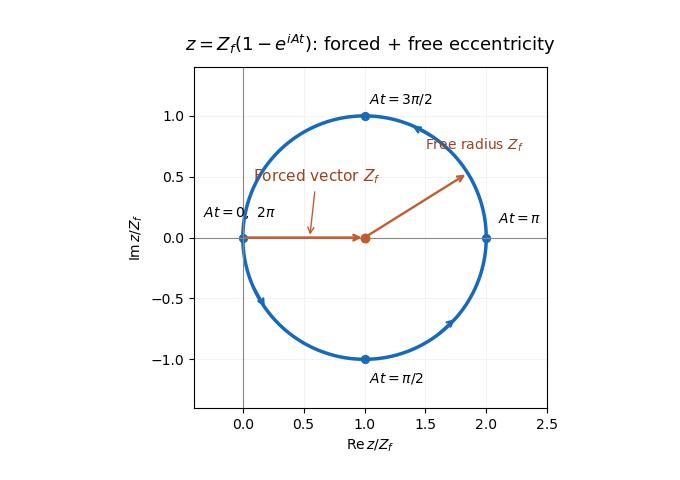
At each fixed semimajor axis, let and . The planet's longitude of pericentre is the zero of longitude. The secular perturbation equation becomes . Integrating it with the initial condition givesThe forced eccentricity vector is the constant real ; the free eccentricity vector is . Consequently the complex eccentricity follows a circle in the Argand plane centered at , with radius , starting at the origin and moving counterclockwise. Its initial velocity is downward, . The secular period is , andThe longitude of pericentre is undefined at the origin, but the complex eccentricity passes smoothly through it. At , and the orbit is maximally eccentric and aligned with the planet.


Using the small- Laplace coefficient expansion givesAlso to leading order in the planet-to-star mass ratio. The secular forcing by a distant outer planet is thereforeA relative correction to can accumulate a phase error at very long times; the leading-frequency formula is not a uniform-in-time expansion.
If with , then and . The outer planetesimal therefore has a slightly larger forced eccentricity circle and a shorter secular period. Its accumulated secular phase lead is . Initially both circles start at the origin, but their eccentricity vectors progressively lose alignment. Linearizing the exponential in additionally requires .
The orbit crossing is caused by this accumulating differential secular phase, even though individual orbital eccentricities remain small. To first order in orbital eccentricity, the radius of an orbit at fixed inertial longitude isFor an infinitesimally neighboring orbit,This derivative is evaluated within the first-order orbital-shape model; derivatives of the neglected quadratic terms give relative corrections near crossing. The least separation over longitude is consequently . The differential secular orbit-crossing criterion is . Since and ,The first term stays bounded by , whereas the second grows in proportion to time. To leading order in , crossing begins when . ThusMore precisely, in this first-order orbital-shape approximation the exact first crossing lies within a fractional window of this value, since the magnitude differs from by at most . Higher-order Laplace coefficients give additional corrections. The local derivation takes the neighboring-orbit limit before the long-time limit; for a finite separation it requires near crossing. A broad continuous disk contains such neighboring orbits. The crossings first appear in directions selected by the phase of , not simultaneously at every longitude.
For the collision energy estimate adopt the phase-averaged mean orbital eccentricity . The specified velocity estimate givesUsing the projectile kinetic energy per target mass convention for specific impact energy, equal-size and equal-density bodies have equal masses and . A catastrophic planetesimal collision requires , soThe numerical coefficient is only illustrative because the collision speed was specified only to order of magnitude. If the disruption threshold is instead defined using the centre of mass kinetic energy per combined mass, equal masses give and the coefficient becomes for a threshold expressed in that convention. The robust result is a lower bound of order .
Within the inner-disk approximation, catastrophic collisions require sufficiently large , not arbitrarily small radii. Although the Keplerian speed rises inward, the secularly induced orbital eccentricity falls faster: . The lower bound must be much smaller than one to leave a domain compatible with . A small planet orbital eccentricity, a large disruption threshold, or a distant planet can eliminate that domain. The planet mass controls the time to crossing but cancels from the eventual forced eccentricity amplitude and this collision-energy criterion. The threshold alone does not ensure that crossing has occurred within the disk's available lifetime.
Articles by others on the same topic
There are currently no matching articles.