Fix the Minkowski metric convention and the Levi-Civita symbol . The antisymmetry of the Lorentz algebra generators gives and the inverse relation . Inserting one temporal index in each generator immediately yieldsTwo Lorentz boosts therefore generate a rotation through their commutator; the minus sign distinguishes this algebra from the rotation algebra in four-dimensional Euclidean space.
For a spatial generator and a boost, the same Lorentz algebra givesContracting with givesThus the three Lorentz boosts transform as a spatial vector under rotations.
Finally, the all-spatial bracket becomesUse in the double contraction with . The epsilon contraction identity reduces it to . One can check the sign directly: and give ; cyclic permutations give the other nonzero brackets. The requested coefficients areThese are rotation and boost commutators with a fixed metric signature. The PDF does not explicitly specify the signature. Keeping its generator convention but choosing reverses every displayed algebra coefficient: the pairs become . More generally, if , the three nonzero coefficients are , and . Specifying the Minkowski metric is therefore necessary to make the numerical signs unambiguous.
The hierarchy problem begins with a large separation of scales: the weak scale is much smaller than possible unification or gravitational scales. A fundamental scalar mass is especially sensitive to a much heavier scale. In an effective description with ultraviolet cutoff , one schematically findsThe coefficient contains gauge, scalar and Yukawa couplings, with different signs for bosonic and fermionic loops. The explicit quadratic cutoff dependence is regulator-dependent, but a heavy physical particle coupled to the Higgs produces a threshold correction of order its mass squared. That heavy-threshold sensitivity is the physical difficulty.
The technical hierarchy problem asks whether a small scale, once chosen, remains stable under such radiative corrections. Maintaining by cancelling unrelated bare and loop contributions, and readjusting the cancellation at successive orders, is the naturalness concern. It is different from explaining why the small scale was chosen in the first place. Supersymmetry primarily supplies protection against the technical instability; a complete explanation of the origin of supersymmetry-breaking scales needs additional dynamics.
The relevant comparison of mass types is:
- For a gauge boson, an explicit Proca mass term is forbidden by an unbroken gauge symmetry. This is gauge protection of a vector mass. In a Higgs phase, a vector mass is of order , but the stability of then depends on the scalar mass that determines the symmetry-breaking scale. Gauge invariance does not, by itself, solve that scalar problem.
- A chiral fermion mass is protected because setting it to zero restores an appropriate chiral symmetry. Perturbative corrections cannot generate a symmetry-forbidden mass; schematically . In the Standard Model, chiral gauge quantum numbers prohibit a bare fermion mass, and the Higgs mechanism permits masses through Yukawa couplings. This is chiral protection of a fermion mass, rather than an additive correction of order .
- A squark or slepton is a scalar. Its bilinear is allowed by gauge symmetries and by the ordinary chiral phase symmetry of its fermion partner. Consequently, without supersymmetry, those symmetries do not protect a small scalar mass against corrections of order .
In exact supersymmetry, each supermultiplet has matched bosonic and fermionic degrees of freedom, with their interaction strengths related. Opposite loop signs then give supersymmetric cancellation of quadratic divergences. This is not just equality of state counts: the supersymmetric relation between quartic and Yukawa couplings is also essential. A schematic paired-loop contribution has the high-momentum formFor equal partner masses the displayed contributions cancel. With a small splitting, the difference falls as , so the remaining ultraviolet sensitivity is logarithmic, proportional to the splitting rather than to .
Realistic partners need not have exactly equal masses. Soft supersymmetry breaking permits scalar squared masses, gaugino masses and suitable trilinear interactions without restoring the unwanted quadratic sensitivity. Typically,up to coefficients and threshold details. Squarks and sleptons can therefore be heavier than their chiral fermion partners while the scalar sector remains stable against the much larger ultraviolet scale. Nevertheless, very large soft masses, particularly in the Higgs-coupled sector, leave large finite or logarithmic corrections and require tuning. This soft scalar-mass sensitivity remains after the quadratic divergence has cancelled. Supersymmetry solves the quadratic radiative instability when breaking is suitably soft; it does not make arbitrarily heavy superpartners natural or explain the entire hierarchy by itself.
Use the usual normalization of the Super-Poincaré algebra, with and under the corresponding index convention:The supercharges are odd operators: they turn bosonic states into fermionic states and vice versa. If is fermion parity, this statement is , soThe same relation holds for the conjugate supercharges.
For a finite-dimensional physical supermultiplet at fixed four-momentum with energy , let count physical bosonic and fermionic states. Cyclicity of the ordinary trace and the parity anticommutation implySumming over the two spinor indices givesThis supertrace pairing at positive energy proves boson-fermion degeneracy in a supermultiplet for massive as well as massless positive-energy representations. It counts on-shell polarizations, not merely the names of fields. The requirement matters: a zero-energy supersymmetric vacuum can be a bosonic singlet without a paired fermionic vacuum.
If supersymmetry-breaking operators are explicitly added to the Lagrangian, the original supercharges generally no longer commute with the full Hamiltonian. They are not conserved symmetries generating finite fixed-energy physical supermultiplets; their original anticommutator does not equal the full translation generator with the breaking terms included. Thus the step replacing the parity-weighted anticommutator by on a closed physical representation fails. The odd parity relation alone does not force energy degeneracy or an equal number of physical states at each mass.
This is explicit versus spontaneous supersymmetry breaking. In spontaneous breaking the action still has conserved supercharges, but the vacuum is not annihilated by them. Acting on particle excitations about that vacuum involves the broken-vacuum/Goldstino sector, so an ordinary finite particle multiplet above an invariant vacuum is no longer the correct pairing argument. The vacuum-energy statements below refer to an exact globally supersymmetric Hamiltonian, including the spontaneously broken case; they are not positivity claims for an arbitrary explicitly broken Hamiltonian.
Sum the diagonal spinor entries of the supercharge anticommutator. Since and , the Hamiltonian isFor a normalized vacuum, energy positivity in global supersymmetry follows fromIn the unbroken case, all supercharges annihilate the vacuum, giving . Conversely, zero energy forces each nonnegative norm to vanish, so the vacuum is supersymmetric. The algebra fixes the additive zero of energy here. For an infinite homogeneous vacuum, use a finite-volume regulator and interpret the result as its vacuum energy density.
For spontaneous breaking of exact global supersymmetry, at least one supercharge does not annihilate the vacuum. Its norm in the preceding expression is positive, henceWith canonical kinetic terms, this is also seen in the nonnegative scalar potential, : nonzero auxiliary expectation values signal breaking and positive energy density. The associated massless fermion is the Goldstino.
If “broken” instead means arbitrary explicit breaking by added operators, the exact Super-Poincaré algebra no longer fixes the full Hamiltonian, and the positive-norm argument does not constrain its vacuum energy. One can, for example, shift that explicitly broken Hamiltonian by a constant. The strict positivity conclusion therefore uses spontaneous breaking of an otherwise exact global theory, not a blanket assertion about all breaking terms. It also is not a statement about supergravity, whose scalar potential contains additional terms.
Take canonical charged chiral superfield kinetic terms, gauge coupling , and no Fayet–Iliopoulos term, since none is specified. Elimination of the three complex auxiliary fields givesThe Abelian gauge auxiliary field obeys in this normalization. Thus the F-term scalar potential and the gauge D-term giveAll terms are nonnegative. The normalization of can be changed together with the vector-field normalization, but the relative charges and the zero-potential conditions cannot. A noncanonical Kähler potential would change the inverse-metric factors in the F-term potential; adding a Fayet–Iliopoulos term would shift and define a different model. Neither is silently introduced here.
For nonzero , zero potential requires both F-flatness and D-flatness:The product condition and equality of charged magnitudes together force . There is no condition on the neutral scalar. Consequently the global minima formOnly the neutral field can acquire a vacuum expectation value. It does not give the gauge vector a mass: its scalar kinetic term has no charged covariant derivative. Hence the gauged remains unbroken in every global minimum for . This is a neutral flat direction with oppositely charged chiral fields; a continuous vacuum family is not automatically gauge-symmetry breaking.
The exceptional uncoupled case should be separated. Then only D-flatness remains, allowing and arbitrary . For , the charged expectations Higgs the ; for it remains unbroken. The usual interacting answer assumes .
Every global minimum found for nonzero has . By energy positivity in global supersymmetry, its zero energy means all supercharges annihilate it. ThereforeThe arbitrary neutral expectation is a supersymmetric modulus; the nonzero derivatives that would break supersymmetry vanish even though itself need not vanish. In the exceptional case, every D-flatness minimum likewise has zero F- and D-auxiliaries, so supersymmetry remains unbroken even on the gauge-Higgsed branch. The supersymmetric Higgs mechanism permits internal gauge breaking without supersymmetry breaking. No extra constant or linear superpotential term is needed to find a zero-energy vacuum in this model.
Chirality and the component expansion. A chiral superfield is constrained byUse left Grassmann derivatives. The sign from differentiating an odd factor matters:For a general superfield written in coordinates , the odd chain rule consequently turns the given superspace covariant derivative intoThe chirality constraint removes the explicit dependence at fixed . There are only two components of , and their Grassmann algebra allows at most a quadratic monomial. Its finite chiral-superfield component expansion is thereforeHere is a complex scalar field, a Weyl spinor, and a complex auxiliary field; the last label avoids confusing it with the effective superpotential later. The factor is the standard canonical component normalization. In ordinary coordinates the same statement isThis translation exponential terminates because its shift is nilpotent; it displays the full component dependence without an unstated convention for the barred spinor square.
A superspace covariant derivative obeys the graded product rule. Since an ordinary scalar chiral superfield is even, . Linear combinations prove the polynomial claim. More generally, a nonsingular holomorphic function of chiral fields is chiral; inserting conjugate fields generally spoils this holomorphic closure of chiral superfields.
The superspace action. For a real Kähler potential and a holomorphic superpotential, the global chiral-field action has Lagrangian densityFull superspace integration gives a D-term, and chiral superspace integration an F-term. The action is real, and its supersymmetry variations are spacetime total derivatives. For one field, positive and algebraic elimination give . The Wess–Zumino model uses the canonical choice at tree level.
Scalar potential and the vertex. In canonical normalization, the auxiliary part of the Lagrangian density isSubstitution leaves . Differentiating the given quadratic-plus-cubic superpotential therefore gives the tree-level effective potentialThis applies for complex . In terms of canonically normalized real fields , phases may be chosen to make real, in which caseThe complex-field quartic interaction is . There are two identical external legs of each field type. Differentiating with respect to those four fields, or counting the Wick attachments to the vertex, produces the factor :The local Feynman diagram for this quartic complex-scalar vertex in the Wess–Zumino model is
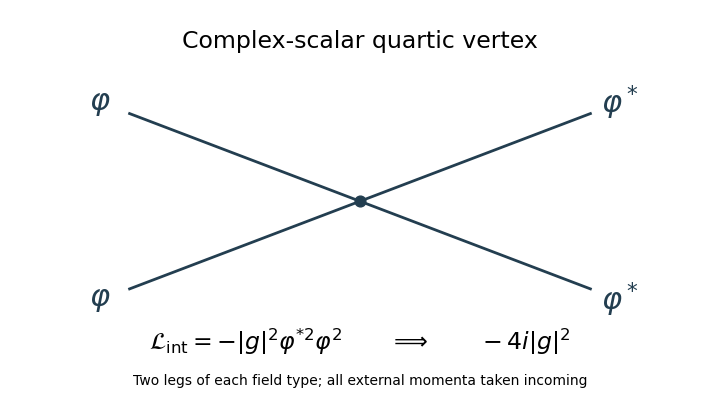

If real-field Feynman rules are preferred, the and vertices are , while the vertex is . These are the same interaction in a different component basis. They should not be confused with a convention that absorbs into the coefficient of the complex quartic term.
Spurion symmetries. Treat as chiral spurions. An ordinary acts on with charges and leaves neutral. An R-symmetry gives charge one and charges . Thus
Each superpotential term has ordinary charge zero and R-charge two; the chiral integration measure has R-charge minus two. In particular is neutral under the specified R-symmetry. These are formal transformations of fields and parameters together, not two exact symmetries of a theory with arbitrary fixed nontransforming numerical couplings. This Wess–Zumino spurion charge assignment is useful because it constrains possible quantum terms.
The general holomorphic form. Let denote the local effective superpotential, reserving for the auxiliary component. The holomorphy argument for superpotential non-renormalization permits dependence on the chiral spurions, not on their conjugates. The dimensionless combination is neutral under both formal symmetries, whereas has the required dimension and charges. Hence, for , their most general allowed form iswith a holomorphic function before perturbative regularity and matching conditions are imposed. Equivalently, a monomial must obeySolving gives , . Thus the terms in the holomorphic expansion have the form , which is precisely the expansion of the displayed function.
What is and is not renormalized. Apply the non-renormalization theorem to a local Wilsonian effective action retaining the elementary field and a nonzero infrared cutoff. Perturbative coefficients are regular as and : no massless infrared modes have been integrated all the way to zero momentum. Negative powers of are incompatible with the free weak-coupling limit, and powers would require negative powers of . Only the quadratic and cubic structures survive this regularity test. Their coefficients cannot acquire a loop correction here: a quadratic term with no is the free-theory mass term, while a cubic term only linear in is already the tree interaction. A loop renormalizing that cubic term requires additional interaction insertions. Such a dependence is excluded by the holomorphic charge constraints; dependence on cannot repair it in a superpotential. Matching to the specified tree action fixesThe limit is taken in the final polynomial, not by evaluating the intermediate ratio . The holomorphic Wilsonian superpotential and its parameters receive no independent perturbative vertex renormalization. Symmetries alone would only give the arbitrary function ; regularity and the free/tree matching are necessary to reach the stronger conclusion.
The Kähler potential is not protected by that theorem. In particular a corrected kinetic term leads to wave-function renormalization. Writing in canonical normalization givesThese holomorphic and canonically normalized superpotential couplings distinguish the two senses of “renormalized”: the physical/canonically normalized parameters can run, entirely through the common field normalization, even when the holomorphic coefficients do not. The scalar effective potential can consequently receive quantum corrections through the Kähler potential. Nor does the local perturbative statement automatically apply to infrared-singular one-particle-irreducible actions or to integrating out whole massive fields. Non-renormalization protects the local holomorphic F-term, not the complete quantum action or every physically normalized mass and coupling.
Articles by others on the same topic
There are currently no matching articles.