Write , and . The Ising-chain Bogoliubov diagonalization uses the eigenvalues of the two-by-two Nambu matrix. For distinct paired modes , choose , and . The rotation satisfies , and its first transformed component isThe opposite signs of the paired angles preserve the canonical anticommutation relations. Self-paired spinless fermion modes have zero pairing and are treated directly as occupied or empty number levels; they do not require this paired-angle formula.
Both and occur in the sum, so the physical quasiparticle coefficient is , not . ConsequentlyThis is the bulk quadratic result under the stipulated boundary simplification. Restoring the finite-chain parity sectors adjusts allowed modes and global excitation constraints. In the thermodynamic limit, the ground-state energy per site isFor , the bulk quasiparticle gap is . The requested three regimes are shown in the original sketch and discussed separately below.
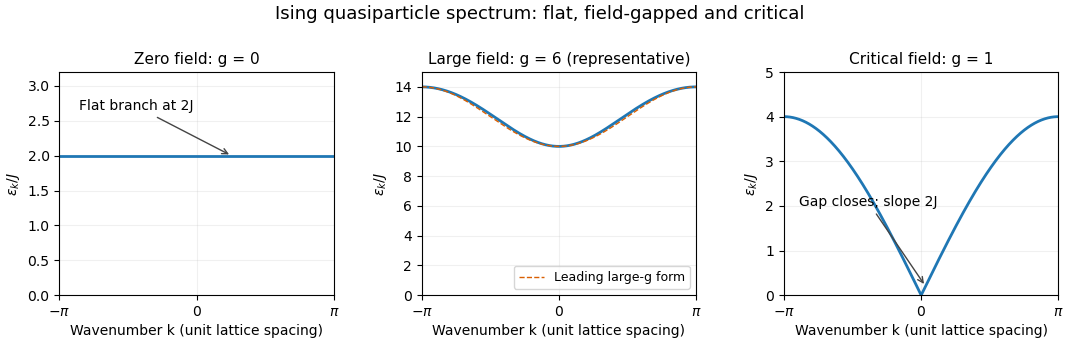

At zero field, and for every . The Ising-chain quasiparticle dispersion is flat: the bulk quadratic excitation costs no momentum-dependent energy. In spin language these are domain-wall excitations. A periodic finite spin configuration has an even number of domain walls, so the single bulk quasiparticle energy does not imply an allowed isolated one-wall spin state; the first such closed-chain spin excitation costs .
Expanding at large positive gives , soThe branch is strongly gapped and relatively flat, with width approaching against a mean energy of order . These are field-polarized spin-flip quasiparticles with a small relative exchange modulation. Averaging the expansion over momentum also gives .
At the critical field,The quasiparticle gap closes and the low-energy branch is linear, unlike a massive excitation. This is the Ising-chain quantum critical point of the Transverse-field Ising model; the cusp in the nonnegative dispersion represents the two opposite propagation directions.
Articles by others on the same topic
There are currently no matching articles.