Use spin one-half states with , so and . At , every ferromagnetic bond has its lowest energy when adjacent spins agree. On the connected periodic chain the normalized ground states arewhere . Their span is the two-dimensional ground-state subspace; any normalized superposition is another ground state. They are exchanged by the global spin-flip discrete symmetry generated by .
As , the field dominates and selectsThe limiting polarized state is unique. At large finite , exchange admixes virtual spin flips, so the product state is the limiting wavefunction rather than an exact finite-field eigenstate. The bulk expansion below gives . The exact twofold degeneracy stated at should be distinguished from thermodynamic spontaneous symmetry breaking in the ordered phase: a finite chain at nonzero field can have a split pair of symmetry eigenstates.
Put and . The Jordan–Wigner transformation is , and . Since , and , adjacent bonds becomeThus, apart from the end bond,The end bond contains the global fermion parity and sets the sector-dependent periodic or antiperiodic fermion modes. It contributes an order-one boundary term, which is negligible for the thermodynamic energy density; it is not identically zero for the finite spin chain.
Choose the discrete Fourier transform convention . Hopping gives . Opposite-momentum pairing gives , using the canonical anticommutation relations to antisymmetrize the coefficient. ThereforeFor the Ising-chain Nambu spinor , expansion ofrecovers every term: the diagonal contributes , and the two off-diagonal entries supply the pairing. Since , the constant is . Reversing the Fourier sign changes the pairing convention; the specified sign makes the displayed matrix agree directly.
Write , and . The Ising-chain Bogoliubov diagonalization uses the eigenvalues of the two-by-two Nambu matrix. For distinct paired modes , choose , and . The rotation satisfies , and its first transformed component isThe opposite signs of the paired angles preserve the canonical anticommutation relations. Self-paired spinless fermion modes have zero pairing and are treated directly as occupied or empty number levels; they do not require this paired-angle formula.
Both and occur in the sum, so the physical quasiparticle coefficient is , not . ConsequentlyThis is the bulk quadratic result under the stipulated boundary simplification. Restoring the finite-chain parity sectors adjusts allowed modes and global excitation constraints. In the thermodynamic limit, the ground-state energy per site isFor , the bulk quasiparticle gap is . The requested three regimes are shown in the original sketch and discussed separately below.
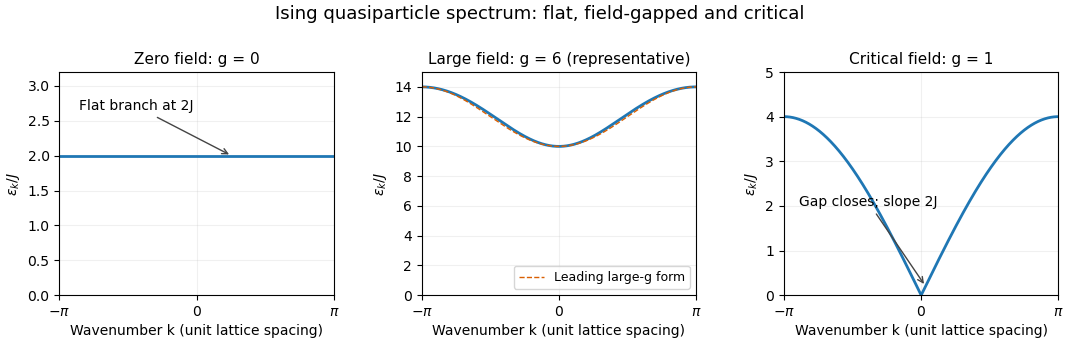

At zero field, and for every . The Ising-chain quasiparticle dispersion is flat: the bulk quadratic excitation costs no momentum-dependent energy. In spin language these are domain-wall excitations. A periodic finite spin configuration has an even number of domain walls, so the single bulk quasiparticle energy does not imply an allowed isolated one-wall spin state; the first such closed-chain spin excitation costs .
Expanding at large positive gives , soThe branch is strongly gapped and relatively flat, with width approaching against a mean energy of order . These are field-polarized spin-flip quasiparticles with a small relative exchange modulation. Averaging the expansion over momentum also gives .
At the critical field,The quasiparticle gap closes and the low-energy branch is linear, unlike a massive excitation. This is the Ising-chain quantum critical point of the Transverse-field Ising model; the cusp in the nonnegative dispersion represents the two opposite propagation directions.
The Hellmann–Feynman theorem gives . Differentiating the Ising-chain ground-state energy yields . HenceThis is also obtained from the occupations of the Bogoliubov quasiparticle vacuum: and . At an exact zero mode the finite-sector limiting ground state specifies the occupation. In the bulk limits, the magnetization per site is zero at , tends to as , and equals at : there the integrand .
Articles by others on the same topic
There are currently no matching articles.