Use spin one-half states with , so and . At , every ferromagnetic bond has its lowest energy when adjacent spins agree. On the connected periodic chain the normalized ground states arewhere . Their span is the two-dimensional ground-state subspace; any normalized superposition is another ground state. They are exchanged by the global spin-flip discrete symmetry generated by .
As , the field dominates and selectsThe limiting polarized state is unique. At large finite , exchange admixes virtual spin flips, so the product state is the limiting wavefunction rather than an exact finite-field eigenstate. The bulk expansion below gives . The exact twofold degeneracy stated at should be distinguished from thermodynamic spontaneous symmetry breaking in the ordered phase: a finite chain at nonzero field can have a split pair of symmetry eigenstates.
Put and . The Jordan–Wigner transformation is , and . Since , and , adjacent bonds becomeThus, apart from the end bond,The end bond contains the global fermion parity and sets the sector-dependent periodic or antiperiodic fermion modes. It contributes an order-one boundary term, which is negligible for the thermodynamic energy density; it is not identically zero for the finite spin chain.
Choose the discrete Fourier transform convention . Hopping gives . Opposite-momentum pairing gives , using the canonical anticommutation relations to antisymmetrize the coefficient. ThereforeFor the Ising-chain Nambu spinor , expansion ofrecovers every term: the diagonal contributes , and the two off-diagonal entries supply the pairing. Since , the constant is . Reversing the Fourier sign changes the pairing convention; the specified sign makes the displayed matrix agree directly.
Write , and . The Ising-chain Bogoliubov diagonalization uses the eigenvalues of the two-by-two Nambu matrix. For distinct paired modes , choose , and . The rotation satisfies , and its first transformed component isThe opposite signs of the paired angles preserve the canonical anticommutation relations. Self-paired spinless fermion modes have zero pairing and are treated directly as occupied or empty number levels; they do not require this paired-angle formula.
Both and occur in the sum, so the physical quasiparticle coefficient is , not . ConsequentlyThis is the bulk quadratic result under the stipulated boundary simplification. Restoring the finite-chain parity sectors adjusts allowed modes and global excitation constraints. In the thermodynamic limit, the ground-state energy per site isFor , the bulk quasiparticle gap is . The requested three regimes are shown in the original sketch and discussed separately below.
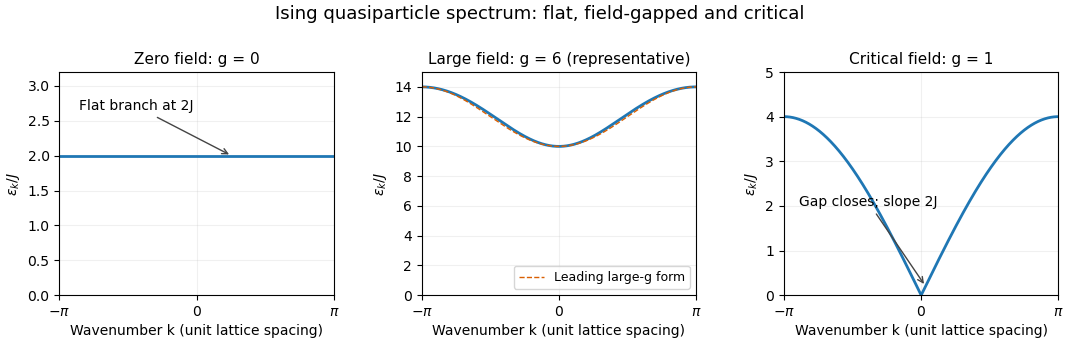

At zero field, and for every . The Ising-chain quasiparticle dispersion is flat: the bulk quadratic excitation costs no momentum-dependent energy. In spin language these are domain-wall excitations. A periodic finite spin configuration has an even number of domain walls, so the single bulk quasiparticle energy does not imply an allowed isolated one-wall spin state; the first such closed-chain spin excitation costs .
Expanding at large positive gives , soThe branch is strongly gapped and relatively flat, with width approaching against a mean energy of order . These are field-polarized spin-flip quasiparticles with a small relative exchange modulation. Averaging the expansion over momentum also gives .
At the critical field,The quasiparticle gap closes and the low-energy branch is linear, unlike a massive excitation. This is the Ising-chain quantum critical point of the Transverse-field Ising model; the cusp in the nonnegative dispersion represents the two opposite propagation directions.
The Hellmann–Feynman theorem gives . Differentiating the Ising-chain ground-state energy yields . HenceThis is also obtained from the occupations of the Bogoliubov quasiparticle vacuum: and . At an exact zero mode the finite-sector limiting ground state specifies the occupation. In the bulk limits, the magnetization per site is zero at , tends to as , and equals at : there the integrand .
On a connected bipartite graph, every exchange bond can attain its lower classical energy . Set on one sublattice and on the other, for any unit vector . This Néel state minimizes all bonds simultaneously and hasThe direction parametrizes the continuous orientation degeneracy; disconnected components can choose their orientations independently.
A triangular lattice illustrates geometric frustration. For three fixed-length spins on a triangle,The minimum requires their sum to vanish, giving coplanar -degree spins rather than antiparallel alignment on every bond. A three-sublattice pattern realizes this condition on the nearest-neighbour triangular lattice. Its energy per bond is , and global rotations produce equivalent classical states.
The Holstein–Primakoff transformation acts on the physical Fock states , , with the specified operator ordering. Its matrix elements areThe unavailable endpoint states have zero coefficient. These formulas directly give . MoreoverThus the spin commutation relations hold in units . The Holstein–Primakoff occupation constraint is essential: the spin Hilbert space has dimension , so unrestricted boson Fock space is not itself this finite-spin representation. The square root and oscillator operators must retain their order for the displayed matrix elements and endpoint conditions to agree.
Take to be an even number for a perfectly bipartite periodic chain and make the bipartite spin rotation by about the axis on alternating sites. In the local frame the Néel state has all spins up, while a bond becomesThe linear spin-wave approximation keeps and . ThereforeEvery site has two neighbours. Fourier transform gives and pairing coefficient , soThe bosonic Nambu normal-ordering shift follows from . It adds inside the matrix expression, which must be subtracted in its constant. HenceA periodic chain with an odd number of sites is frustrated at the boundary and lacks this exact two-sublattice reference; the bulk thermodynamic calculation uses the even-chain sequence.
Use bosonic Bogoliubov diagonalization with , . Away from the zero modes, letHere preserves the canonical commutation relations, while the sign of cancels anomalous pairing. In hyperbolic notation , , this condition is . Combining the normal ordering constants givesThe dispersion vanishes linearly near and , with spin-wave velocity in unit lattice spacing. The exact zero modes make the Bogoliubov coefficients singular; use a small infrared regulator or a symmetry-selected reference and treat the global rotations separately. A finite transformation at is not asserted.
On a hypercubic lattice of coordination , the same hypercubic antiferromagnetic spin-wave dispersion usesThe corresponding constant is , and near a Goldstone point. Restoring lattice spacing multiplies this velocity by .
The vacuum of the diagonal quasiparticles contains original spin bosons: . Thus the quantum depletion of Néel order givesIn one dimension . Removing the global zero modes with an infrared cutoff, the continuum integral contains near both gapless points and diverges logarithmically as the cutoff is removed. This is a breakdown of the assumed Néel order reference, not a physical infinitely negative magnetization. It indicates that the one-dimensional ordered spin-wave expansion cannot maintain a finite staggered moment; it does not determine the exact spectral gap or all properties of the spin chain for arbitrary .
At zero temperature in dimensions the singular contribution scales as . It is infrared finite for , permitting a finite quantum reduction and a self-consistent ordered spin-wave description in an appropriate regime. This differs from the positive-temperature contribution, where yields . Its divergence for agrees with the Mermin-Wagner theorem for short-range continuous-symmetry models. Finite-temperature nonordering and the zero-temperature one-dimensional depletion argument are separate statements.
A Euclidean configuration-space transition kernel is obtained by slicing into steps , inserting position resolutions and using the free Gaussian kernel. With initial and final ,The normalization means the limit of with exponent , in a consistent time-slice prescription. This fixes the endpoint normalization that an informal continuum symbol alone leaves unspecified. The Wick rotation converts oscillatory real-time weight into the positive-potential Euclidean weight; classical extrema of this action organize the semiclassical approximation.
For a trajectory connecting the degenerate minima in infinite Euclidean time, the first integral gives . The quartic double-well instanton and its reverse areTheir action isThe instanton fluctuation prefactor has dimensions of inverse time. It incorporates nonzero Gaussian fluctuation eigenvalues and the translation zero-mode Jacobian; a conventional determinant expression iswith common endpoint regularization and the prime removing the translation mode. Only its positive quantum tunnelling rate is needed here.
In the dilute instanton gas, well-separated crossings alternate in direction. Integrating ordered centers gives . A path returning to the same well has an even number, and one connecting opposite wells has an odd number. The common leading harmonic endpoint factor follows from the supplied harmonic oscillator transition kernel:Expanding these functions gives the sums over even numbers and odd numbers, with the position-kernel normalization that its abbreviated formula suppresses. Validity requires , and , so typical crossing separation greatly exceeds an instanton width. Local anharmonic corrections replace the harmonic well energy by its perturbatively corrected value; the leading formula does not claim uniformly negligible relative error at arbitrarily large .
The two exponents identify the double-well tunneling splitting:The superposition with an even spatial wavefunction is the lower state. Coherent quantum tunnelling removes the classical degeneracy, and the exponentially small splitting sets the long quantum tunnelling timescale.
For the new periodic potential, let be the single-neighbour hopping rate and . It is determined by the barrier between adjacent minima; an unspecified periodic potential does not determine it from the preceding quartic potential's numerical action. The minimum spacing is now .
A path with right hops and left hops has . Summing the ordered-center weights and their direction choices givesInsert the Fourier representation of a Kronecker delta. The two exponential series sum independently, yielding the dilute-hopping lattice propagatorThe two Fourier-sign choices are equivalent by . Equivalently the integral is the modified Bessel function .
The original PDF prints here. Its sign is inconsistent with both the previous double-well result and the requested positive on-site oscillator energy. The correct factor is : a positive oscillator ground-state energy must decay under . The other factors and their derivation remain as displayed. The energy is the positive nearest-neighbour quantum tunnelling matrix-element magnitude, exponentially small relative to the local well scale in the semiclassical regime.
The low-energy localized-well basis gives the tight-binding modelA Bloch state with coefficients is an eigenstate because the two neighbouring coefficients add to . ThusHere is a Bloch wavenumber; physical momentum is , and writing for physical momentum would require . Spectral evolution of these eigenstates is exactly the Fourier integral in the preceding solution. The negative hopping lowers the symmetric state, and coherent quantum tunnelling spreads a formerly degenerate family of localized levels into a band of width . Using the printed positive Euclidean prefactor instead would give on-site energy , showing its contradiction directly.
Use natural units for the action conventions of this question. Insert the coherent-state resolution of identity between imaginary-time steps and take the thermal trace. Coherent-state time slicing gives the normally ordered interaction and first-order time term:The fields obey the coherent-state thermal boundary conditions and . Bosonic Matsubara frequencies are therefore . A periodic spatial box can be chosen for the homogeneous bulk calculation; temporal periodicity follows from the trace independently of that spatial choice. The barred and unbarred labels belong to the coherent-state integral prescription, with the usual conjugate contour for bosonic Gaussian integral.
A homogeneous static saddle minimizes for . With and ,The mean-field Bose-Einstein condensate has a macroscopic coherent occupation of the uniform mode. Its continuous particle-number phase symmetry is , the circle group generated by particle number. Choosing one phase breaks it, and the saddle manifold is a circle. For , the constrained minimum is the vacuum , so the condensed saddle requires the stated positive-density regime.
Spontaneous symmetry breaking is understood through a phase-selected thermodynamic description: an exact finite-volume number eigenstate has vanishing field expectation. The resulting Goldstone boson is a gapless phase/sound mode, while phase gradients carry the superfluid velocity . This is the saddle-point conclusion requested, not a proof of true condensate order in every dimension or temperature. Long-wavelength phase fluctuations can invalidate the assumed order, as quantified below.
The density-phase action of a Bose gas follows directly from :The total derivative integrates to zero for periodic density. HenceA uniform density fluctuation has nonzero quadratic cost , whereas a uniform phase change has no energy cost. Thus the radial fluctuation is massive in the static quadratic-action sense, while the phase is massless. The number-phase conjugacy term couples their dynamics: this does not imply an additional independent gapped quasiparticle branch in the nonrelativistic Bose gas.
The compact phase winding term vanishes for the smooth zero-winding phonon sector. Globally the phase can wind by while the complex field remains periodic, so that term should not be discarded across all topological sectors without a further argument.
Put and retain quadratic fluctuations in the smooth zero-winding sector. The quadratic density-phase action isAt wavelengths long compared with the healing length, drop the density-gradient term. Completing the square givesThe real Gaussian density integral, or its equivalent contour shift, contributes only a field-independent determinant. Absorb that normalization and the uniform saddle action into . To this quadratic long-wave accuracy,The Gaussian extension of to the full real line is a fluctuation approximation around positive ; it is not an exact replacement of the global density constraint. The compact field's vortex/winding sectors also lie beyond this smooth-phonon integral.
The Bose-gas phase-only action is a continuum harmonic chain with Euclidean inverse propagator . Continuing to real frequency givesRestoring gives for a wavenumber . This is the phonon branch of the Bogoliubov spectrum. Keeping the omitted density-gradient term replaces by and yields in the adopted units, so the full quadratic spectrum is with .
The phase-only action also tests the condensate assumption. At zero temperature its equal-time phase variance has an infrared contribution , logarithmically divergent in one dimension; at positive temperature the zero Matsubara mode gives , divergent in dimensions at or below two. Thus this same low-energy theory exposes the regimes where the mean-field condensate cannot describe true thermodynamic long-range order. It permits a finite infrared fluctuation at zero temperature for and at positive temperature for , within the remaining weak-coupling assumptions.
Articles by others on the same topic
There are currently no matching articles.