Take the optical depth to increase inward and let denote an outward ray. For thermal absorption and emission in local thermodynamic equilibrium, the radiative transfer source function is the Planck function, so the radiative transfer equation isThis assumes negligible scattering, or a source function genuinely thermalized to ; LTE by itself does not turn an arbitrary scattering source into a Planck function. Multiply by , integrate between the two boundaries, and solve for the outward specific intensity:The bottom boundary value is the quantity denoted in the supplied notation; it is not an optical-depth-zero boundary. The first term is attenuated incident radiation, and the second is emission from the intervening layers. This is the formal solution of the radiative transfer equation.
For an isothermal atmosphere at temperature , the Planck function is constant and the integral can be evaluated:For a bounded bottom intensity and , in every outgoing direction, and . Thus the emergent spectrum is a blackbody spectrum. The blackbody limit of an isothermal atmosphere does not require a temperature gradient: it follows from complete thermalization in an optically thick medium.
For unresolved, uniformly bright blackbodies at a common distance , the monochromatic observed radiative fluxes are and . Define the planet-star contrast . The Planck law givesOutside the exoplanet secondary eclipse, the system flux is ; during complete occultation it is . Consequently the exact thermal eclipse depth normalized to the out-of-eclipse light isOnly in the faint-planet limit is . Reflected starlight, partial occultation and spatial temperature variations are omitted under the stated blackbody model.
For a cooler hot Jupiter with , the planet-star contrast is exponentially small at short wavelengths and increases towards a constant plateau. This is the monotonicity of blackbody planet-star contrast, rather than the peaked shape of the planet's absolute blackbody flux. An illustrative example uses , and :
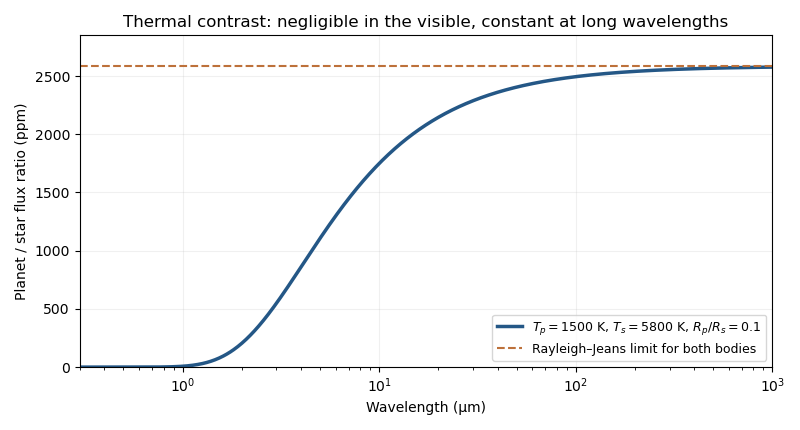

At wavelengths long enough for the Rayleigh-Jeans law to apply to both bodies, . ThereforeThe common dependence cancels. In the illustrative case, the contrast plateau is about , or parts per million.
The continuum exoplanet transit photometry depth is approximately the opaque projected area ratio, assuming a corrected or negligible limb darkening contribution:For a Sun-sized host, . The natural size analogue is Jupiter, not Earth.
The expected bulk constituent is molecular hydrogen, with helium next most abundant for a retained primary planetary atmosphere. The water band detects a strong trace absorber; it does not imply that water is the dominant gas. This interpretation assumes a conventional H/He gas giant; the measured radius by itself is not a measurement of mass or composition.
Interpret the quoted band amplitude as an absolute transit-depth increment , or parts per million. For a thin atmospheric annulus of extra height , the atmospheric spectral-feature amplitude isLet the water band span atmospheric scale heights, so . For a nearly isothermal atmosphere with constant gravity and mean molecular weight , . The temperature from a transmission-band amplitude is thereforeHere refer to the chosen Jupiter reference layer. Assuming , an H/He exoplanet atmosphere with , and a clear strong band with , gives and . Equivalently, a Jovian reference with has , giving .
The assumptions are hydrostatic, approximately isothermal limb gas, constant gravity, negligible cloud truncation, H/He composition, and an effective opacity contrast yielding about five scale heights. In an ideal clear limb, follows from the slant optical depth of an isothermal atmosphere. The data fix , not separately: the temperature is conditional on the band opacity contrast and composition. For – with the same composition and gravity, the estimate is about –.
Articles by others on the same topic
There are currently no matching articles.