Assume , , uniform disk-averaged thermal emission, a nearly blackbody stellar continuum, negligible reflected light at , and a flat response over the narrow band. If the eclipse depth is normalized to the out-of-eclipse star-plus-planet flux, the planet/star flux ratio is ; using changes the estimate by less than one percent. The exoplanet secondary eclipse then givesUsing the Planck law at gives , or about at the precision justified by the radius assumption. The Rayleigh-Jeans law instead gives , a useful rough check. This is a brightness temperature, not the bolometric planetary equilibrium temperature. With zero Bond albedo and global redistribution, the latter would be only about at ; a thermal window can sample hotter, deeper gas.
A continuum photon normally emerges from an optical depth of order unity. In hydrostatic equilibrium,The emission-pressure degeneracy of a brightness temperature means that pressure cannot be uniquely recovered from the measured brightness temperature without and an opacity model. For an explicit nominal estimate, take and an effective continuum mass absorption coefficient . Then , or approximately one bar. In a hydrogen-rich atmosphere, collision-induced absorption by transient pairs supplies continuum opacity even without ordinary molecular lines; its density dependence makes the constant-opacity calculation an illustrative estimate. With a normal deep atmospheric pressure-temperature profile, temperature increases at larger pressures, eventually following an interior adiabatic temperature gradient.
Two mechanisms for are wavelength-dependent sampling of a vertically varying temperature, and wavelength-dependent weighting of a horizontally nonuniform dayside. In the first, carbon monoxide-rich opacity near can sample cooler gas around bar while the continuum samples hotter gas around one bar. In the second, hot and cool areas contribute different proportions of the total flux in different bands because the Planck function depends nonlinearly on temperature. The vertical mechanism alone produces the illustrated pair of temperatures; a single isothermal, horizontally uniform blackbody would have the same brightness temperature in both bands.
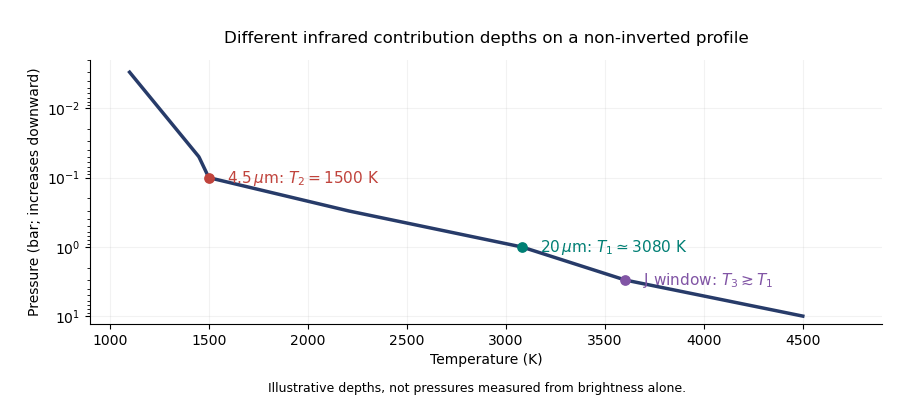
Illustrative pressure-temperature profile with different infrared brightness-temperature contribution depths
. Details. 
If the J-band observation is thermal emission, its low-opacity window normally samples at least as deeply as the continuum at . On the illustrated non-inverted profile, . The ordering is conditional: molecular-line absence alone does not specify the relative continuum opacities, and an inversion or reflected-light contamination can change the inference. The exoplanet emission spectrum measures weighted contribution regions rather than three exact thermometers at known pressures.
The pressure axis increases downward in the sketches. Solid red segments indicate efficient convection; blue segments indicate mainly radiative transfer. The boundaries are nominal examples, since radiative-convective boundary pressure depends on opacity, gravity and intrinsic flux.
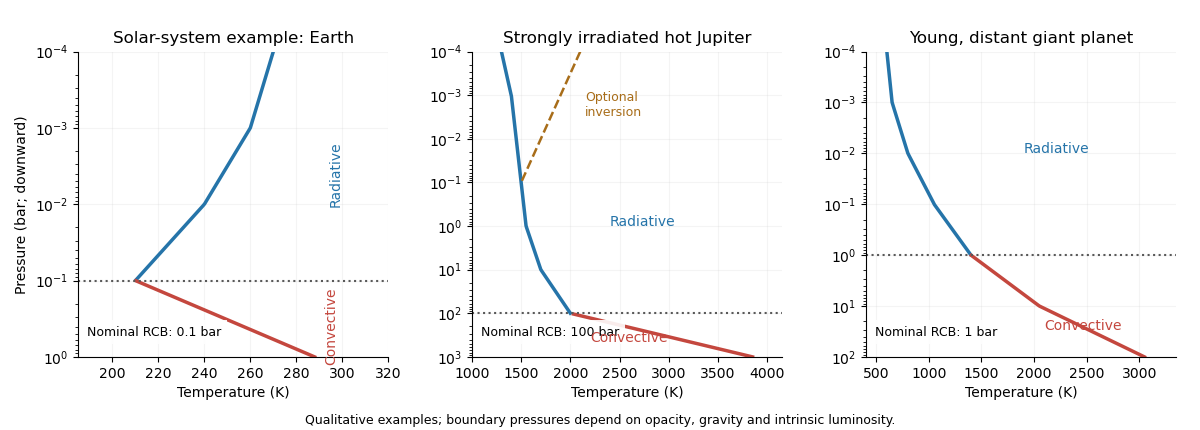
Qualitative solar-system, irradiated hot-Jupiter and isolated young-giant temperature profiles with radiative-convective boundaries
. Details. 
For Earth, the convective troposphere lies beneath a radiative stratosphere, with the transition near -- bar. The larger solar-system planets likewise have deep convective regions beneath largely radiative upper atmospheres; their tropopause/upper radiative-convective boundary is commonly of order -- bar. Their temperatures differ greatly from Earth's, and detached radiative layers can occur deeper down.
For an irradiated hot Jupiter, absorbed stellar flux maintains a hot, extended, relatively shallow-gradient radiative atmosphere. In models with a weak old-planet intrinsic flux, the deep radiative-convective boundary can lie around -- bar, with a useful wider model-dependent range of tens to thousands of bars. A thermal inversion can appear at low pressures if visible/UV absorption heats the upper atmosphere. Below the deep boundary the profile joins a convective adiabat.
A young, directly imaged exoplanet on a distant orbit is primarily heated from within. Its photosphere commonly joins the convective interior at order -- bar, illustrated here at one bar. The temperature generally rises monotonically with pressure over the infrared-forming layers. Strong stellar heating is absent, so a broad stellar-heated isothermal layer is unnecessary.
Two differences in thermal inversions are their absorbers and their formation conditions. Earth's ozone layer and solar-system hydrocarbon absorption can heat upper layers; the proposed hot-Jupiter absorbers include refractory titanium monoxide/vanadium monoxide or other strong visible absorbers, since ozone and methane-rich cold-planet chemistry are unsuitable at very high temperatures. Hot-Jupiter inversions depend strongly on irradiation, atmospheric cold traps and atmospheric transport, and can occur at mbar-to-sub-bar pressures; Earth and the solar-system giants have cooler, established stratospheres above their shallow tropospheres.
Two differences between the hot Jupiter and distant young-giant profiles are external versus internal heating, and the depth/shape of the radiative zone. The former can have a broad warm radiative layer, a much deeper convective boundary and sometimes an inversion; the latter typically has a steeper outward decrease toward a photosphere, a shallower boundary and no irradiation-driven inversion. These are class trends, not a unique temperature profile for every planet.
The three basic modes are radiation, convection and thermal conduction. Radiative transfer dominates transparent atmospheric layers; convection carries heat through sufficiently unstable fluid regions; thermal conduction matters especially in solids or highly conducting dense material.
Consider a chemically homogeneous ideal gas atmosphere and a small, dry parcel displacement, with rapid pressure equilibration and negligible heat exchange during the displacement. The parcel's first law of thermodynamics per unit mass isFor an adiabatic process, . Using hydrostatic equilibrium, , the parcel followsAfter an upward displacement , its temperature relative to its new surroundings isHere is the specific heat capacity at constant pressure, and is the buoyancy frequency. At the same pressure, a warmer parcel has lower density and accelerates upward. Thus strict instability requires . Equivalently, the parcel equation is , withNegative gives growing displacements. The printed non-strict inequality includes the onset boundary: equality is neutrally stable, not a strictly growing instability. This dry parcel buoyancy in a homogeneous atmosphere is the dry Schwarzschild criterion; condensation and composition gradients require modified criteria.
Articles by others on the same topic
There are currently no matching articles.