In the mode expansion of a Dirac field, is the fermionic annihilation operator for a particle of four-momentum and spin angular momentum label , while is the fermionic creation operator for the corresponding antiparticle. The Dirac spinor is the positive-frequency particle wavefunction and is the negative-frequency antiparticle wavefunction; they solve and , respectively.
Apply the parity symmetry in quantum field theory to the given mode expansion of a Dirac field:The stated Dirac spinor identities are equivalently and . Relabel the momentum sum by and use to obtainThe phase is the intrinsic parity convention.
Write . The chain rule gives and . Using the gamma matrix relations and ,Thus the Dirac equation is invariant under parity symmetry in quantum field theory.
The quantum electrodynamics interaction is , where the Dirac electromagnetic current is . Under parity symmetry in quantum field theory,Invariance of the interaction therefore requires the electromagnetic four-potential to transform as the same Lorentz four-vector:so is parity even and is parity odd. Under charge conjugation, the current is odd, , so invariance requires
The operator is the relativistic fermion electric dipole moment operator. Its nonrelativistic limit contains : spin angular momentum is an axial vector, whereas the electric field is a polar vector. It is consequently odd under parity symmetry in quantum field theory. Both the pseudotensor fermion bilinear and the electromagnetic field tensor are odd under charge conjugation, so their product is even. ThereforeThe CPT theorem then makes it odd under time-reversal symmetry. Such an interaction can arise only from CP violation. The Cabibbo-Kobayashi-Maskawa matrix therefore induces a nonzero Standard Model electric dipole moment at sufficiently high loop order, but its flavor structure and loop suppressions make the result extraordinarily small.
Let and be the scalar mass matrix, which is the Hessian matrix of the scalar potential at the vacuum. Invariance under the infinitesimal Lie group action givesDifferentiate with respect to and evaluate at the vacuum expectation value . Since at a minimum,Thus every tangent vector generated by a broken Lie algebra generator is a zero eigenvalue eigenvector of the scalar mass matrix. The unbroken generators are precisely those in the stabilizer Lie algebra and give the zero tangent vector; independent broken directions span . Hence Goldstone theorem givesmassless scalar modes at the classical level.
The minima of the scalar potentialsatisfyThe SU(2) group acts transitively on this three-sphere of vacua, and the stabilizer of a nonzero fundamental doublet is trivial. A global transformation may therefore choose . Because the symmetry is gauged, unitary gauge removes all three angular Goldstone bosons, leaving only the real radial Higgs mode :Substitution into the gauge-covariant kinetic term giveswithThe interaction terms produce , , , , and the cubic and quartic non-Abelian gauge-boson vertices shown below.
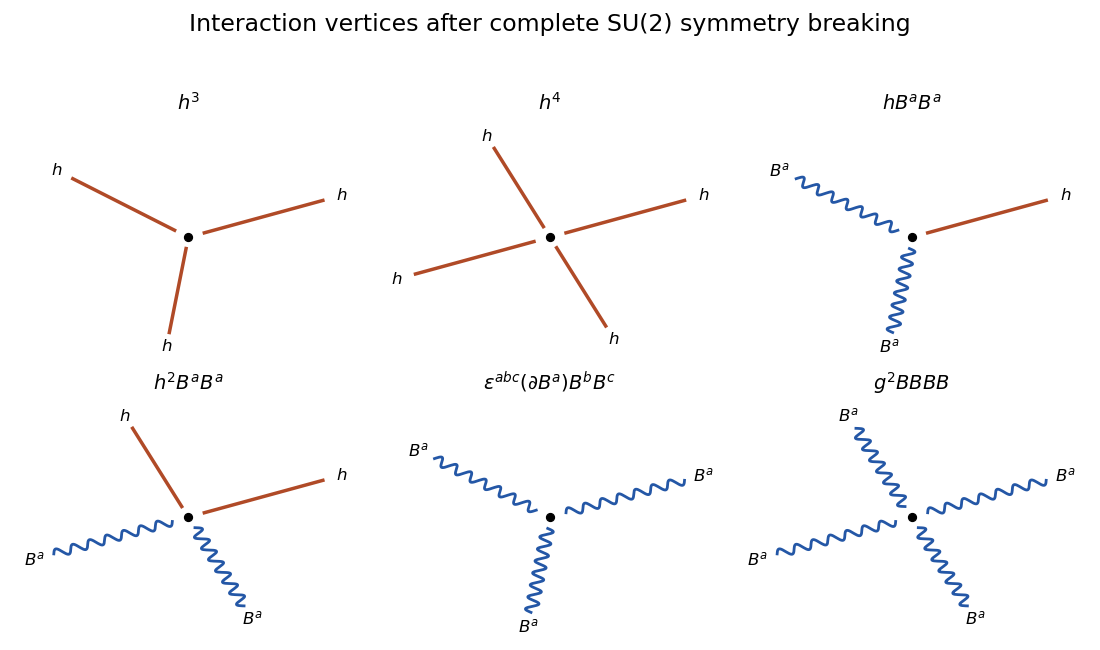

The three broken generators supply the three longitudinal polarizations of the equally massive gauge bosons. No physical massless Goldstone boson remains, and because the unbroken subgroup is trivial there is no massless gauge boson either. The remaining physical spectrum has degrees of freedom, equal to the original .
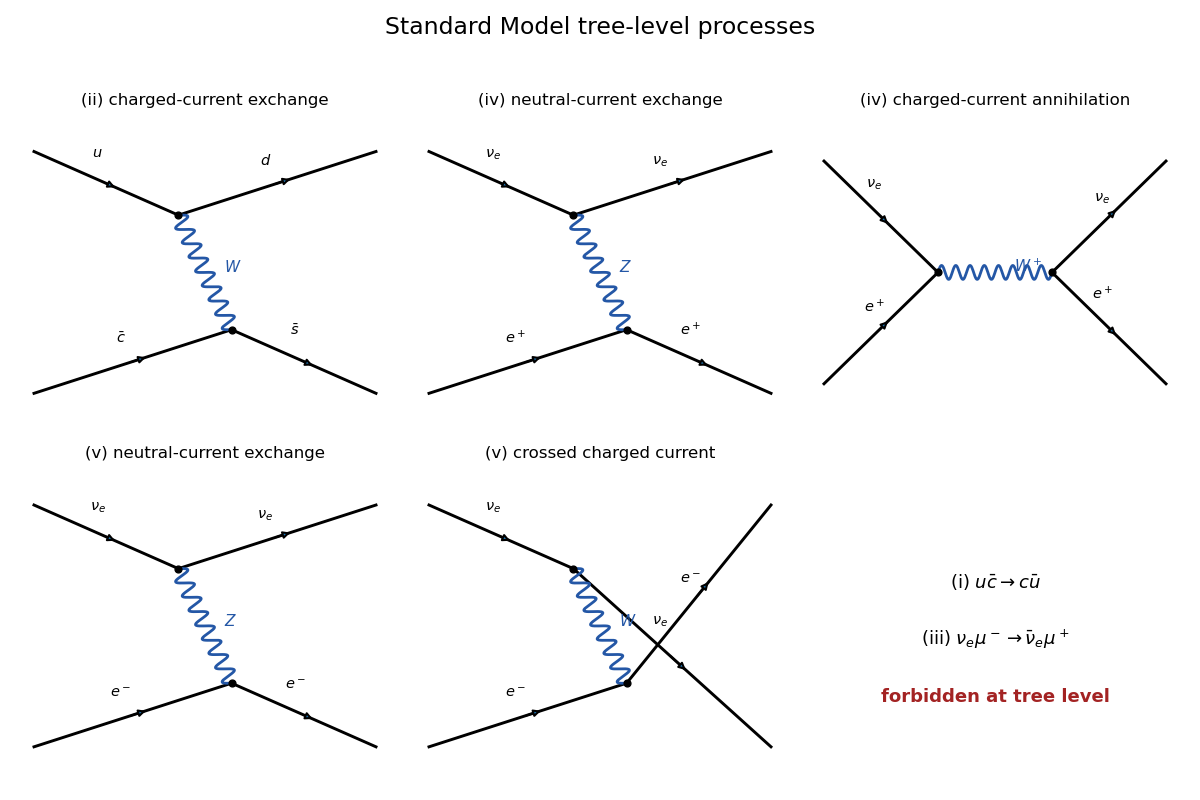
Forbidden at tree level. A photon, gluon, boson, or neutral Higgs interaction is flavor diagonal in the quark mass basis, while a boson connects an up-type quark to a down-type quark. The process would therefore require a flavor-changing neutral current, which first appears through loops in the Standard Model.
Allowed. A single -channel W boson mediates the weak charged current transitions and . The amplitude is proportional to the Cabibbo-Kobayashi-Maskawa matrix product .
Forbidden. The initial state has total lepton number two and the final state has total lepton number minus two. No renormalizable Standard Model vertex changes total lepton number by four.
Allowed. There are two tree-level Feynman diagrams: -channel Z boson exchange through the weak neutral current, and -channel formation through the weak charged current.
Allowed. There are again two tree-level Feynman diagrams: -channel Z boson exchange and the crossed charged-current diagram with a W boson exchanged between the neutrino and electron lines.
The complete tree-level list for (ii), (iv), and (v) is:
Tree-level processes in the Standard Model
. Details. 
The first four-fermion operator is the low-energy Fermi interaction obtained by replacing the crossed propagator in the charged-current diagram by . The second operator is obtained analogously from the -exchange weak neutral current; and are its electron vector and axial-vector couplings. Thus the two terms represent respectively the charged-current and neutral-current diagrams in part (v), with their interference retained when the amplitude is squared.
A Fierz rearrangement puts the charged-current operator in the same current ordering as the neutral-current operator. Accounting for the interchange of fermionic fields, the combined amplitude isSum over final spins and average over the initial electron spin. The fermion spin sum and gamma-matrix trace identities giveFor massless two-body scattering in the centre-of-momentum frame, and . Integrating therefore yieldsConsequently
The result grows linearly with the squared centre-of-momentum energy, . This growth eventually violates partial-wave unitarity and signals the breakdown of the pointlike Fermi interaction. At energies comparable to or , the full gauge-boson propagators must replace the contact interaction; the renormalizable electroweak theory then softens the high-energy behavior.
Since , the stated renormalization-group beta function impliesFor , the running coupling decreases at high energy: the theory is asymptotically free and becomes strong in the infrared, as in Quantum chromodynamics. For , it is infrared free but grows toward an ultraviolet Landau pole.
Integrating the renormalization-group beta function and defining by givessoThe scale is the QCD scale in this one-loop approximation.
Direct integration between the two renormalization scales gives
Put . At the gauge coupling unification scale, write the common normalized coupling as . Running downward givesSubtracting the second equation from the third determinesEliminating from the first two equations yields
For one generation, the Standard Model representation content under iswith no right-handed neutrino. For , three generations give from the two left-handed quark flavors and from the two right-handed quark flavors, while . ThereforeFor , each generation supplies three colored quark doublets and one lepton doublet, so , , and the single complex Higgs doublet gives . Hence
Articles by others on the same topic
There are currently no matching articles.