Write , where and . The chain rule givesFor a twice continuously differentiable classical solution, mixed partial derivatives commute, so the wave equation becomesHence depends only on . Integrating first in yields the countertravelling decomposition of the one-dimensional wave equation:On a rectangular domain in this follows immediately; on the full line for , the connected characteristic slices give the same representation. The two terms travel at wave speed one in opposite directions.
Impose the initial conditions. At ,Differentiate the first identity and combine:If , then and . Substitution cancels and the arbitrary base point , giving D'Alembert's formula:For example, and make this a classical solution of the wave equation satisfying both initial conditions. The same formula defines a weak solution for less regular data, including the continuous piecewise smooth data of part (b).
Since the initial velocity vanishes, D'Alembert's formula reduces toEach translated copy has half the original amplitude. To identify each requested cross-section, track the translated support intervals and add the values where they overlap.
At , is supported on and on . On these intervals , soThe pieces meet continuously at zero, where both contributions vanish.
At , the support of is ; that of is . In the central overlap,so the two contributions cancel. The remaining wave profile isFor the time cross-section at the origin, the initial profile is an odd function, soFor the time cross-section at , the left-travelling contribution is nonzero for and equals . The right-travelling contribution is nonzero for and also equals . At the common endpoint both vanish. HenceThe following graphs show all four cross-sections. In particular, the last trace reaches at and at .
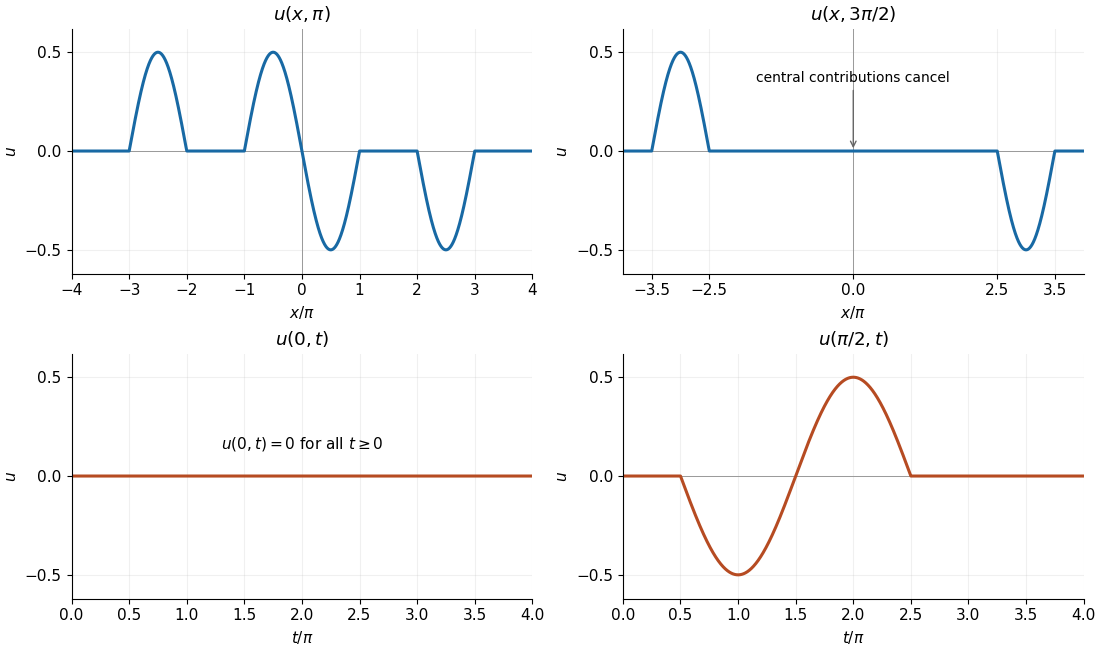
The four requested cross-sections of the wave equation solution
. The upper panels show the spatial profiles at and . The lower panels show the time traces at and for . Horizontal axes are labelled in multiples of . Details.
Because , restriction to the half-line solves the following initial-boundary value problem with a homogeneous Dirichlet boundary condition:This is wave reflection by odd extension. If a condition at infinity is desired, take the solution with finite wave energy; here the profile has bounded support at every finite time.
The initial profile is continuous and piecewise continuously differentiable, but its first derivative jumps at the support endpoints. Thus the formula gives a weak solution globally and a piecewise classical solution away from the characteristic lines for the one-dimensional wave equation issuing from those endpoints. The initial velocity is zero in the square-integrable function sense and pointwise wherever the initial profile is differentiable; at the kink points a pointwise right time derivative need not equal zero. This regularity qualification is needed for the given data.
Articles by others on the same topic
There are currently no matching articles.