For , the partial derivatives and giveAdding these partial derivatives yields the divergence:The original vector field is undefined at the origin. Since , it has the continuous extension . This extension is not differentiable: on its first component is , whose derivative at zero does not exist. Thus the displayed divergence has no classical value at the origin.
The triangle is . In polar coordinates this becomesbecause the outer side is . The vector field and the Jacobian determinant giveEvaluate the double integral component by component:Consequently,The origin causes no ambiguity in this double integral: the continuous extension from part (a) is bounded there, and changing a value at a single point does not change the integral.
Pair each point of the square's boundary with . The vector field obeys , whereas the outward unit normal vector changes sign: . Corresponding arc length elements are equal. Thus the two contributions to the flux cancel, proving without evaluating any boundary integral thatThe same cancellation appears in the divergence, which is an odd function of over a region symmetric under . To justify using the planar divergence theorem despite the lack of differentiability at the origin, remove a disk of radius . The vector field is continuously differentiable on the remaining region, its divergence has zero double integral by this symmetry, and the magnitude of the inner flux is at most , since there. Letting recovers the result. This is flux around a removable point singularity.
Let be a bounded region with a piecewise smooth closed boundary, and let be a continuously differentiable vector field on an open neighbourhood of its closure. With the outward unit normal vector, the divergence theorem statesThe boundary surface integral is the total outward flux. All boundary components are included; on the boundary of a cavity, the outward unit normal vector points into the cavity.
The specific heat capacity is the energy needed per unit mass per unit increase in temperature. With constant, a small element of volume has mass and thermal energy , measured relative to the reference at which . Summing over givesChoosing a different reference temperature only adds a time-independent constant to this energy, so it does not affect the heat balance with volumetric heat generation.
For any fixed subregion , with no internal heat generation, conservation of energy says that the rate of stored thermal energy equals the incoming heat flux:The minus sign is needed because denotes outgoing heat flux. Substitute Fourier's law and apply the divergence theorem:Here differentiation under the integral uses a fixed region and sufficient regularity of . Since the identity holds for every , continuity of the integrands gives the local heat equationFor spatially varying thermal conductivity, the product rule gives ; the second term cannot generally be discarded.
Suppose and are two sufficiently regular steady state solutions with the same prescribed temperature on the boundary. Their difference satisfiesThe identical PDE source terms cancel. Apply the product rule and the divergence theorem to ; this is the weighted form of Green's first identity:Since , the nonnegative integrand must vanish, so . Hence is constant on each connected component of , and its zero Dirichlet boundary condition makes each constant zero. Therefore : the solution, if it exists, is unique. This proves Dirichlet uniqueness for variable-conductivity heat conduction; it does not require a constant thermal conductivity.
Integrate the steady state equation over and use the divergence theorem:The zero heat flux condition makes the boundary term vanish. But and throughout a region of positive volume, soa contradiction. Thus no steady-state solution exists. This is the insulated steady heat balance: positive internal heat generation continually increases the stored thermal energy when no heat can escape.
For any closed surface enclosing a region , Gauss's law for gravity states that the outward flux of the gravitational field isHere is the gravitational constant and is the enclosed mass; the negative sign expresses attractive gravity.
Use the gravitational potential sign conventions specified by this paper: . Thus is the negative of the usual Newtonian gravitational potential defined by . For example, setting the value at infinity to zero gives for a point mass. The divergence theorem now givesSince is arbitrary, continuity of the integrands implies the local Poisson's equationConversely, integrating this Poisson's equation over any and applying the divergence theorem recovers Gauss's law for gravity. At a discontinuity of the mass density, the local equation is interpreted piecewise, or globally in the sense of distributions.
The mass density depends only on , so it has spherical symmetry. For this isolated planet, choose the Newtonian gravitational potential to vanish at infinity, or equivalently choose to do so. There is no imposed external gravitational field. Rotating the mass distribution therefore leaves unchanged: .
The gradient in spherical coordinates consequently has no angular components, and the paper's gravitational potential sign conventions giveAt the centre there is no distinguished radial direction, and spherical symmetry makes .
On a sphere of radius , the radial gravitational field has constant magnitude. Thus Gauss's law for gravity becomeswhere is the enclosed mass. In the hollow core . In the material shell, put and use the spherical coordinates volume element:Outside the shell the enclosed mass is the totalConsequently,At the displayed value refers to the radial derivative of the constant core value. The expressions match at both shell boundaries. There is no surface sheet of mass, so a jump in the volume mass density does not produce a jump in the gravitational field. The core has zero gravitational field, and the exterior gravitational field equals that of a central point mass , as in the shell theorem.
The core contributes no change in , since there. Integrating the radial gravitational field across the shell, with , givesUsing the supplied antiderivative,HenceThe negative sign agrees with in the material shell under the paper's gravitational potential sign conventions.
Write , where is an integer and . The change of variables and the fact that is a periodic function giveSplit at , then substitute in the second piece:ThereforeThis proves translation invariance of an integral over one period without assuming that is differentiable.
First let . Substitute in the negative half of the integral. Since is an odd function,The two halves cancel, soFor both limits coincide. For , reverse the limits and apply the result with . Thus the identity holds for every real .
The real Fourier series of is writtenwhere the Fourier coefficients areBy part (a)(i), any other interval of length gives the same Fourier coefficients, because each integrand is a periodic function with period . The notation associates with its Fourier series; existence of the integrals alone does not assert pointwise convergence.
On the function is odd, so its mean and all its cosine Fourier coefficients vanish:The assigned endpoint value does not affect these integrals. The product of the two odd functions and is even, hence the sine Fourier coefficients areTwo applications of integration by parts giveThereforeThe periodic extension has a jump discontinuity at every odd multiple of : its left and right limits are and . Its assigned value at each such point is . Thus it is odd away from these points, but it is not a globally odd function pointwise. The Fourier series will take the midpoint value zero at these jumps.
By Dirichlet's theorem on Fourier series, a piecewise continuously differentiable periodic function has a Fourier series converging at each point to the average of its one-sided limits. In particular it converges to the function at every point of continuity. Our periodic extension satisfies these hypotheses, and is a point of continuity with .
At this point for even . For ,Substituting in the Fourier series from part (c) provesThe sum is taken in its displayed order. Discarding its zero even-indexed terms is valid and does not rearrange the remaining terms.
Write , where and . The chain rule givesFor a twice continuously differentiable classical solution, mixed partial derivatives commute, so the wave equation becomesHence depends only on . Integrating first in yields the countertravelling decomposition of the one-dimensional wave equation:On a rectangular domain in this follows immediately; on the full line for , the connected characteristic slices give the same representation. The two terms travel at wave speed one in opposite directions.
Impose the initial conditions. At ,Differentiate the first identity and combine:If , then and . Substitution cancels and the arbitrary base point , giving D'Alembert's formula:For example, and make this a classical solution of the wave equation satisfying both initial conditions. The same formula defines a weak solution for less regular data, including the continuous piecewise smooth data of part (b).
Since the initial velocity vanishes, D'Alembert's formula reduces toEach translated copy has half the original amplitude. To identify each requested cross-section, track the translated support intervals and add the values where they overlap.
At , is supported on and on . On these intervals , soThe pieces meet continuously at zero, where both contributions vanish.
At , the support of is ; that of is . In the central overlap,so the two contributions cancel. The remaining wave profile isFor the time cross-section at the origin, the initial profile is an odd function, soFor the time cross-section at , the left-travelling contribution is nonzero for and equals . The right-travelling contribution is nonzero for and also equals . At the common endpoint both vanish. HenceThe following graphs show all four cross-sections. In particular, the last trace reaches at and at .
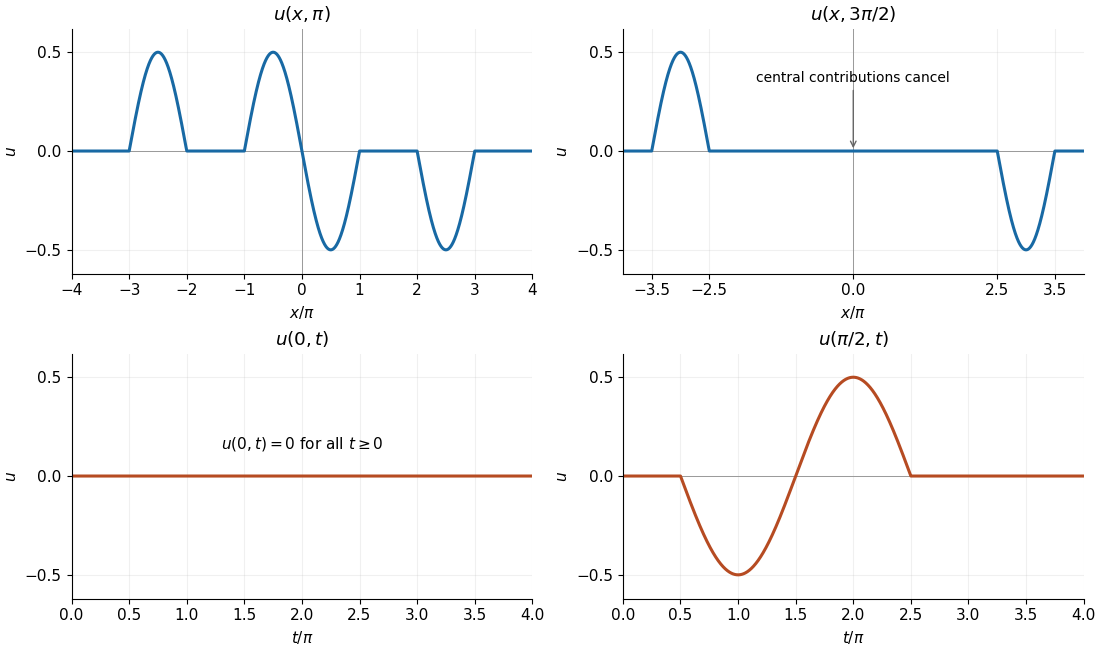
The four requested cross-sections of the wave equation solution
. The upper panels show the spatial profiles at and . The lower panels show the time traces at and for . Horizontal axes are labelled in multiples of . Details.
Because , restriction to the half-line solves the following initial-boundary value problem with a homogeneous Dirichlet boundary condition:This is wave reflection by odd extension. If a condition at infinity is desired, take the solution with finite wave energy; here the profile has bounded support at every finite time.
The initial profile is continuous and piecewise continuously differentiable, but its first derivative jumps at the support endpoints. Thus the formula gives a weak solution globally and a piecewise classical solution away from the characteristic lines for the one-dimensional wave equation issuing from those endpoints. The initial velocity is zero in the square-integrable function sense and pointwise wherever the initial profile is differentiable; at the kink points a pointwise right time derivative need not equal zero. This regularity qualification is needed for the given data.
Let be the constant cross-sectional area, and suppose that the temperature is uniform on each cross-section. Consider a slice . Its stored thermal energy is . Since the lateral surface is insulated and there is no internal heat generation, conservation of energy giveswhere is the heat flux in the positive direction. By Fourier's law, , soThe slice is arbitrary; therefore the local heat equation isThe constant is the thermal diffusivity. The cancellation of uses a rod of uniform cross-section; the one-dimensional model assumes no transverse temperature variation.
Subtract the constant steady state profile: set . ThenThe last equation follows from Fourier's law and zero heat flux at the insulated end. For a nonzero separated solution , separation of variables givesTo see that for a nonzero eigenfunction, multiply the spatial equation by and use integration by parts:Both boundary terms vanish. If the right side were zero, would be constant and would make it zero. Thus write with . Solving gives , and requires . The mixed Dirichlet-Neumann modes on an interval therefore haveThe eigenvalues of are ; are their positive square roots. By superposition, with coefficients for which the resulting series and its required derivatives converge at positive times,The eigenfunctions are orthogonal on and have squared norm . Expanding the initial excess temperature givesThus the requested temperature isAt the insulated endpoint cancels the alternating coefficient sign, leavingEvery summand is positive. The endpoint temperature never drops below ; it decreases towards as and starts at .
For completeness, the Sturm-Liouville eigenfunction expansion gives the initial profile in the sense. Here the coefficients are absolutely summable, so the Weierstrass M-test also gives uniform convergence on , and the initial values are recovered everywhere. For positive times the exponential factors justify all required termwise derivatives, giving a classical solution. There is, however, an initial incompatibility with a Neumann boundary condition at : the initial slope is , while the insulated Neumann boundary condition requires zero slope for . The temperature is continuous to the initial edge, but cannot extend continuously to that corner. One must not differentiate the initial series term by term at .
Articles by others on the same topic
There are currently no matching articles.