The solid cylinder has constant mass density . A thin cylindrical shell of radius and thickness has mass . Its contribution to the axial moment of inertia is . ThereforeThe attached wheels are massless, so they add no moment of inertia. This is the moment of inertia of a uniform solid cylinder about its central longitudinal axis of rotation.
Apply the general linear momentum equation to the whole rigid body. Its center of mass has acceleration , and each rail contributes its own static friction and normal force. HencesoHere is the normal force at each rail, not the combined support.
Take torques about the center of mass, with positive angular velocity along . The thread leaves the lower side shown in the source diagram: its contact position vector relative to the center isThus . Each contact point has relative position vector , so each friction torque is . The gravitational weight acts through the center of mass and the normal forces have zero torque about it. The angular momentum equation becomesThe condition of rolling without slipping makes the contact point instantaneously stationary:Integrating and using gives . Thus rightward translation corresponds to clockwise rotation. Eliminating from the two dynamical equations with yieldsand therefore
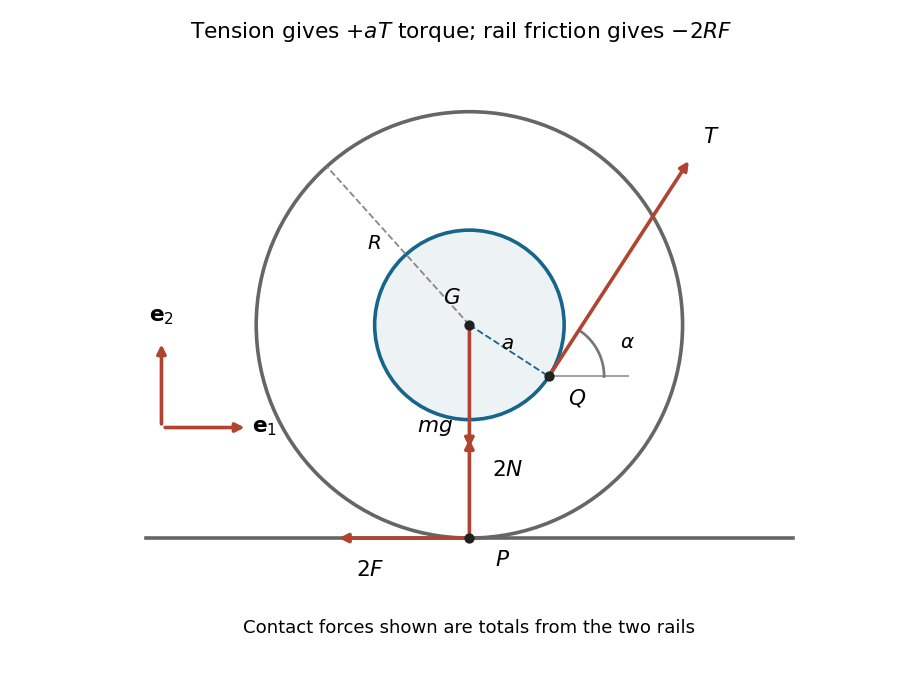

Put . The angular acceleration is constant. The initial rest conditions and giveFor the upward rightward pull in the diagram, , the sign of is the sign of . Consequently it rolls towards the horizontal pull when . At it remains at rest, with balanced forces and torques. For , it rolls to the left. In particular a horizontal pull, , makes it roll to the right, since . If other pulling angles are allowed, the general condition for motion in the same horizontal direction as the pull is .
The required static friction at each rail follows from the translational equation:For it is positive, agreeing with the leftward force convention. The assumed rolling without slipping is physically possible only if the rails can supply this force while maintaining contact. With coefficient of static friction , the necessary contact inequalities areFor the usual pulling range, these becomeIf either fails, the proposed motion requires lift-off or more static friction than the rails provide. Equality is also incompatible here: it gives but a nonzero required friction. The question supplies no coefficient of static friction, so it determines the required friction exactly but gives no numerical slip threshold. If is regarded as a prescribed force rather than an available contact response, it must equal for the rolling constraint to hold.
Articles by others on the same topic
There are currently no matching articles.