Use the vector triple product identitySince is a unit vector, putThus is the component of in the orthogonal complement of , and . A cross product is orthogonal to both its factors, so and . ConsequentlyAll three pairs are orthogonal. This remains true when is parallel to : then and are zero vectors. Pairwise orthogonality does not assert linear independence in this case.
Use the convention for the scalar triple product. With as above, . The vector triple product identity givesThe Lagrange identity for the cross product, , also givesTaking the dot product with the unit vector proves
Decompose by orthogonal projection onto the straight line spanned by and its orthogonal complement:The first term is fixed by the rotation. If , the vectors and form an orthonormal basis of the perpendicular plane, oriented in the positive sense about . A planar rotation through therefore sendsHere . Adding the fixed parallel component proves the Rodrigues rotation formula in the required form:When , both perpendicular terms vanish, so the same formula fixes as required. Positive angles use the right-hand convention about .
The straight line has direction vector , so take the unit vector . A half-turn has and . The preceding rotation formula becomesThus the rotation matrix in the standard basis isIt fixes and negates every vector in its orthogonal complement, which also checks the half-turn geometrically.
First find the fixed axis of rotation by solving . After removing a nonzero common factor, the linear equations areThey give . Choose the following unit vectors:Their dot products show that they form an orthonormal basis; hence is an orthogonal matrix. Since is an orthogonal matrix fixing , it preserves the orthogonal complement of . Its restriction there has determinant , so it is a planar rotation.
The trace gives , so . To determine the sign of the sine, rather than just its magnitude, calculateThus a suitable angle and change of basis areIn fact direct matrix multiplication gives
Write . The sine addition formula and cosine addition formula give . Therefore function composition satisfiesThe resulting angle is real and the new translation vector lies in , so is closed under function composition. Associativity holds because, for any functions and any , both and take to .
The identity element is , since . Every element has the two-sided inverse elementIndeed , and substituting into the composition formula makes the translation vector zero in either order. These verify all the group axioms. Thus is a group under function composition, the special Euclidean group in two dimensions.
A possible center must be a fixed point, so . Let and . The determinant iswhen is not an integer multiple of . The unique center is thereforeThe fixed point equation implies , whenceRelative to , this is precisely a planar rotation through . This also explains the excluded case: when , is a translation, with no fixed point unless .
The quadratic form isThe symmetric matrix has eigenvalues , with respective orthogonal eigenvectors . Normalize them to obtain the orthonormal basisThe given change of basis meansSubstitution, or orthogonal diagonalization of a real symmetric matrix, givesThus the semi-major and semi-minor axes have lengths and . The eccentricity and enclosed area areThe orthogonal change of basis preserves area, so this is also the area in the original Cartesian coordinates.
Use the parametric curveHere , so the ellipse stays strictly above the axis of rotation . Rotating in three dimensions gives a surface of revolution with parametrizationThe two parameter tangent vectors are orthogonal, with Euclidean norms and . Hence the area element of a surface isThe generating ellipse is simple and has positive distance from the axis of rotation; its rotation sweeps the surface once, apart from the identified parameter endpoints. AlsoWriting , the surface area is therefore . Since and ,ConsequentlyThe cancellation is an instance of the surface area of revolution of a centrally symmetric curve: the surface area is the generating curve’s arc length times the distance traveled by its center.
For polar coordinates, the rotating unit vectors satisfy and . Applying the product rule twice to gives the velocity and accelerationNewton's second law for a central force now givesMultiplying the azimuthal force equation by yieldsThis is conservation of specific angular momentum. Here is the signed radial component of the force; a negative value points inward.
When , is a valid local parameter along the trajectory. Put and let primes denote derivatives with respect to . The chain rule yieldsSubstituting into the radial Newton's second law equation and dividing by proves the Binet equation:
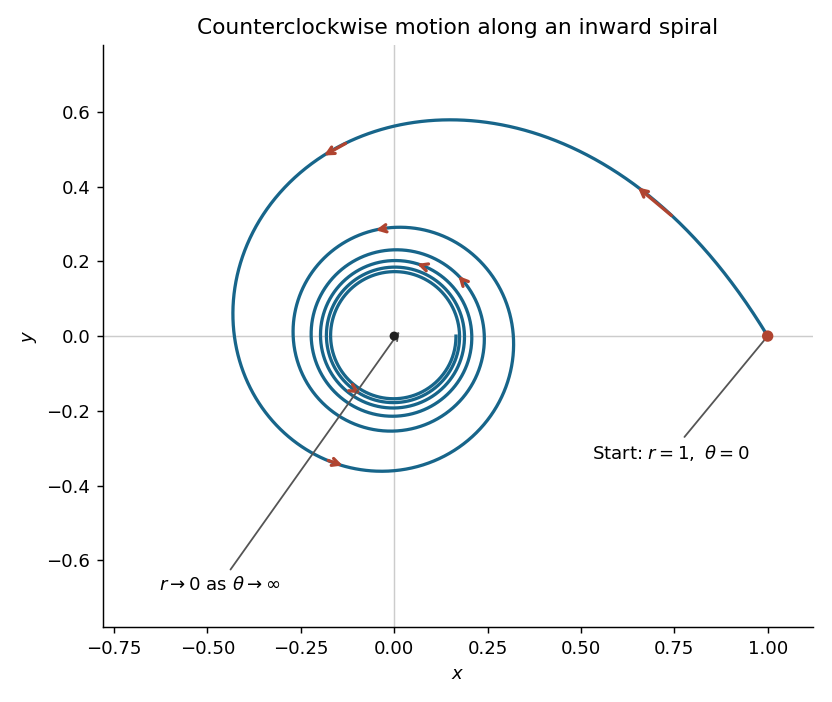
Here , so the Binet equation reduces toThe initial conditions becomeMultiply the differential equation by and use the chain rule:The initial conditions give . Since , cannot change sign at a finite value of . Thus on the physical branch. Separation of variables givesThereforeThe natural logarithm must be positive because . For the forward trajectory, and , so : the particle travels counterclockwise while strictly decreases.
For , it starts at , with tangent vector proportional to . Its successive crossings of the positive coordinate axis have radiiIt makes infinitely many inward turns, approaching the origin as . There is no finite-time arrival at the origin: behaves as , whose improper integral diverges. If extended backwards, it comes from infinity as .
The free-body diagram shows a meridional section of the right circular cone. On the first particle, gravity acts vertically downwards, tension points along the straight line to the apex, and the normal reaction is perpendicular to the surface. The smooth mechanical constraint supplies no tangential friction. The second particle has only its downward gravitational weight and the upward tension.
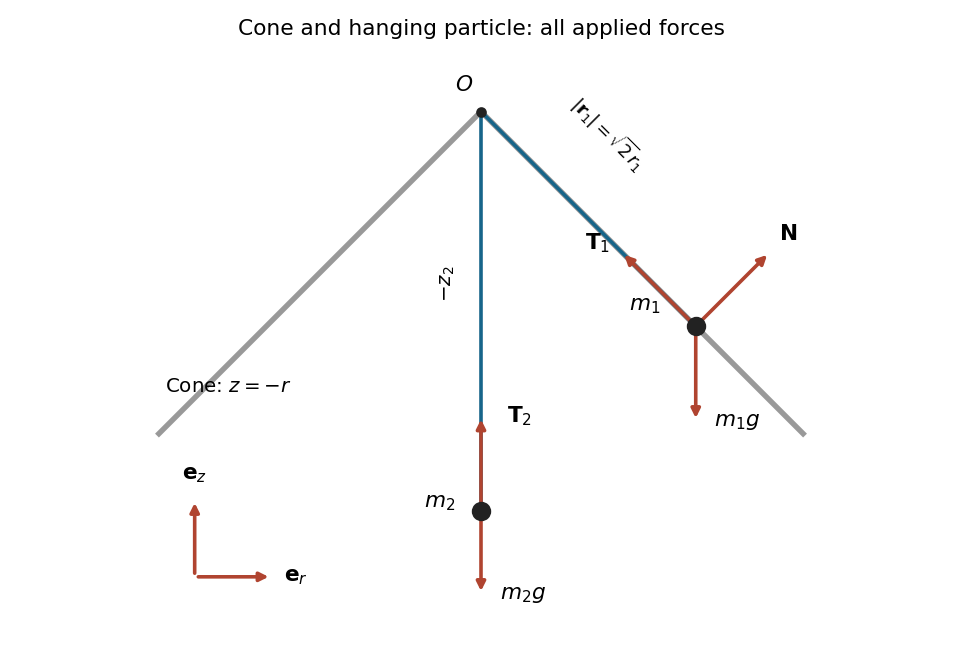
Meridional section of the inverted cone and the forces on both particles; the reaction is normal to the cone
. Details. Adding the forces on each particle and applying Newton's second law givesAt , a normal vector is . Its sign depends on the supporting face of the cone; either sign has zero dot product with every permitted velocity. The diagram chooses the reaction towards the upper side of the surface.
The massless inextensible string has a common tension magnitude . Since , the unit vector from the first particle towards the apex is . The second particle lies below the apex, soThe string length constraint isThe velocity of the first particle in cylindrical coordinates is . Therefore the powers delivered by the two tension forces areThusThe tension can transfer energy between the particles, but its total power on the pair is zero.
All forces on the first particle lie in the plane spanned by and : this holds for gravity, tension, and the normal reaction. Hence the azimuthal component of Newton's second law vanishes:Using the product rule givesStrictly, is the axial specific angular momentum; the actual axial angular momentum is , which is conserved as well.
Differentiate the stated total energy using the chain rule and then substitute the two Newton's second law equations:The gravitational potential energy terms have canceled the power of gravity. Also is proportional to , whose dot product with is . Thus the stationary smooth mechanical constraint does no work. The remaining tension powers cancel by part (b), proving and conservation of total energy while the massless inextensible string remains taut and contact is maintained.
Initially and , so the total gravitational potential energy isIf the given velocity is understood as a full tangential vector , put . The string length constraint gives , and henceThis formula accounts for both particles' kinetic energies, including that of the hanging particle.
If denotes only the initial speed, the printed wording does not specify its direction within the tangent plane. To make that dependence explicit, let be the angle from the downward generator of the cone towards the azimuthal unit vector, soThen , andFor a launch along a generator, or , this reduces to . For a horizontal azimuthal launch, , it instead gives . A scalar speed alone does not determine a unique energy here. Both directions are tangent to the surface; “along the surface” does not distinguish them. The assumed configuration also requires so the second particle hangs below the apex.
The solid cylinder has constant mass density . A thin cylindrical shell of radius and thickness has mass . Its contribution to the axial moment of inertia is . ThereforeThe attached wheels are massless, so they add no moment of inertia. This is the moment of inertia of a uniform solid cylinder about its central longitudinal axis of rotation.
Apply the general linear momentum equation to the whole rigid body. Its center of mass has acceleration , and each rail contributes its own static friction and normal force. HencesoHere is the normal force at each rail, not the combined support.
Take torques about the center of mass, with positive angular velocity along . The thread leaves the lower side shown in the source diagram: its contact position vector relative to the center isThus . Each contact point has relative position vector , so each friction torque is . The gravitational weight acts through the center of mass and the normal forces have zero torque about it. The angular momentum equation becomesThe condition of rolling without slipping makes the contact point instantaneously stationary:Integrating and using gives . Thus rightward translation corresponds to clockwise rotation. Eliminating from the two dynamical equations with yieldsand therefore
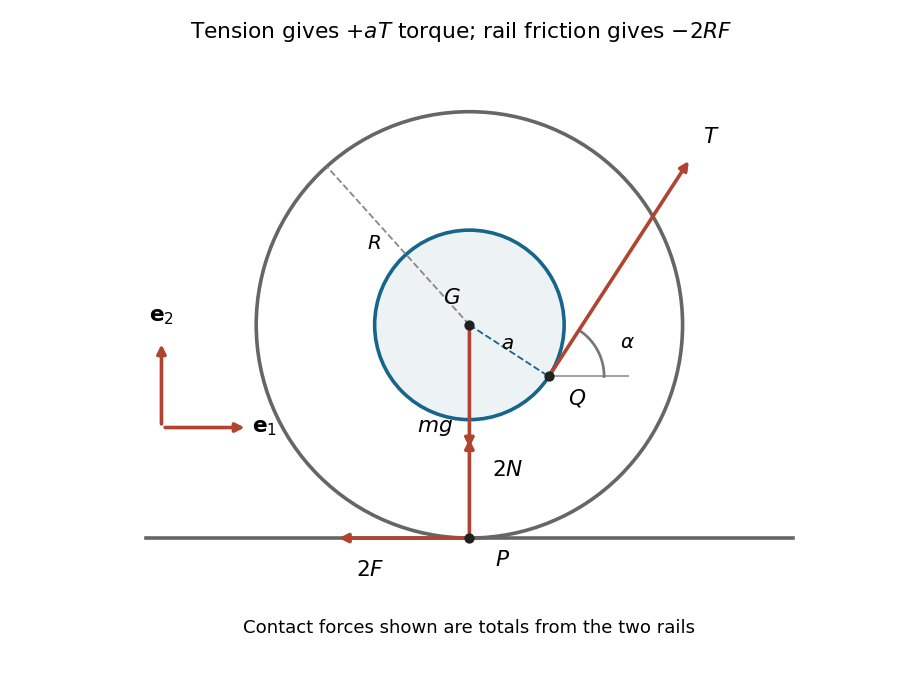


Put . The angular acceleration is constant. The initial rest conditions and giveFor the upward rightward pull in the diagram, , the sign of is the sign of . Consequently it rolls towards the horizontal pull when . At it remains at rest, with balanced forces and torques. For , it rolls to the left. In particular a horizontal pull, , makes it roll to the right, since . If other pulling angles are allowed, the general condition for motion in the same horizontal direction as the pull is .
The required static friction at each rail follows from the translational equation:For it is positive, agreeing with the leftward force convention. The assumed rolling without slipping is physically possible only if the rails can supply this force while maintaining contact. With coefficient of static friction , the necessary contact inequalities areFor the usual pulling range, these becomeIf either fails, the proposed motion requires lift-off or more static friction than the rails provide. Equality is also incompatible here: it gives but a nonzero required friction. The question supplies no coefficient of static friction, so it determines the required friction exactly but gives no numerical slip threshold. If is regarded as a prescribed force rather than an available contact response, it must equal for the rolling constraint to hold.
Let be any positive integer. If divides and , it divides the integer linear combination . Conversely, if divides and , it divides . Thus and have exactly the same positive common divisors. Their greatest elements coincide:This greatest common divisor invariance is the step behind the Euclidean algorithm; it does not require , although that additional bound ensures the algorithm terminates. If the convention permits , the same argument works and for .
The successive division with remainder steps of the Euclidean algorithm areEach step preserves the greatest common divisor by part (a). The final nonzero remainder is , so
Back-substitute in the Euclidean algorithm to obtain an integer linear combination:Multiplying by gives the particular solution of the linear Diophantine equation. Subtracting it from any other solution and dividing by givesThe integers and are coprime, so divides . Writing forces . Conversely these expressions satisfy the original equation for every integer . Thus all solutions of a linear Diophantine equation here are
Rearrange the polynomial equation as a fixed point equation:First establish existence and uniqueness of the target root of a polynomial. Since is a continuous function, and , the intermediate value theorem gives a root of a polynomial . Moreover for all real , so is strictly increasing and this is its only real root of a polynomial.
For ,so maps the closed interval into itself. AlsoThe mean value theorem therefore gives on the closed interval: is a contraction mapping. For any starting value , all iterates remain in that closed interval, and since ,Thus the fixed-point iteration converges to the unique real root of a polynomial from every . This explicit error estimate proves the needed convergence directly.
Articles by others on the same topic
There are currently no matching articles.