Interpolate the radius and height byA parametrized surface for the conical frustum isThe strict positivity of gives . Since , the height identifies uniquely; the angle then identifies a point of each circle uniquely modulo . Hence this covers the lateral surface of revolution once. If , it is the lateral surface of a circular cylinder.
For the parametrized surface in i,These tangent vectors are orthogonal, and their Euclidean norms are and , respectively. Their cross product therefore has Euclidean norm . Integration givesThis is the lateral surface area of a conical frustum, with no end disks included.
The endpoint radii are and , but substituting those two numbers in the finite conical frustum formula is invalid. A rotation about the -axis preserves the horizontal angle between the endpoint position vectors; here and are not parallel. The radius along the generating segment is not linear in height.
Parametrize the actual segment byIts rotated circle at height has radiusThus the rotated image is the surface of revolution . Applying the conical frustum formula to infinitesimal pieces of this radial profile, or directly using the cross product as in ii, gives the surface area of a surface of revolutionTo evaluate it explicitly, put . Then . DefineThe chain rule gives , so the answer isThe positive logarithm arguments make this a real-valued expression. Rotating the segment's endpoints independently into one vertical plane before joining them would instead create a different surface, with surface area .
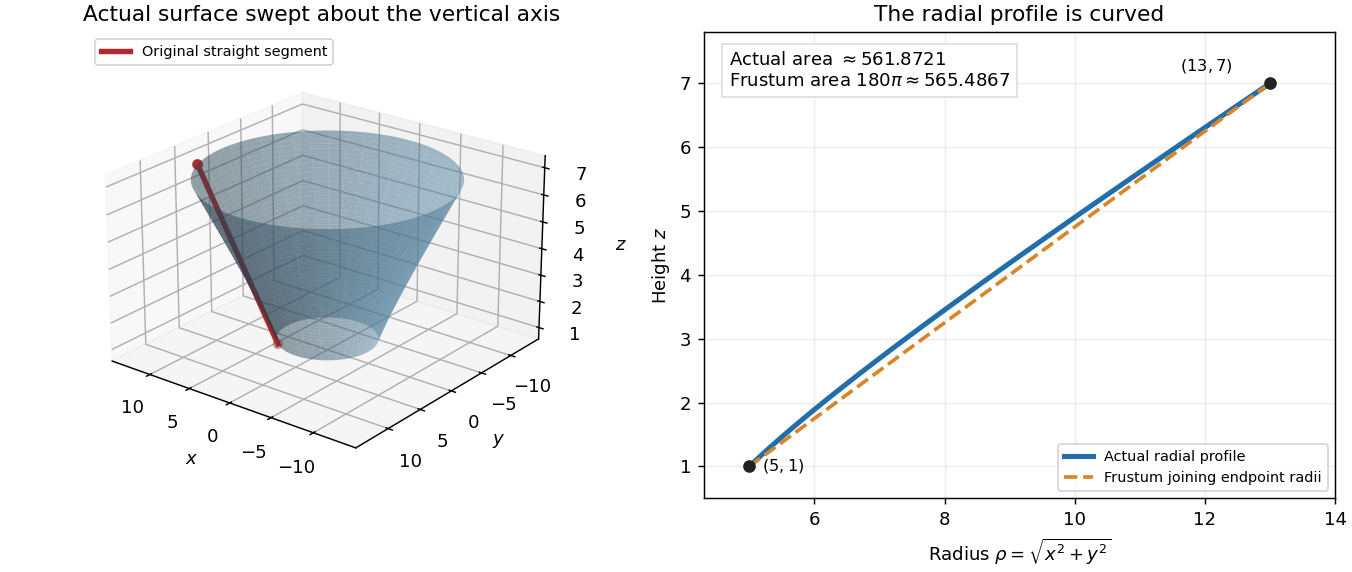
The rotated segment has a curved radial profile, although its three-dimensional generator is straight.
Details. 
Articles by others on the same topic
There are currently no matching articles.