Write . Since the triangle is nondegenerate, . Every point on the line has a unique position vector . The condition that is orthogonal to is the dot product equationIts coefficient of is , so it has exactly one solution. The foot of a perpendicular is thereforeThis is the orthogonal projection of onto the line , expressed using the Euclidean norm.
With as in i, the foot of a perpendicular lies strictly between the endpoints precisely when . Since the denominator is positive, this givesEquivalently, both dot productsare positive: the angles of the triangle at and are both less than . If “between” includes the endpoints, replace both strict inequalities by non-strict ones; equality gives or .
The altitude of a triangle through has equation , and the altitude of a triangle through has equation . Their normal vectors and are linearly independent because the triangle is nondegenerate. Consequently these two lines meet in exactly one point .
Substitute its position vector in the supplied identity. Its first term vanishes by the first altitude of a triangle equation, and its second term vanishes by the second altitude of a triangle equation. HenceThis is exactly the condition that lies on the altitude of a triangle through . The three lines therefore meet in a unique point, the orthocenter. This argument includes right triangles and triangles whose orthocenter lies outside them.
Let , , and , interpreting these expressions as position vectors. The resulting medial triangle is nondegenerate: for example,Thus is parallel to , and the same calculation holds cyclically. The altitude of a triangle through is consequently the line through the midpoint of that is orthogonal to , namely its perpendicular bisector. Each remaining altitude of a triangle similarly gives one of the other two perpendicular bisectors.
By iii, the medial triangle has a unique orthocenter, so the three perpendicular bisectors meet in one point. Every point on the perpendicular bisector of is equally far from and : expanding the squares of the two Euclidean distances gives . Applying this to the three sides shows that the common point is equally far from . It is the circumcenter.
Write , with because the triangle is nondegenerate. Let be its circumcenter. Equality of the complex modulus values gives . Equality of , after expanding the squares, givesThus the real part and imaginary part determineUsing the complex conjugate , we also haveThereforeThe nonzero denominator is exactly the nondegeneracy condition. If is real, the three distinct collinear points do not have a finite circumcenter.
Represent the quadratic form by the symmetric matrixThe spectral theorem for real symmetric matrices gives an orthogonal matrix and real eigenvalues such that . In the orthogonal change of coordinates , the equation becomes .
If both eigenvalues are positive, this is an ellipse with semiaxes and . Conversely, a zero eigenvalue makes the set either empty or unbounded along that coordinate, while two negative eigenvalues give the empty set. Opposite signs give an unbounded hyperbola. A negative eigenvalue together with a zero one also gives the empty set. None of those cases is an ellipse. Therefore the exact condition is that be a symmetric positive-definite matrix.
The sum and product of its eigenvalues are its matrix trace and determinant:Two real numbers are both positive precisely when their sum and product are positive. ThusAn orthogonal transformation preserves area. Using i gives the quadratic-form ellipse area
Eliminate using the plane equation. The orthogonal projection consists exactly of the points satisfyingsince each such lifts uniquely to on the intersection. Translating to the center of an ellipse with and givesThe symmetric matrix of this quadratic form is , whose eigenvalues are and . Thus it is a symmetric positive-definite matrix, and the projected curve is an ellipse. The quadratic-form ellipse area, with the right-hand side scaled by , isFor example, the orthogonal change of coordinates , gives semiaxes and , with the same product.
Let be the filled projected ellipse. The part of the plane bounded by is the parametrized surfaceIts tangent vectors satisfyThe surface area is thereforeThis also illustrates the orthogonal projection area formula: the unit normal to the plane has vertical component , so projection multiplies area by .
For a regular parametrized surface that covers its image once, up to sets of zero area, its surface area isThe integrand is the area element of a surface, the area of the small parallelogram spanned by the two tangent vectors. A parametrization that covers a region more than once counts that multiplicity; the geometric surface area requires a single covering or a division into nonoverlapping patches.
Interpolate the radius and height byA parametrized surface for the conical frustum isThe strict positivity of gives . Since , the height identifies uniquely; the angle then identifies a point of each circle uniquely modulo . Hence this covers the lateral surface of revolution once. If , it is the lateral surface of a circular cylinder.
For the parametrized surface in i,These tangent vectors are orthogonal, and their Euclidean norms are and , respectively. Their cross product therefore has Euclidean norm . Integration givesThis is the lateral surface area of a conical frustum, with no end disks included.
The endpoint radii are and , but substituting those two numbers in the finite conical frustum formula is invalid. A rotation about the -axis preserves the horizontal angle between the endpoint position vectors; here and are not parallel. The radius along the generating segment is not linear in height.
Parametrize the actual segment byIts rotated circle at height has radiusThus the rotated image is the surface of revolution . Applying the conical frustum formula to infinitesimal pieces of this radial profile, or directly using the cross product as in ii, gives the surface area of a surface of revolutionTo evaluate it explicitly, put . Then . DefineThe chain rule gives , so the answer isThe positive logarithm arguments make this a real-valued expression. Rotating the segment's endpoints independently into one vertical plane before joining them would instead create a different surface, with surface area .
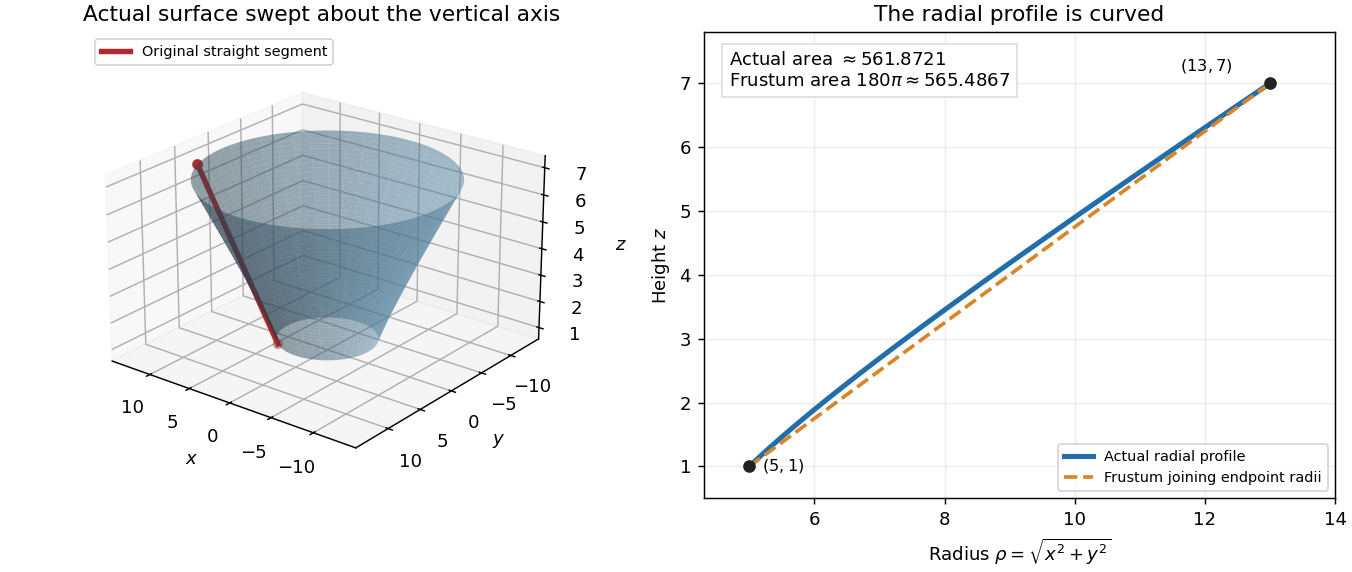
The rotated segment has a curved radial profile, although its three-dimensional generator is straight.
Details. 
Let parametrize . Then parametrizes its image, with tangent vectors and . An orthogonal matrix preserves dot products, so the Lagrange identity for the cross product gives, for any ,The area element of a surface is therefore the same pointwise before and after applying . Integrating provesThis includes orthogonal transformations with determinant : reversal of orientation does not affect the Euclidean norm in the surface area formula.
Let . It is a symmetric matrix, and . By the spectral theorem for real symmetric matrices, choose an orthonormal basis of eigenvectors of , with nonnegative eigenvalues .
For each , take the unit parallelogram parametrized by , . Its surface area is . Moreover,The image parallelogram consequently has area . By the assumption this equals for all three pairs, givingNo eigenvalue can be zero. Dividing the equations and using positivity yields . HenceThus testing all surfaces is stronger than necessary: the three unit parallelograms in these principal directions already determine the result. This is the three-dimensional characterization of linear surface-area isometries.
Write . Differentiating the angular momentum and applying Newton's second law givesThe central force contributes no torque, because it is parallel to . The angular momentum direction is fixed whenever it is nonzero; the motion is consequently planar. In the plane's polar coordinates, , soFor the mechanical energy, use the chain rule, Newton's second law, and :ThusFor a trajectory on a time interval, both and are each a constant of motion precisely when or the velocity vanishes throughout that interval. Under the stated strictly attractive central force at a regular point , a permanently stationary trajectory is impossible by Newton's second law. For the stated attractive motion, both are conserved if and only if . An isolated instant of zero speed only makes the derivatives vanish at that instant. A radial trajectory has even with quadratic drag, but its mechanical energy still decreases whenever it moves.
With , a gives constant , and the polar coordinates basis satisfies , . Also . Differentiating the proposed Laplace-Runge-Lenz vector therefore givesFor this to vanish for arbitrary , including nonzero , the central force must satisfyAttraction requires . The condition “for any value of ” matters: with alone, the Laplace-Runge-Lenz vector is constant on each radial ray for any central force, so that special case would not determine the force law.
Assume . The velocity in polar coordinates is . HenceTaking the dot product of the conserved Laplace-Runge-Lenz vector with givesConsequently the polar equation of a conic isOnly angles for which the denominator is positive describe the physical trajectory. Its eccentricity is , giving an ellipse, parabola, or hyperbola when this ratio is respectively less than, equal to, or greater than .
If , the angle is undefined, but the same dot product identity gives the circular orbit . If , the trajectory is radial and the displayed division degenerates; for , and on a fixed ray, so the identity does not determine as a function of a varying angle.
On the surface of revolution, a normal vector is proportional to . Thus the normal force and gravity have no component. The component of Newton's second law, using the given linear drag force, isMultiplication by therefore givesThe printed target equation omits the factor . The matching original PDF, page 5, gives both and , so this is a source inconsistency. If its in the target equation is intended to mean the drag coefficient per unit mass, put and write . Equivalently, if the intended force was , the requested convention givesThese formulas determine once is known; they do not assume a constant radius.
For a smooth surface the friction force vanishes. The component of Newton's second law then gives , constant. Along the constraint , the chain rule givesThe acceleration in cylindrical coordinates isTake the dot product of Newton's second law with the tangent vector . The normal force disappears, while the gravity term is . Dividing by givesUsing yields
Initially also gives . Thus the initial velocity is azimuthal, with . By conservation of energy, the supplied mechanical energy divided by givesThe first term is nonnegative. ConsequentlyFor a positive launch speed , introduce twice the radial effective potential on a surface of revolution per unit mass,It satisfiesso it is a strictly convex function. Also as . To justify the other endpoint carefully, convexity gives for . This supplies a finite lower bound near , and the positive term consequently forces there.
Thus has a unique minimum at some . Its derivative is strictly increasing and zero there, so decreases to and increases afterwards. Its sublevel set is a single interval , with . If , the two boundary equations have distinct solutions; if , both boundaries are . The conservation of energy identity therefore provesThe two radii coincide exactly when , equivalently . This givesThe equation in b then has the constant solution , with : this is a circular orbit.
A positive inner bound requires . If zero launch speed is allowed, and the displayed inequality only gives because is strictly increasing; one may take the limiting inner bound . For example, satisfies all the stated hypotheses but permits inward motion from rest all the way towards the excluded axis. The two-positive-turning-radii argument therefore uses the natural interpretation of “launched with speed ” as .
All time derivatives in this part are taken relative to the rotating reference frame, so its basis is held fixed during differentiation. Put and . The chain rule and product rule giveExplicitly,The separate Coriolis force and centrifugal force terms in the stated equation account for the motion of the basis relative to an inertial observer.
Continue with and . The tangent vector to the hoop is . Smooth contact means that the hoop's normal force has zero dot product with this tangent vector. The remaining applied force is , whose dot product with is .
Since , the Coriolis force is perpendicular to the hoop's plane and hence to . AlsoTake the dot product of the rotating-frame Newton's second law with , substitute a, and divide by :DefineThen and , soExpanding the squares makes the cancellation of the mixed terms explicit:The strict inequality follows from . Here is the rotating-frame effective potential per unit mass. Multiplication of the equation by gives the useful first integral .
An equilibrium point has and . Since , the linearized displacement satisfiesThus gives a stable equilibrium, while gives an unstable equilibrium point. More generally, a strict local minimum of is sufficient for stability by the conserved first integral in b. When , the second-derivative test alone is inconclusive, and the local shape of must be examined.
For the specified ellipse, put . Direct differentiation givesConsequently, with and ,Two equilibria always occur at . Any further equilibria must satisfyTo decide exactly when this is possible, view the equation as with . Its derivative is positive on , and it takes endpoint values and . Since implies , the complete list is:
- If , there are four distinct equilibria modulo : , , and . For the additional positive angle lies in ; at the additional pair is ; for it lies in .
- If , the additional pair merges with , leaving two distinct equilibria, and .
- If , there are only the two equilibria and . In particular, does not introduce a missing case: the undivided bracket is then the positive constant , so there is no extra root.
These are positions of the bead at rest relative to the rotating hoop. No stability classification of the particular ellipse is needed.
The greatest common divisor of and is , which divides . Divide the linear Diophantine equation by to obtainReducing modulo gives , so . Substitution gives the complete family of integer solutionsEvery such pair satisfies the equation, and every solution must have this residue for , so none are omitted. Positivity requires and . For integer these are exactly . Thus the pairs with both entries positive are
To find a critical point, apply multivariable Newton iteration to the gradient, rather than to the scalar value . The gradient and Hessian matrix areWrite the correction as . At , Newton's method in optimization requiresSubtracting the second equation from the first gives , so and . HenceThe gradient there isA critical point has not been found after one iteration.
At the alternative starting point , the Hessian matrix and gradient areThe correction would need to satisfy and simultaneously. This linear system is inconsistent. The standard iteration cannot take even its first step: the Hessian matrix is a singular matrix, and the required correction does not exist. This is a Newton correction compatibility condition failure, not merely an ambiguity between several corrections.
For multivariable Newton iteration, use the Jacobian matrixAt , direct evaluation givesWith , the required linear system is thereforeAfter solving this linear system, form . To get the second iterate, evaluate both the Jacobian matrix and the residual anew at , solveand set . Reusing the initial Jacobian matrix would define a different iteration. The requested linear system has deliberately been left unsolved.
Articles by others on the same topic
There are currently no matching articles.