For a regular parametrized surface that covers its image once, up to sets of zero area, its surface area isThe integrand is the area element of a surface, the area of the small parallelogram spanned by the two tangent vectors. A parametrization that covers a region more than once counts that multiplicity; the geometric surface area requires a single covering or a division into nonoverlapping patches.
Interpolate the radius and height byA parametrized surface for the conical frustum isThe strict positivity of gives . Since , the height identifies uniquely; the angle then identifies a point of each circle uniquely modulo . Hence this covers the lateral surface of revolution once. If , it is the lateral surface of a circular cylinder.
For the parametrized surface in i,These tangent vectors are orthogonal, and their Euclidean norms are and , respectively. Their cross product therefore has Euclidean norm . Integration givesThis is the lateral surface area of a conical frustum, with no end disks included.
The endpoint radii are and , but substituting those two numbers in the finite conical frustum formula is invalid. A rotation about the -axis preserves the horizontal angle between the endpoint position vectors; here and are not parallel. The radius along the generating segment is not linear in height.
Parametrize the actual segment byIts rotated circle at height has radiusThus the rotated image is the surface of revolution . Applying the conical frustum formula to infinitesimal pieces of this radial profile, or directly using the cross product as in ii, gives the surface area of a surface of revolutionTo evaluate it explicitly, put . Then . DefineThe chain rule gives , so the answer isThe positive logarithm arguments make this a real-valued expression. Rotating the segment's endpoints independently into one vertical plane before joining them would instead create a different surface, with surface area .
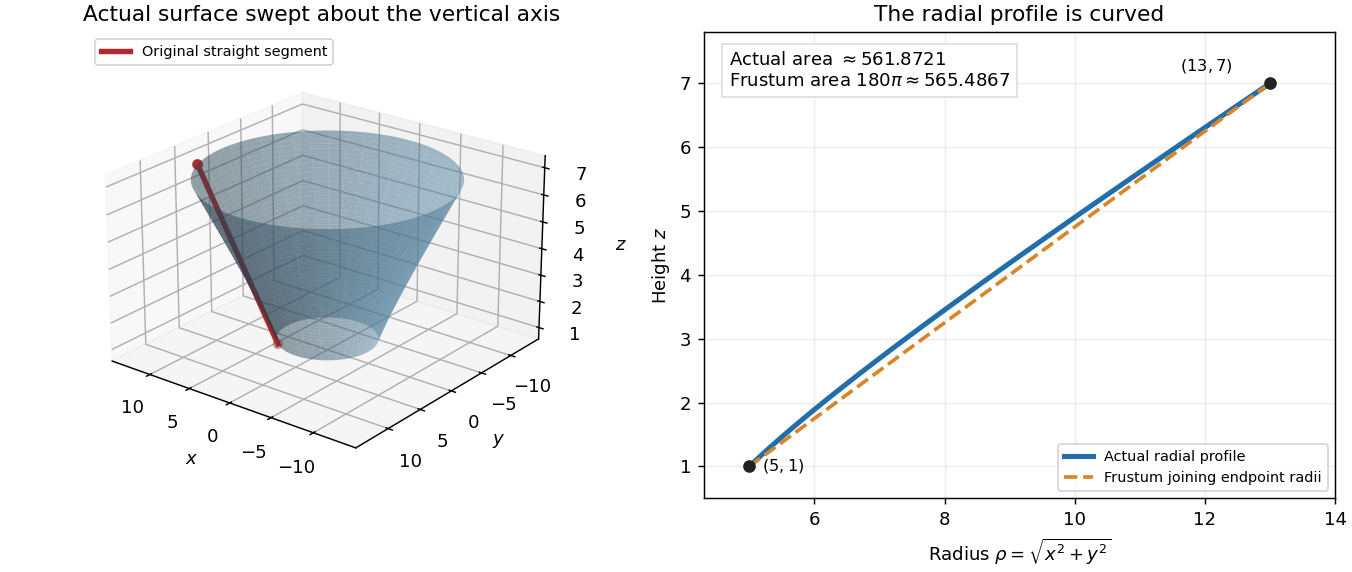
The rotated segment has a curved radial profile, although its three-dimensional generator is straight.
Details. 
Let parametrize . Then parametrizes its image, with tangent vectors and . An orthogonal matrix preserves dot products, so the Lagrange identity for the cross product gives, for any ,The area element of a surface is therefore the same pointwise before and after applying . Integrating provesThis includes orthogonal transformations with determinant : reversal of orientation does not affect the Euclidean norm in the surface area formula.
Let . It is a symmetric matrix, and . By the spectral theorem for real symmetric matrices, choose an orthonormal basis of eigenvectors of , with nonnegative eigenvalues .
For each , take the unit parallelogram parametrized by , . Its surface area is . Moreover,The image parallelogram consequently has area . By the assumption this equals for all three pairs, givingNo eigenvalue can be zero. Dividing the equations and using positivity yields . HenceThus testing all surfaces is stronger than necessary: the three unit parallelograms in these principal directions already determine the result. This is the three-dimensional characterization of linear surface-area isometries.
Articles by others on the same topic
There are currently no matching articles.