For and , D'Alembert's formula for the wave equation on the full real line isFor the specified initial data, define the cumulative initial-velocity integralThen . The initial velocity jumps at , so the resulting solution is interpreted piecewise classically, or as a weak wave-equation solution across the corresponding characteristic curves.
At , the interval of integration has half-width . Evaluating the cumulative integral in part a gives the even functionIt has value at zero and maxima at , then falls to zero at the two wavefronts.
At , the integration interval first moves through positive arguments, then crosses zero, and finally contains all of . The result isThe final plateau is the integral of the entire initial velocity profile divided by .
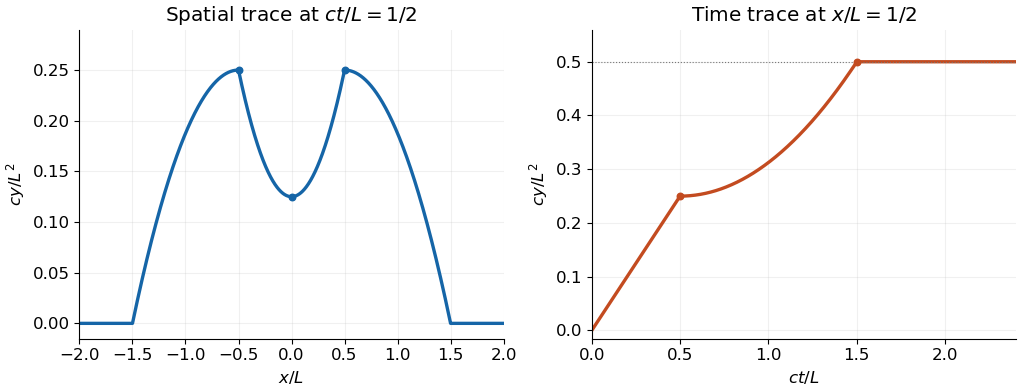
Two traces of the D'Alembert solution for the compactly supported initial velocity
. The spatial profile has two peaks at half the initial support radius. The time trace at that location eventually reaches a constant plateau. Axes use dimensionless variables; plotted curves use . Details.
The multivariable chain rule gives and . Substitution into the differential equation yieldsThe coordinate transformation is invertible exactly when .
Eliminate the two pure second derivatives by taking to be the roots of . They are distinct real numbers exactly whenThus the required function is . The mixed coefficient becomes , so the transformed equation is . Integrating once in each coordinate giveswith arbitrary sufficiently smooth functions . This is the characteristic form of a strictly hyperbolic partial differential equation.
Articles by others on the same topic
There are currently no matching articles.