Along a differentiable graph satisfying the implicit equation, the multivariable chain rule givesThus, wherever ,The implicit function theorem supplies such a local graph under that nonvanishing condition. At a singular point both numerator and denominator vanish, so this division cannot determine its tangent.
For the specified polynomial,The first equation forces ; substitution into then gives , and hence . It also satisfies the curve equation. Therefore the unique singular point is
A real square on the left requires , so . Taking the two square roots gives exactly the two real graph branchesThey meet only at the origin. The local coordinate change turns the equation into , the plane cusp of type (2,5); both branches share the tangent there.
For , differentiate the two explicit branches:The plus branch is strictly increasing and strictly convex for . Its only zero is , also its one-sided global minimum; it has no interior extremum or inflection point.
The minus branch rises initially, then has at , changing from positive to negative. Its second derivative changes sign at . Its zeros follow from . ConsequentlyThe origin is a one-sided local minimum of both graph branches, because their domain ends there; it is not an interior critical point. The minus branch has no global minimum since it tends to as . Its maximum and inflection heights, useful for the sketch, are and , respectively.
The upper branch leaves the origin horizontally and curves upward, growing like . The lower branch shares the horizontal tangent, rises to its small maximum at , then crosses the axis at and falls toward . Its concavity changes at , before the maximum. A separate zoom makes those nearby lower-branch features visible.
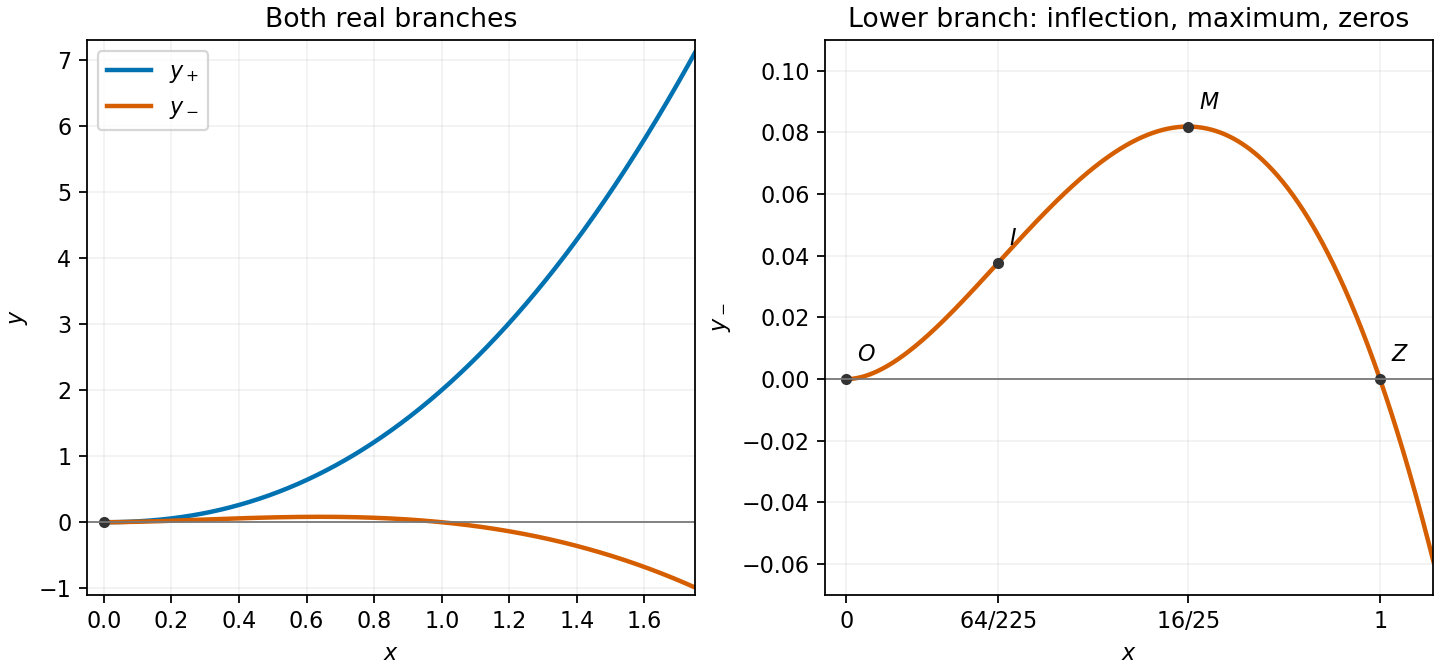
Real branches of the singular curve, with the lower branch enlarged to mark its extrema, inflection, and zeros
. Details. 
Articles by others on the same topic
There are currently no matching articles.