On a connected domain, a vector field is a conservative vector field if and only if it is the gradient of a single-valued scalar potential, . Equivalently, its line integral is path independent, or its integral around every closed curve is zero. For a continuously differentiable field on a simply connected domain, this is equivalent to . Without the domain hypothesis, vanishing curl alone is only a local test and is not the necessary-and-sufficient global statement.
Yes. For any sufficiently smooth scalar , the gauge transformationleaves its curl unchanged because . This freedom is much larger than adding a constant vector: for example, adds the nonconstant vector . Two vector potentials for the same field differ by a curl-free field; on a simply connected domain that difference is a gradient, while nontrivial topology may allow additional global freedom.
Take the curl component by component:Its divergence is zero, as expected because the divergence of a curl is zero.
For a smooth oriented surface with piecewise smooth boundary and a continuously differentiable vector field , the Stokes theorem statesThe boundary orientation is fixed by the right-hand rule: curling the fingers along the positive boundary direction makes the thumb point along the surface normal. For an outward upper cap, its boundary ellipse is traversed counterclockwise when viewed from the positive direction. The figure shows two possible caps with the same oriented boundary, anticipating the last part.
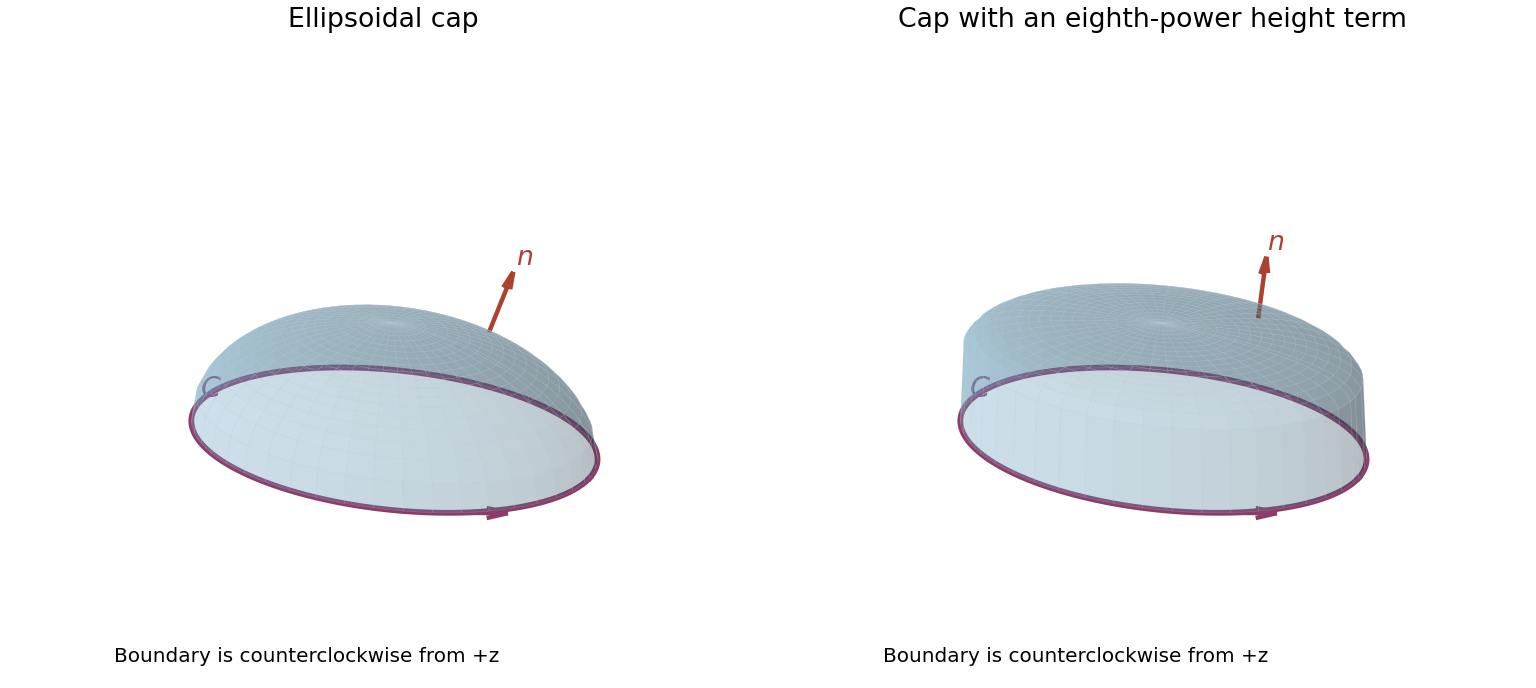

The integrand field is exactly the curl computed in part (a), so use its polynomial vector potential . The upper cap meets the plane in an ellipse. Since the parameters are only assumed nonzero, set and to use positive semiaxes. Its correctly oriented boundary isOn that boundary, and , so only contributes. The Stokes theorem therefore givesThe last integral follows by expanding . ThusThe result is independent of . A sign check uses the divergence theorem: closing the cap with its base disk adds outward normal there. Since , the cap flux equals , consistent with the boxed expression and its absolute values.
The modified upper surface has exactly the same ellipse at and the same boundary orientation. The field retains the global polynomial vector potential from part (a). By the Stokes theorem, both surface fluxes equal the same boundary line integral; the cap's height and interior shape do not enter. HenceThis is an instance of the fact that solenoidal flux depends on the oriented boundary, with the domain condition automatically satisfied by the smooth polynomial field on all of . When are chosen positive, the formula simplifies to ; the absolute-value form respects the original allowance of arbitrary nonzero signs.
Articles by others on the same topic
There are currently no matching articles.