The two open balls are disjoint: a common point would have distances to their centres summing to less than two, contradicting the triangle inequality. Both are nonempty and relatively open, and they cover the union. They therefore give a separation, so the union is neither connected nor path-connected.
Each closed ball is a convex set and contains the origin. Join any point to zero by a line segment inside its ball, then join zero to the other point. Concatenating the two segments gives a path in the union. It is therefore path-connected and connected.
Only the right-hand ball is closed, but the union is still path-connected and connected. Its right-hand closed ball contains zero, and every point of the left-hand open ball can be joined to zero by .
To check the endpoint carefully, write . For , convexity and the triangle inequality giveAt , the path reaches zero in the other, closed ball. Points in that ball also join zero by line segments, completing the construction.
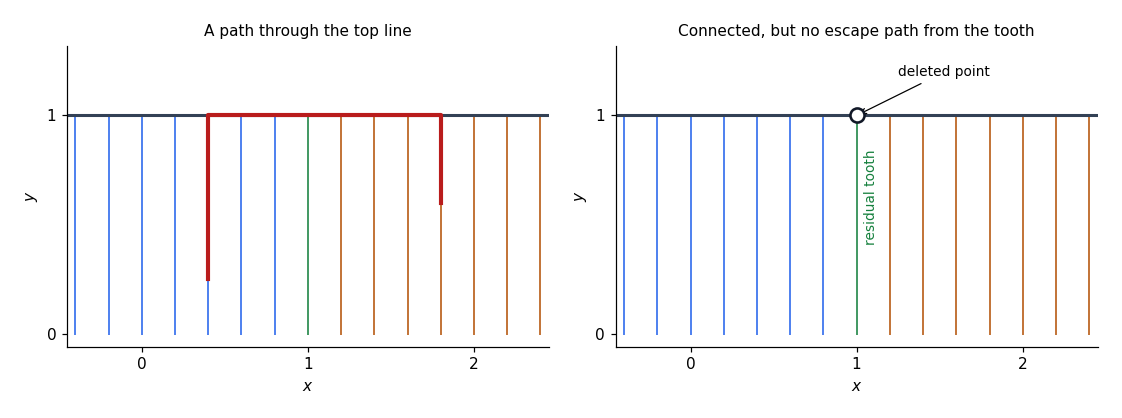
Each vertical line segment over a rational coordinate meets the horizontal line at height one. A point on such a segment can move vertically to the top, then horizontally along that line; points already at height one use only the horizontal motion. Concatenating these motions joins any two points.
Thus the rational comb with a deleted attachment point construction, before deletion, is path-connected and hence connected. The infinitely many vertical pieces cause no difficulty because each individual path uses only finitely many segments.
Let be this union of rational-coordinate horizontal and vertical lines. A point has either rational , in which case it moves vertically to then horizontally to , or rational , in which case it moves horizontally to then vertically to . Every segment remains on a line with a rational fixed coordinate.
Write and . Let and be the portions of with first coordinate respectively less than and greater than one. Each is path-connected: move along a rational tooth to its corresponding open half of the top line, then horizontally there. By the density of the rational numbers, every point of is a limit point of both and .
Use the elementary fact that adjoining any collection of limit points to a connected set preserves connectedness. Indeed, in a proposed separation, the connected subset lies on one side; relative openness would prevent any point on the other side from being a limit point of it. Therefore and are connected. They intersect in , so their union is connected.
There is, however, no path from to . If were one, let be the first time at which . Such a first time exists by continuity and compactness of , and . For , membership in the comb forces . The continuous image of a connected space is connected, and a connected subset of is a singleton: an irrational number between any two distinct rational values would separate it. Hence for . By continuity, , which was deleted.

Articles by others on the same topic
There are currently no matching articles.