A material exhibiting piezoelectricity converts cyclic mechanical stress into electric charge; its mechanical and electrical boundary conditions jointly set the extractable energy. piezoelectric ceramics such as lead zirconate titanate are stiff and often have large charge coefficients and electromechanical coupling, but are brittle and can be difficult to match to large-strain flexible motion. piezoelectric polymers such as polyvinylidene fluoride are compliant, light and compatible with flexible large-area films. Their lower charge coefficient is partly offset in voltage-sensitive applications by lower permittivity: the voltage coefficient is .
Ceramics often favor strong charge generation and coupling; polymers favor flexibility and strain accommodation. The larger open-circuit voltage of a low-capacitance film does not itself imply more useful power. For a simple fixed-stress comparison the electrical energy scale involves , while coupling also depends on mechanical compliance. At fixed imposed strain, different stiffnesses change the available mechanical energy. resonance tuning, fatigue, mechanical mounting, rectifier losses and load matching can reverse a simplistic material ranking; compare complete devices under the same actual vibration source.
specific energy is usable stored energy divided by device mass, commonly in Wh/kg; specific power is deliverable power per the same mass, in W/kg. The definition must specify whether packaging and inactive components count, and the discharge conditions must be comparable. On a Ragone plot with energy horizontal and power vertical, ordinary capacitors occupy high-power/low-energy territory, batteries tend toward higher energy and lower power, and supercapacitors bridge and overlap the two. These are broad regions rather than universal measured boundaries.
High specific energy means long operation for a given mass; high specific power means rapid delivery. Their ratio is a characteristic duration: when the preceding units are used, or . The diagonal lines in the sketch keep that unit conversion explicit. A cell's rated energy and peak pulse power need not be available simultaneously throughout discharge.
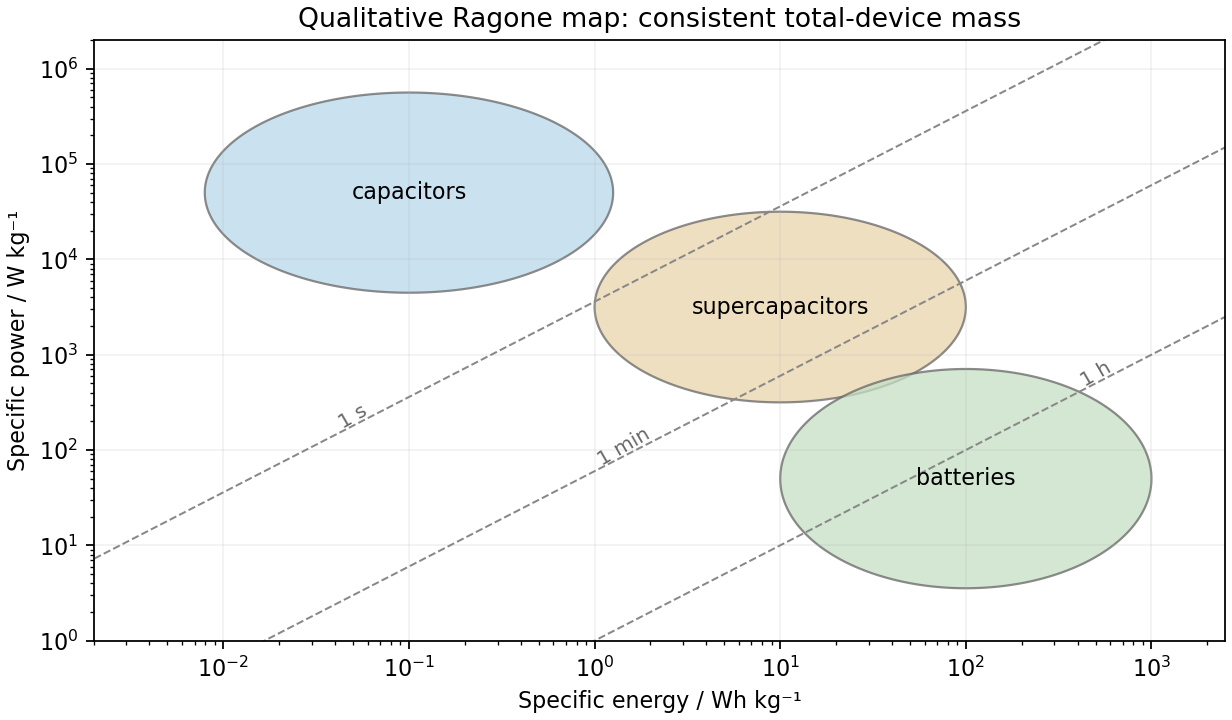
Qualitative storage regions and constant-duration lines on a Ragone plot
. Details. 
Four moles of lithium react per mole of iron disulfide. Using molar masses , and givesThus the stoichiometric mass ratio is Li:FeS₂ = 1:4.322, or approximately 18.79 wt% lithium and 81.21 wt% iron disulfide within the combined active reactants. This excludes electrolyte, current collectors, casing and any deliberate excess of one reactant. The underlying conversion reaction, rather than the nominal cell voltage, sets that ratio.[ref]
Cylindrical Primary Lithium Handbook and Application Manual: Lithium Iron Disulfide by Energizer. printed p.4, the two-step discharge reaction sums to four Li per FeS₂
Each lithium atom supplies one electron. If all of the stated lithium is electrochemically accessible and there is enough iron disulfide, the ideal electric charge isThe voltage is not needed to calculate charge. At an assumed constant 1.5 V the corresponding ideal energy would be , but an actual discharge voltage varies with load and state of charge. Side reactions, incomplete utilization and the practical cutoff reduce accessible capacity. The preceding optimal ratio would require approximately 1.96 g of iron disulfide for this amount of lithium.
This lithium iron disulfide battery consumes a metallic lithium anode and converts iron disulfide into iron and lithium sulfide. Commercial cells of this chemistry are primary batteries. A conventional lithium-ion battery is designed for reversible cycling: lithium ions transfer between two host electrodes, commonly a carbon insertion anode and a transition-metal compound cathode, while electrons travel in the external circuit. Metallic lithium is not the intended normal anode reactant in that design. Primary Li/FeS₂ conversion is the key distinction from the rechargeable lithium-ion host-electrode system. The fact that both transport lithium ions does not make them the same battery chemistry, and a nominal 1.5 V is not a definition of either class.[ref]
Articles by others on the same topic
There are currently no matching articles.