All three interactions respect color charge; quark flavor is conserved by the strong interaction and the electromagnetic interaction, but can change in the weak interaction. These statements concern charges and net numbers, rather than an unchanging inventory of particles.
A quark transforms in the fundamental representation of the color charge gauge group . The strong interaction can change an individual quark's colour by exchanging a gluon, which itself carries color charge. For example, the colour flow is allowed: demanding that the outgoing quark remain red would be incorrect. At each interaction vertex the full colour flow is conserved. The colourless photon, W boson, and Z boson instead couple to a quark with an identity factor in colour space. A weak charged current can therefore change to , but cannot turn into without another coloured participant. External isolated hadrons are colour singlets; confinement prevents direct observation of a free coloured state.
For each quark flavor , define the net quark flavor number . The strong interaction and electromagnetic interaction preserve every : pair creation , for example, changes neither net strangeness nor any other . Their quark couplings are diagonal in quark flavor. The weak charged current contains , where is the Cabibbo-Kobayashi-Maskawa matrix, and changes these net numbers. Weak neutral currents are diagonal in tree-level Feynman diagrams; flavor-changing neutral currents can occur through higher-order Feynman diagrams.
The observed hierarchy of mean lifetimes and decay channels supplies evidence: associated strange-particle production through the strong interaction preserves net strangeness, whereas a kaon's weak interaction decay to pions changes it. The electromagnetic interaction process has zero net quark flavor before and after annihilation. Neutrino oscillations show that individual lepton family numbers are not exact conserved quantities. Within the usual effectively massless-neutrino approximation, charged current decays such as preserve family numbers only when the emitted neutrinos are counted.
Evidence for three colours includes the hadronic R ratio , the colour multiplicities in W boson decay widths, and three-jet events revealing gluon radiation. These test Quantum chromodynamics and its colour structure together; they are not direct measurements of a named red or blue charge on a free quark.
Two mechanisms are a tau lepton pair with two leptonic decays, and a W boson pair with two leptonic decays. With equal beam energies, the laboratory is the centre-of-mass frame, and four-momentum conservation gives in natural units.
For the first mechanism,There are four escaping neutrinos. Each tau lepton decay proceeds through a virtual W boson. The fixed-charge final state has branching fraction ; the factor two for the inclusive sample does not apply when the charges are specified.
For the second mechanism,There are two escaping neutrinos. The leading Feynman diagrams comprise both -channel photon/Z boson exchange and -channel electron neutrino exchange. Their scattering amplitudes interfere; the complete set is needed for a consistent high-energy prediction. In particular, the neutrino-exchange diagram alone does not define an independently observable production rate.
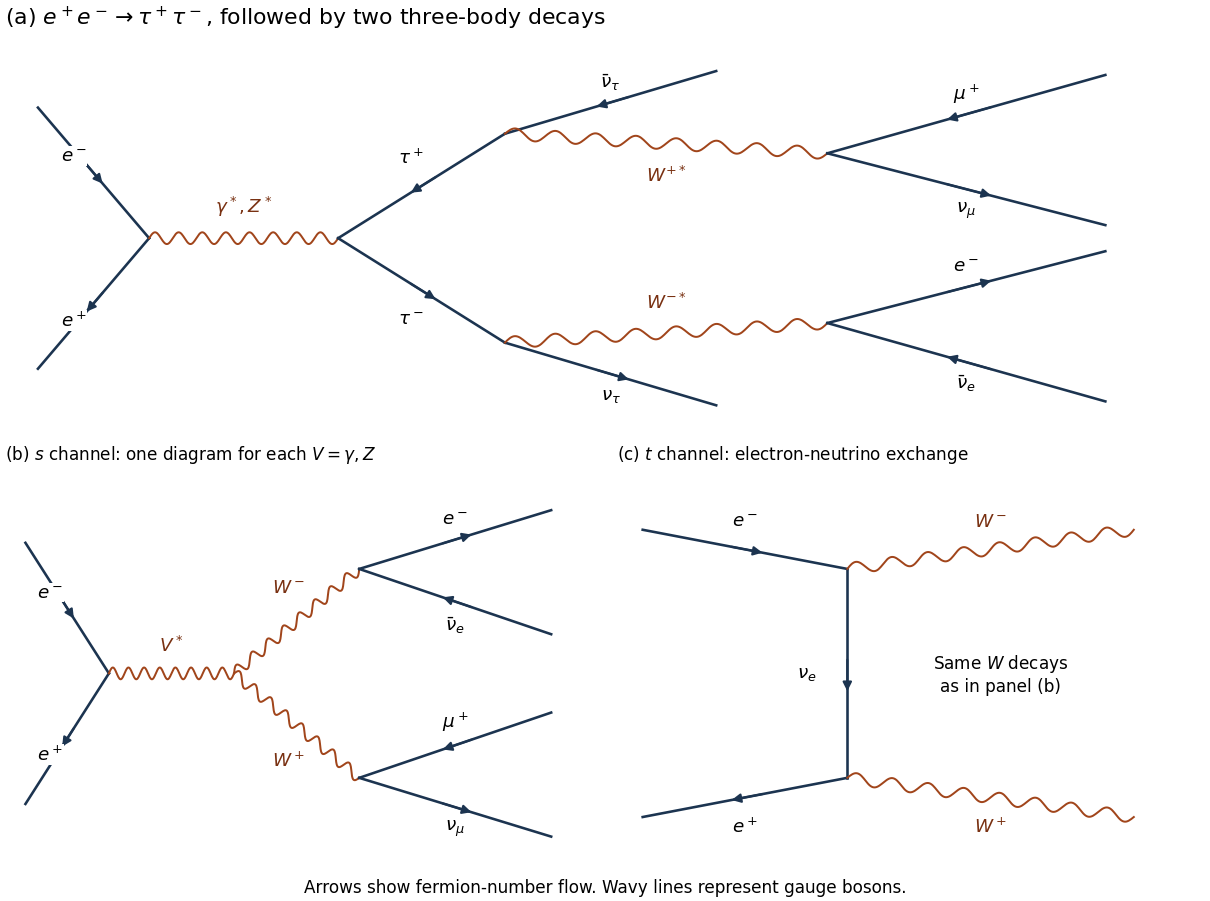
A tau lepton pair has enhanced production at the Z boson particle resonance, . The four-neutrino missing energy has a broad continuous distribution. To derive a useful schematic, neglect daughter masses and parent spin correlations. In an unpolarized tau lepton rest frame, the Michel spectrum for isA Lorentz boost gives , with uniform on in this approximation. For , the charged-daughter probability density function in isFor two independent decays, has the convolutionand . It vanishes at both endpoints and peaks on the larger-missing-energy side. This is a shape illustration, not the exact polarized Z boson prediction; spin correlations, acceptance, and radiative effects alter it.
The W boson process turns on near . At exact on-shell production threshold, each neutrino has energy , soThe cross section vanishes at the ideal two-body threshold, so this narrow limiting spectrum must not be called the maximum-rate spectrum. The large W boson-pair rate occurs above threshold, around . There and each neutrino hasThusAn isotropic independent-decay schematic is triangular, centered at , with endpoints approximately and at . Actual W boson particle polarizations and their correlations change this shape; their V-A interaction is not isotropic for a fixed helicity. The finite decay width, beam spread, and radiation also smear the edges.
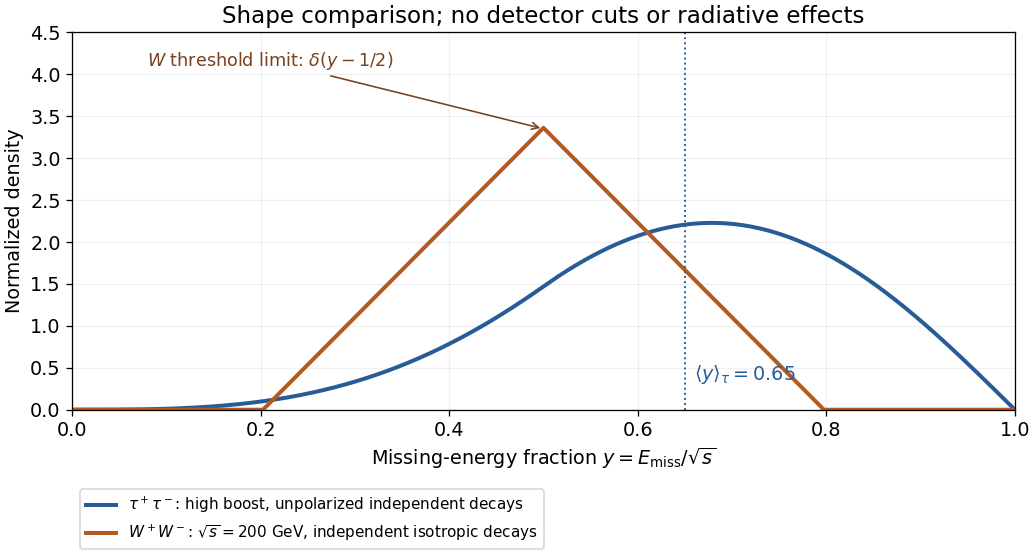


The phrase “maximum rate” also needs a production regime: a Z boson peak is a resonant maximum, whereas pure photon-mediated tau lepton production has its continuum maximum near . Indeed, has . The displayed high-boost curve describes the resonant regime; at the continuum maximum use in the boost formula. An observed event-rate maximum additionally depends on collider luminosity and detection efficiency.
The ideal two-shower event fraction is , approximately in simple channel counting or using the measured tau lepton electronic branching fraction. The selected particle decay chain isThe electron and Positron each make a contained electromagnetic shower; muons penetrate, and generic hadrons do not deposit all their energy as a contained electromagnetic shower.
To estimate , use lepton universality and neglect final masses and Quantum chromodynamics corrections. The electronic and muonic decay widths each carry weight one. The accessible inclusive hadronic channels have weights and , where three is the color multiplicity in a decay width. The charm quark is inaccessible in physical tau lepton hadronic decays. With , the total weight is , givingThe 2021 measured value instead gives .[ref]
Review of Particle Physics by Particle Data Group (2021). Tau listing, p. 6, mode 5: electronic branching fraction
The difference reflects effects omitted by the simple free-channel estimate, especially the hadronic contribution to the total decay width.There are two tau leptons per produced pair and two per selected pair, so the fraction of all produced tau leptons belonging to these two-shower events is also . The unrestricted fraction of individual tau leptons decaying electronically is ; these are different selections. A real high-energy shower cut gives an additional acceptance factor: , which cannot be computed without the cut and detector response. No factor of two is needed for the unique assignment.
For a purely electromagnetic interaction continuum with five active quark flavors, the usual estimate is . The unspecified particle resonance and the word “total” require qualifications before this can be treated as a unique physical prediction.
In natural units, neglecting final masses, single-photon annihilation givesHere is the fine-structure constant, the quark electric charge in elementary-charge units, and the factor three counts orthogonal colour final states. Consequently the inverse hadronic R ratio isWith accessible, the denominator is . The corresponding values for and are and . Inclusive Quantum chromodynamics corrections increase the hadronic denominator, approximately by away from thresholds and particle resonances. These are annihilation ratios before selection and detection efficiency corrections, not ratios of uncorrected detector counts.
A future muon-collider Higgs resonance is a plausible reading of part (c), since its narrow decay width makes a detuning of a few relevant. Even then, two further assumptions are necessary. First, being a few below the Higgs boson peak does not eliminate it: for detuning , the ideal narrow Breit-Wigner resonance cross section retains the relative factorFor and this is , not zero. Resonant hadronic production can still change the requested denominator substantially.
Second, at the Z boson continuum is not negligible. A more complete annihilation estimate including both tree-level Feynman diagrams usesHere is the squared sine of the weak mixing angle, is weak isospin, and is one for a lepton and three for a quark. Thus the continuum ratio is , rather than necessarily . For example, , and give approximately at before Quantum chromodynamics corrections.
If the unspecified particle resonance instead means the Z boson, detuning by a few is tiny compared with its decay width. The resonant ratio remains approximately .[ref]
Review of Particle Physics by Particle Data Group (2021). Z listing, p. 9: hadronic-to-single-lepton partial-width ratio
This is a concrete counterexample to treating any slight downward detuning as permission to discard the particle resonance. The source supplies neither its identity nor the detuning and selection needed for a unique all-process ratio. The boxed continuum formula is the charge-counting answer under its stated approximation; a literal total must also include remaining resonant and other accepted hadronic channels. Articles by others on the same topic
There are currently no matching articles.