For a steady flow the local time derivative in the Euler equations vanishes. The vector identityreduces to a gradient when the vorticity is zero. With constant density and gravity , the momentum equation becomesThus on each connected flow region,This is Bernoulli's theorem for a steady irrotational flow: irrotationality makes the same constant apply throughout a connected region, rather than only along an individual streamline.
This is a Rankine vortex. Write . Inside the core the velocity is , soThis is the core value obtained from the inner formula; outside, the given irrotationality makes the vorticity zero. For nonzero , the sharp boundary has different one-sided velocity gradients, so a single classical vorticity is not defined exactly on that edge; the inner trace is the boxed value and the outer trace is zero.
Inside the core, direct differentiation gives . The steady Euler equations therefore give and . Integrating,Outside, , so part (a) givesMatching pressure at the core edge yields . Hence the complete pressure field, up to one additive constant , isBoth the velocity and pressure are continuous at . The inside expression has been derived from the momentum equation because the core is rotational.
The Free surface of a Rankine vortex follows from setting its pressure constant. At a free surface with constant pressure , solve the two pressure expressions from part (b) for . With , this givesSubstituting recovers the required Cartesian form. The two values coincide at , and both radial slopes there equal . The surface is parabolic in the core and approaches height as ; at the centre its depression below is .
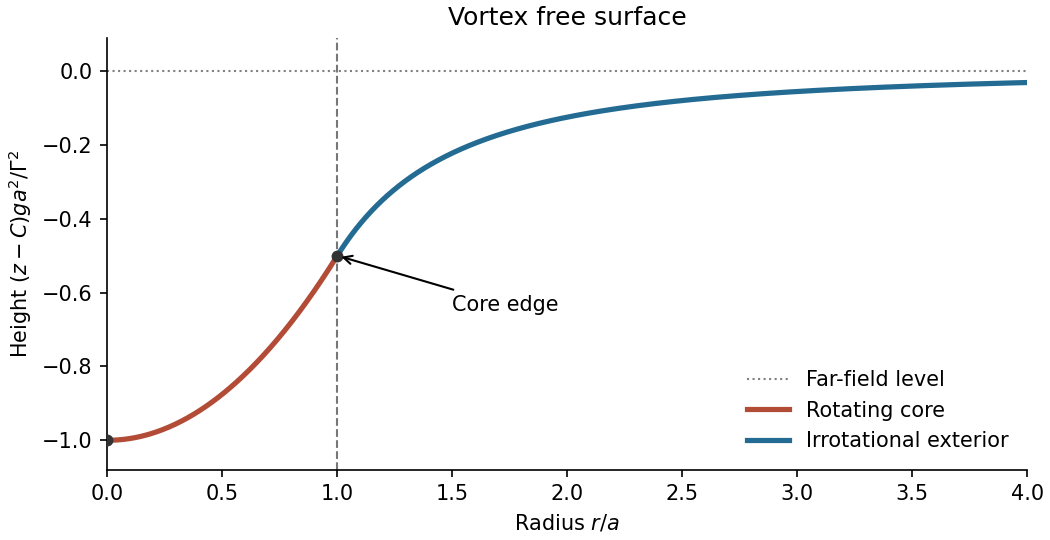
Free surface through the vortex core and irrotational exterior
. Details. 
Articles by others on the same topic
There are currently no matching articles.