An S wave has and positive parity. The deuteron's therefore requires a spin-one-half triplet state, . The two-nucleon isospin description makes this the antisymmetric channel. Its existence proves sufficient attraction to bind in the -dominated channel.
A spin one-half pair could also form . The absence of a bound deuteron indicates that the singlet interaction does not bind, not that it is everywhere repulsive. Together with triplet binding, this shows that a spin-independent central attraction is insufficient. No radial excited bound level also constrains the strength and range: the attraction supports only a shallow low-energy bound state.
For identical neutrons or protons, two-particle isospin has and is symmetric. At even , spatial exchange is symmetric, so the Pauli exclusion principle requires an antisymmetric spin state, . A low-energy or pair cannot occupy the deuteron's channel. With approximate charge independence of nuclear forces, their singlet strong interaction corresponds to the unbound neutron-proton singlet; proton-proton electrostatic repulsion further disfavors binding. There is no bound dineutron or diproton in these physical low-energy channels. The inference uses charge independence and singlet-channel behavior; the deuteron's quantum numbers alone do not constrain every imaginable potential.
The nuclear binding energy is the separated-nucleon rest energy minus the bound-state rest energy. Consistent nuclear masses avoid atomic-electron bookkeeping:It is positive because the bound deuteron has lower total energy.
In a pure stretched state both spins point along the total angular momentum, with no orbital contribution. The nuclear magnetic moment would beThe measured differs. More decisively, a pure S wave spatial state is isotropic and has zero electric quadrupole moment. Its nonzero value requires a nonspherical component of the quantum charge distribution.
Positive parity allows even ; coupling to permits and . The state contains a deuteron D-state admixture:with radial wavefunctions implicit. A nuclear tensor force couples the orbital components. The quadrupole moment involves their interference as well as a D-state contribution, making it sensitive to a small admixture. This is a quantum angular correlation, not two particles permanently fixed in space.
In the nonrelativistic one-body magnetic-moment approximation,The D-state coupling has and at ; the proton supplies approximately half the relative orbital magnetic moment. ThusThe robust conclusion is a predominantly S wave state with a small tensor-induced D wave component. The 4% estimate is model dependent: exchange currents and other corrections also affect the magnetic moment, and a wavefunction component probability is not itself a uniquely measured observable.[ref]
Modern Theory of Nuclear Forces by Evgeny Epelbaum and others. §I.F, Observables and not-so observable quantities; §II.B, spin-dependent nuclear interactions
Use the relative coordinate and reduced massTake inside, outside, and . For , define inverse lengthsThe radial equation becomes inside and outside. Finiteness of the full wavefunction at the origin imposes ; normalizability excludes the growing exterior exponential. HenceContinuity of was built in. Continuity of its derivative at the finite step givesFor the nodeless ground state, selects the first branch. Higher roots would correspond to different wells with more bound states. Normalization is
For the requested weak-binding estimate, makes . On the first branch , and . The leading threshold estimate isThis is the zero-binding threshold of a spherical square well, so nonzero positive binding needs a depth above it. Corrections start at order , not just at order : setting gives and
The actual numbers permit an accuracy check: and are not extremely small. Retaining the exterior decay, solveThis gives , and the full square-well result isNeglecting only in the interior kinetic relation while retaining the measured exterior decay instead estimates . These approximations should be identified: 23.2 MeV is the leading threshold, whereas matching the supplied nonzero binding requires a boundary phase shift and a deeper well.
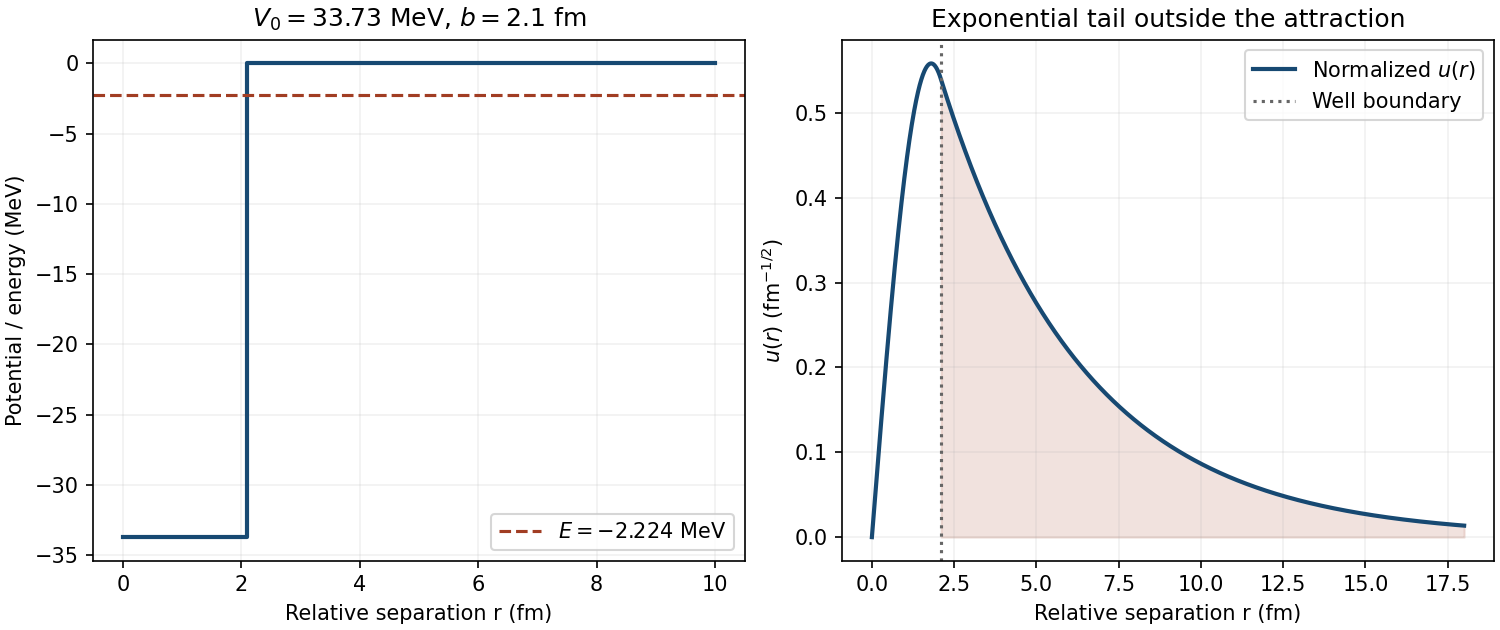
A weakly bound radial state extends beyond the finite nuclear well
. Original calculation from the stated masses, radius and binding. The reduced radial function is normalized with and matches its derivative at the well edge. The central-well model omits the tensor-induced D component. Details.
In neutron-proton radiative capture, the initial pair at rest has total energy , where . The emitted photon carries momentum, requiring equal and opposite nuclear recoil. Some binding energy becomes deuteron kinetic energy.
Exact two-body kinematics in natural units givesSince ,With the stated rounded masses,The photon energy is . At leading order the difference equals the nonrelativistic recoil estimate ; exact kinematics fixes the small distinction between using and in that approximation.
Articles by others on the same topic
There are currently no matching articles.