Count strangeness before drawing a weak interaction diagram. An Omega baryon has , a Lambda baryon has , a negatively charged kaon has , and a pion has . Thus the two nonleptonic baryon decays requireThe strong interaction cannot supply either net change of strangeness.
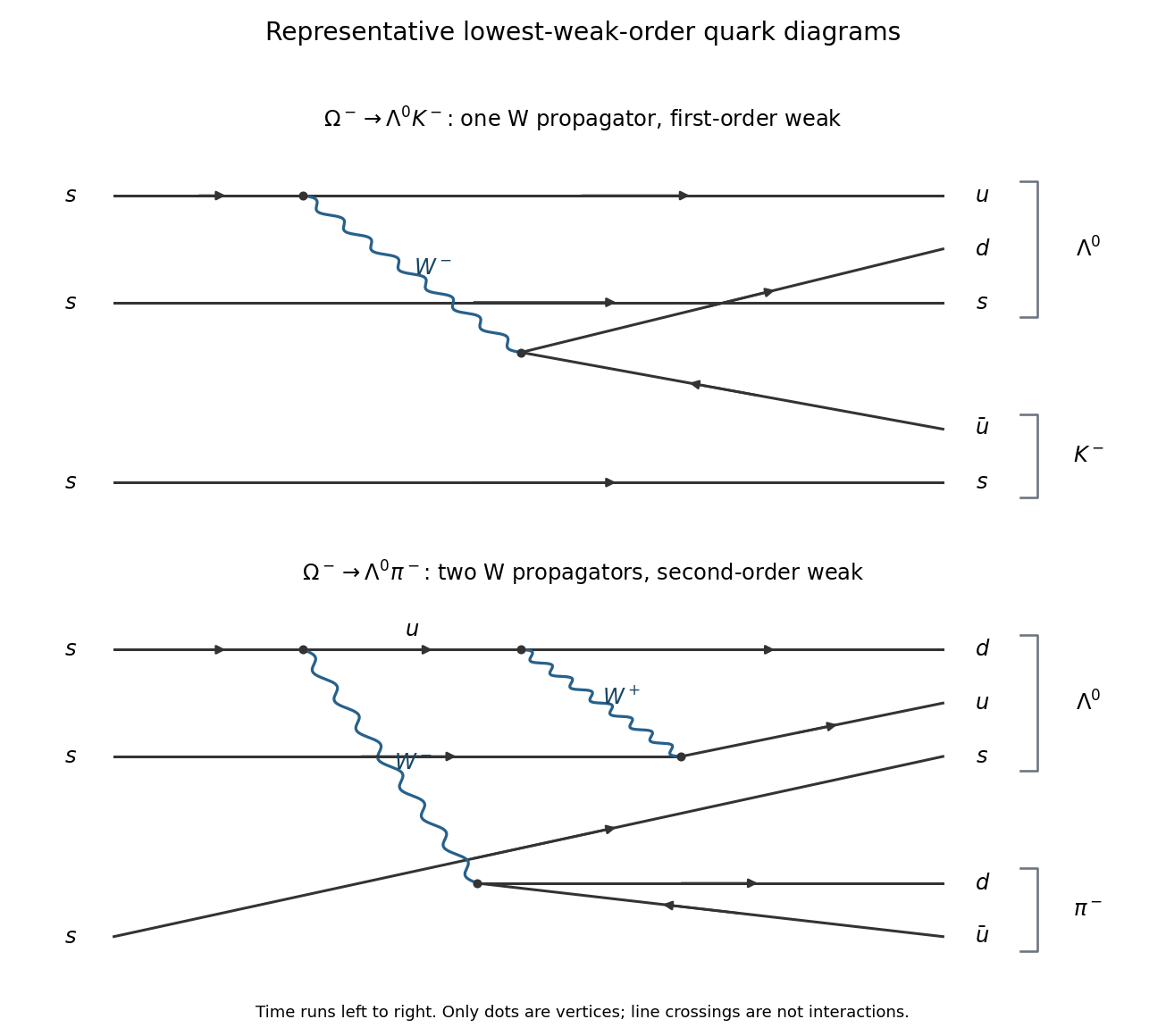

In the upper Feynman diagram, one initial strange quark undergoes the weak charged current transitionThe remaining two strange quarks are spectator quarks. Combine the outgoing and one spectator into the Lambda baryon, and the remaining with into the kaon. This uses one W boson propagator and two weak interaction vertices. Its Cabibbo-Kobayashi-Maskawa matrix factor has magnitude .
For the lower Feynman diagram, let the upper initial first emit a and become a virtual , then emit a and become a . The is absorbed by a second initial , turning it into a ; the third initial remains a spectator quark. The emitted produces . The complete quark flavour flow is thereforeThe final form the Lambda baryon and the other form the pion. Electric charge conservation holds at every vertex. Internal lines are virtual; this is a contribution to one decay amplitude, not a sequence of freely propagating on-shell constituent-quark decays.
This is a possible lowest-weak-order diagram for a second-order strangeness-changing weak decay: it has two W boson propagators and four weak interaction vertices. Its Cabibbo-Kobayashi-Maskawa matrix factor has magnitude in the displayed light-quark topology. Other contributions can exist, but a single charged-current insertion cannot turn two net strange quarks into nonstrange ones. No extra loop Feynman diagram is compulsory: the displayed two-W tree already realizes the required quark flavour change.
At low energies, one-W exchange produces one power of the Fermi constant in an effective decay amplitude; the second process requires an additional weak insertion. Hadronic matrix elements and propagators supply the accompanying dimensions, so a numerical ratio cannot be obtained by simply squaring a dimensionful constant. The robust comparison isThe dominant reason is the extra weak order, with additional Cabibbo suppression in this representative topology. It is not a comparison between a strong decay and a weak decay.
In both semileptonic decays, an active quark emits a virtual W boson, which produces an Electron and an electron antineutrino:The unchanged spectator quarks combine with the produced into the final proton. The relevant Cabibbo-Kobayashi-Maskawa matrix elements are and .
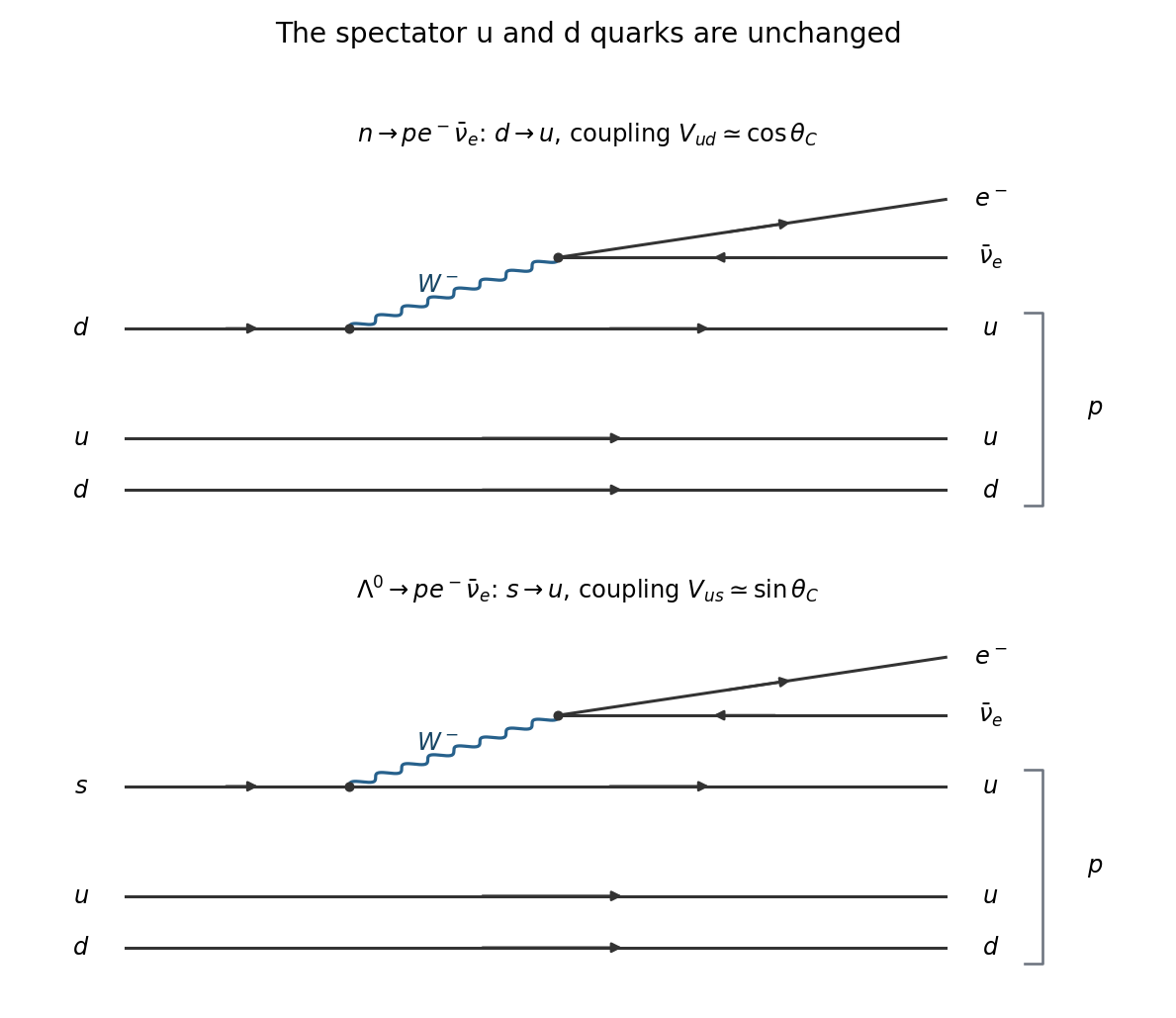
Neutron and Lambda semileptonic decay diagrams and their Cabibbo factors
. Details. 
Use the quoted masses in energy units, equivalently natural units , and define the energy releases before subtracting the electron rest energy asThe prescribed density of states ansatz uses precisely these differences to the fifth power. A Cabibbo-angle extraction from semileptonic decay rates also needs a common reduced hadronic strength. In that approximation the partial decay rates, measured in , areThe supplied mean lifetimes describe all decays, so multiply their inverses by the relevant branching fractions:Taking their ratio cancels and givesChoose the conventional first-quadrant Cabibbo angle:The Lambda baryon partial rate is much larger despite its smaller weak flavour coupling because the fifth-power phase space factor is enormous.
There is an assumption beyond the stated density of states ansatz: the neutron and Lambda reduced hadronic strengths have been set equal. If their ratio is , the same data instead imply . Without specifying , the angle is not uniquely determined. Unequal hadronic form factors, finite electron mass and recoil make the displayed common-strength result an exercise-level estimate, rather than a precision measurement.
Use the leading lepton-orbital classification of a beta decay transition. For lepton-pair orbital angular momentum , Fermi transitions have pair spin and total lepton angular momentum ; Gamow-Teller transitions have and . Addition of angular momentum requireswhile the nuclear parity change requires . The least allowed gives the order: means an allowed beta decay, and an th-forbidden beta decay. Fermi-type and Gamow-Teller-type below refer to these spin-independent and spin-dependent contributions, including their higher-orbital generalizations.
- For , the nuclear spin changes by and parity is unchanged. An lepton pair cannot carry ; would have the wrong parity. At , Fermi transitions can carry , and Gamow-Teller transitions can carry , including the permitted transfers and . Therefore this is a second-forbidden, nonunique transition, with both Fermi-type and Gamow-Teller-type contributions permitted. The quantum numbers do not determine their actual relative matrix elements.
- For , and parity is unchanged. Already carries . The operator for a Fermi transition has rank zero and cannot connect these unequal nuclear spins. This is an allowed Gamow-Teller transition. The decrease of atomic number makes the nuclear conversion proton-to-neutron; the angular momentum classification applies to either the energetically available beta-plus decay or electron capture branch.
- For , requires transfer and a parity change. The lowest possible orbital order is . The pair for a Fermi transition then has only , whereas the pair for a Gamow-Teller transition can attain . Thus this is a first-forbidden unique Gamow-Teller-type transition. Here unique means the maximal transfer at the leading orbital order, as in a unique forbidden beta decay.
- For , permits the scalar operator for a Fermi transition with . The allowed Gamow-Teller transition operator has rank one, and the triangle rule excludes . Interpreting the printed logarithm in the usual comparative half-life convention gives
In the order listed, the concise classification is
Articles by others on the same topic
There are currently no matching articles.