Count strangeness before drawing a weak interaction diagram. An Omega baryon has , a Lambda baryon has , a negatively charged kaon has , and a pion has . Thus the two nonleptonic baryon decays requireThe strong interaction cannot supply either net change of strangeness.
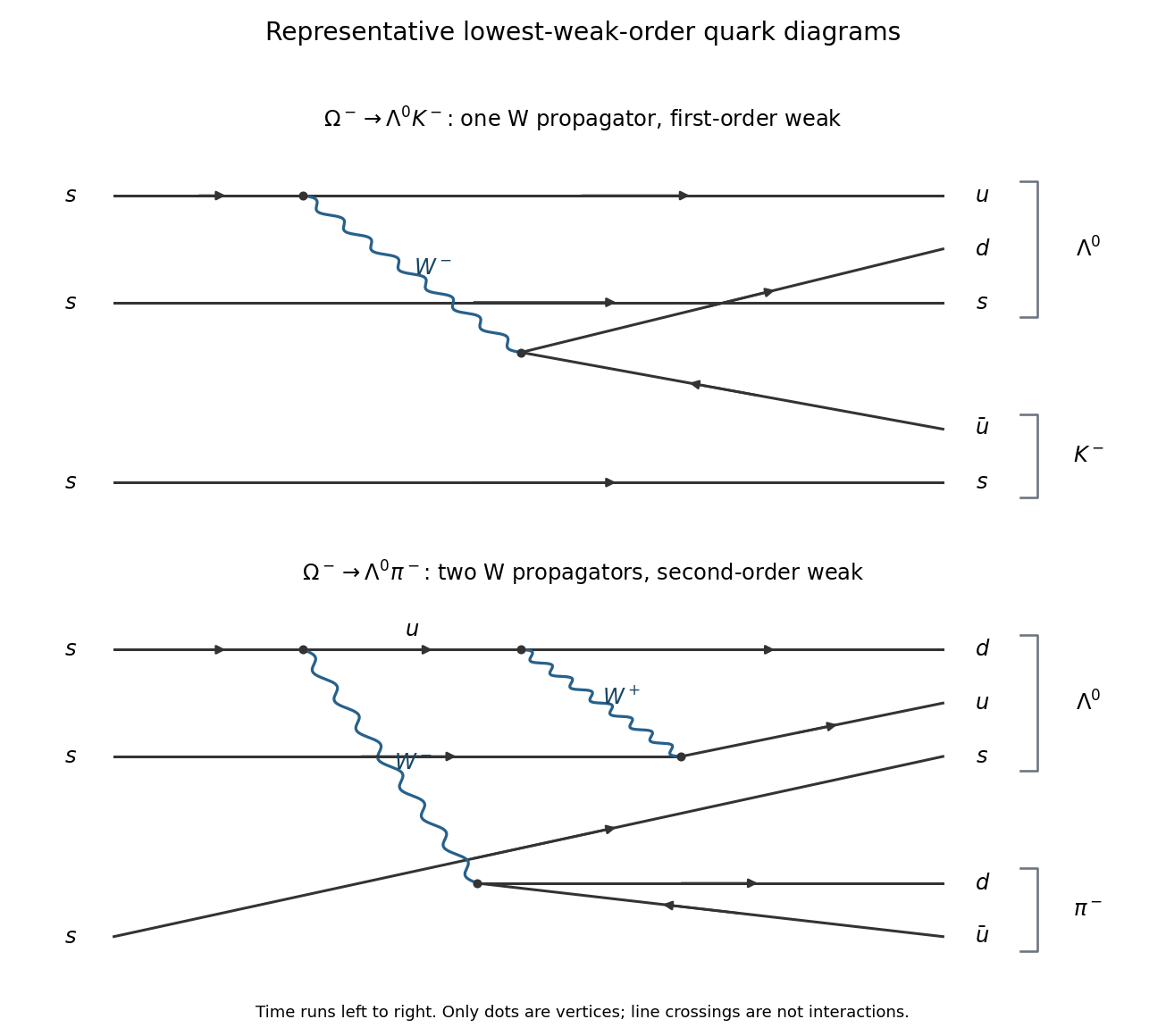

In the upper Feynman diagram, one initial strange quark undergoes the weak charged current transitionThe remaining two strange quarks are spectator quarks. Combine the outgoing and one spectator into the Lambda baryon, and the remaining with into the kaon. This uses one W boson propagator and two weak interaction vertices. Its Cabibbo-Kobayashi-Maskawa matrix factor has magnitude .
For the lower Feynman diagram, let the upper initial first emit a and become a virtual , then emit a and become a . The is absorbed by a second initial , turning it into a ; the third initial remains a spectator quark. The emitted produces . The complete quark flavour flow is thereforeThe final form the Lambda baryon and the other form the pion. Electric charge conservation holds at every vertex. Internal lines are virtual; this is a contribution to one decay amplitude, not a sequence of freely propagating on-shell constituent-quark decays.
This is a possible lowest-weak-order diagram for a second-order strangeness-changing weak decay: it has two W boson propagators and four weak interaction vertices. Its Cabibbo-Kobayashi-Maskawa matrix factor has magnitude in the displayed light-quark topology. Other contributions can exist, but a single charged-current insertion cannot turn two net strange quarks into nonstrange ones. No extra loop Feynman diagram is compulsory: the displayed two-W tree already realizes the required quark flavour change.
At low energies, one-W exchange produces one power of the Fermi constant in an effective decay amplitude; the second process requires an additional weak insertion. Hadronic matrix elements and propagators supply the accompanying dimensions, so a numerical ratio cannot be obtained by simply squaring a dimensionful constant. The robust comparison isThe dominant reason is the extra weak order, with additional Cabibbo suppression in this representative topology. It is not a comparison between a strong decay and a weak decay.
In both semileptonic decays, an active quark emits a virtual W boson, which produces an Electron and an electron antineutrino:The unchanged spectator quarks combine with the produced into the final proton. The relevant Cabibbo-Kobayashi-Maskawa matrix elements are and .
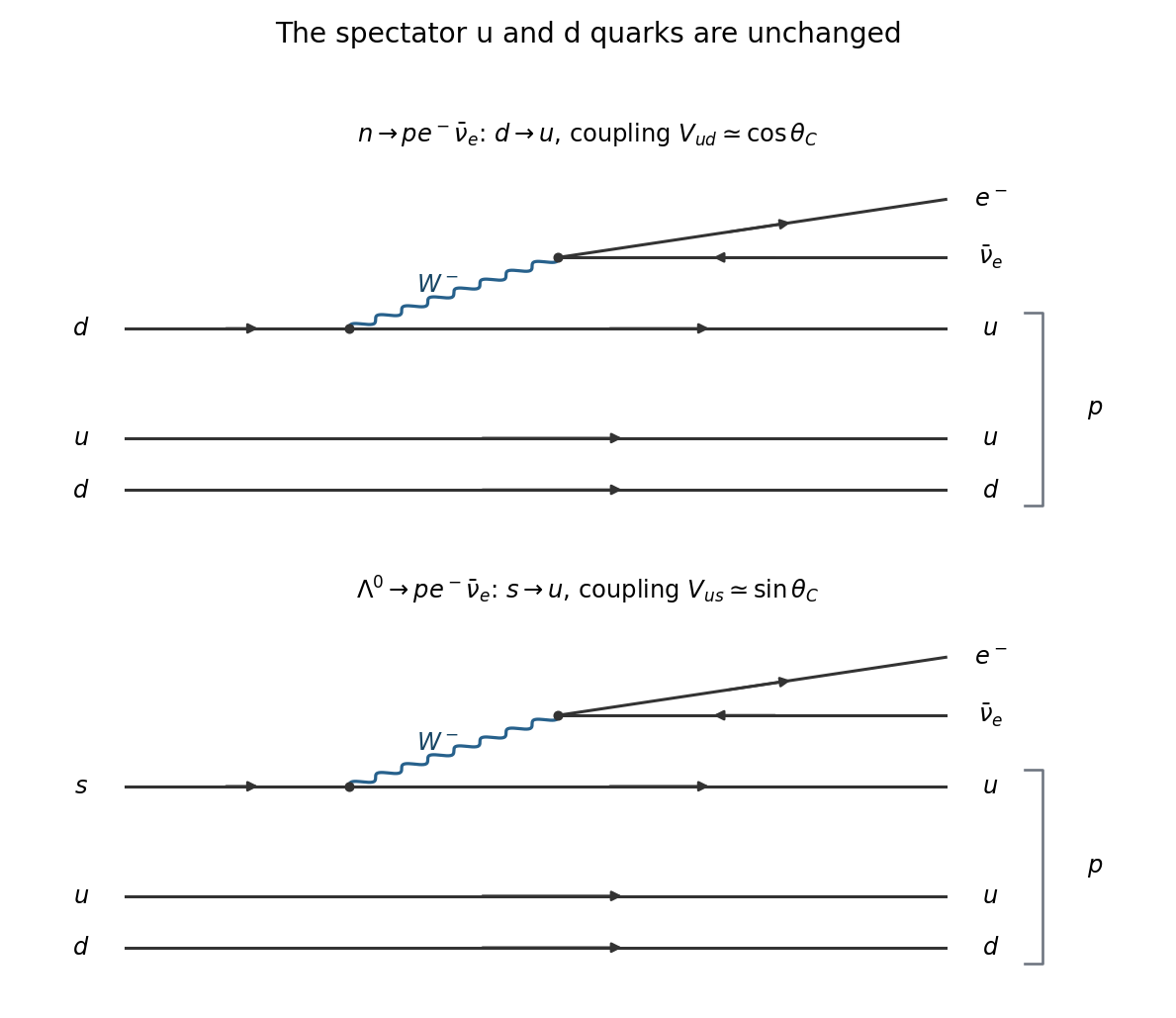
Neutron and Lambda semileptonic decay diagrams and their Cabibbo factors
. Details. 
Use the quoted masses in energy units, equivalently natural units , and define the energy releases before subtracting the electron rest energy asThe prescribed density of states ansatz uses precisely these differences to the fifth power. A Cabibbo-angle extraction from semileptonic decay rates also needs a common reduced hadronic strength. In that approximation the partial decay rates, measured in , areThe supplied mean lifetimes describe all decays, so multiply their inverses by the relevant branching fractions:Taking their ratio cancels and givesChoose the conventional first-quadrant Cabibbo angle:The Lambda baryon partial rate is much larger despite its smaller weak flavour coupling because the fifth-power phase space factor is enormous.
There is an assumption beyond the stated density of states ansatz: the neutron and Lambda reduced hadronic strengths have been set equal. If their ratio is , the same data instead imply . Without specifying , the angle is not uniquely determined. Unequal hadronic form factors, finite electron mass and recoil make the displayed common-strength result an exercise-level estimate, rather than a precision measurement.
Use the leading lepton-orbital classification of a beta decay transition. For lepton-pair orbital angular momentum , Fermi transitions have pair spin and total lepton angular momentum ; Gamow-Teller transitions have and . Addition of angular momentum requireswhile the nuclear parity change requires . The least allowed gives the order: means an allowed beta decay, and an th-forbidden beta decay. Fermi-type and Gamow-Teller-type below refer to these spin-independent and spin-dependent contributions, including their higher-orbital generalizations.
- For , the nuclear spin changes by and parity is unchanged. An lepton pair cannot carry ; would have the wrong parity. At , Fermi transitions can carry , and Gamow-Teller transitions can carry , including the permitted transfers and . Therefore this is a second-forbidden, nonunique transition, with both Fermi-type and Gamow-Teller-type contributions permitted. The quantum numbers do not determine their actual relative matrix elements.
- For , and parity is unchanged. Already carries . The operator for a Fermi transition has rank zero and cannot connect these unequal nuclear spins. This is an allowed Gamow-Teller transition. The decrease of atomic number makes the nuclear conversion proton-to-neutron; the angular momentum classification applies to either the energetically available beta-plus decay or electron capture branch.
- For , requires transfer and a parity change. The lowest possible orbital order is . The pair for a Fermi transition then has only , whereas the pair for a Gamow-Teller transition can attain . Thus this is a first-forbidden unique Gamow-Teller-type transition. Here unique means the maximal transfer at the leading orbital order, as in a unique forbidden beta decay.
- For , permits the scalar operator for a Fermi transition with . The allowed Gamow-Teller transition operator has rank one, and the triangle rule excludes . Interpreting the printed logarithm in the usual comparative half-life convention gives
In the order listed, the concise classification is
Dating principle. Atmospheric cosmic rays produce secondary neutrons, which can generate carbon-14 through . Carbon then enters atmospheric carbon dioxide and living organisms. While an organism exchanges carbon with its environment, its carbon-14 to carbon-12 ratio approximately tracks that reservoir. After exchange stops, surviving carbon-14 undergoes beta-minus decay, whereas the stable carbon remains. On the closed-sample, constant-initial-ratio model, radioactive decay givesThus radiocarbon dating infers elapsed time from the loss of an isotope ratio or of radioactive activity per fixed carbon mass. It dates cessation of carbon exchange, which need not equal the date an object was manufactured or buried. Actual calendar dating also requires radiocarbon calibration and control of contamination and reservoir differences.
Mean lifetime. For exponential decay, the half-life obeys , while the mean lifetime is . HenceUsing gives and .
The mass minimum and beta stability. Treat the supplied masses as nuclear rest energies in , and omit nuclear pairing as instructed. At fixed mass number , the volume and surface terms of the semi-empirical mass formula are constant. Expanding the remaining terms gives a convex nuclear mass parabola,The continuous minimum in atomic number is thereforeAt , the quadratic coefficient is and . The nearest integer is ; the nuclear isobar of minimum mass is nitrogen-14. Maximizing nuclear binding energy alone would omit the neutron-proton rest-mass difference; its continuous optimum is slightly different, but also selects integer here.
The values most useful for checking neighboring decay thresholds areConsequently carbon-14 can lower its nuclear mass by changing a neutron into a proton:For bare nuclear masses, the Q value must include the emitted electron mass. Taking ,The opposite proton-to-neutron conversion would lead to , whose nuclear mass is higher than that of carbon-14. Neither beta-plus decay nor electron capture can bridge that gap by supplying an electron-mass correction. For the nitrogen-14 daughter, both neighboring nuclear masses are higher: by and by . Even electron capture to has . Thus the daughter has no further energetically allowed single beta decay in this model; physical nitrogen-14 is stable.
These threshold numbers belong to the supplied smooth semi-empirical mass formula, not to an accurate prediction of the carbon-14 electron spectrum or its long half-life. Semi-empirical mass errors can change beta-decay thresholds. Also, the instruction to omit nuclear pairing is a model simplification: even does not make physical pairing vanish, and even-even carbon and odd-odd nitrogen need not have the same pairing correction. No omitted pairing coefficient is guessed here.
Activity of modern carbon. Neglect the small contribution of other stable carbon isotopes when counting atoms in a gram. The Avogadro constant givesThe expected radioactive activity of that one gram isor approximately decays per minute per gram of carbon. A becquerel is one decay per second; the normalization is per gram of carbon, rather than per gram of the entire organic sample.
Artefact age. Its remaining activity fraction is . Inverting the exponential decay law,This is the radiocarbon age on the supplied constant-initial-activity, -year half-life model. It is not a calibrated calendar date; the sample's historical initial ratio and any later carbon exchange are not supplied.
Angular momentum and parity. Work in the rho meson rest frame. Since each pion has zero spin, their combined intrinsic spin is and their total angular momentum is entirely relative orbital angular momentum:The parity selection rule for a two-body decay givesThe supplied requires odd , so both conservation laws agree:Here the statement about two-pion decays is understood as the dominant strong interaction channel; the assertion that it occurs literally always is an idealization, since other interactions can produce other channels.
Exchange symmetry. Pions are spin-zero bosons, so the complete two-particle wavefunction must have bosonic exchange symmetry, including its spatial and isospin factors. The unique spin-zero product is symmetric. Exchanging the particle slots reverses the relative position, so an spatial state has orbital parity . Its isospin state must therefore be antisymmetric to make the product symmetric.
For two neutral pions, the internal charge state is symmetric under exchange. There is no antisymmetric internal factor to compensate odd . Equivalently, the odd- projection of two identical spin-zero neutral particles vanishes. ThereforeThis argument does not depend on treating isospin as an exact symmetry of nature.
All nine isospin states. In the following two-pion isospin decomposition, let denote ordered particle slots; each of is . The second label in is the total electric charge in units of the elementary charge. For this pion system it equals the total isospin projection .
Addition of angular momentum for two isospins of one gives . Start from the highest-weight quantum state and apply the sum of the two ladder operators. The ladder recurrence for Clebsch-Gordan coefficients gives the normalized symmetric quintet:The normalized quantum state orthogonal to in the two-dimensional charge-one subspace is antisymmetric. Lowering it gives the antisymmetric triplet:The remaining charge-zero quantum state must be orthogonal to both displayed charge-zero states and annihilated by the total ladder operators. This gives the symmetric singlet:Together the quintet, triplet and singlet contain orthonormal states, accounting for the full charge-product space. Multiplying an entire isospin multiplet by a common quantum phase changes none of these physical conclusions.
Rho isospin and strong decay modes. Only the two-pion isospin decomposition is antisymmetric under exchange; are symmetric. The required spatial state therefore selects . Conservation of isospin by the strong interaction, in its usual approximation, impliesThe three charge states have the corresponding strong two-pion channelsThe ordered antisymmetric combinations above describe the internal part; multiplying by the odd spatial state gives the required symmetric complete bosonic state. The neutral state contains no component, in agreement with the independent identical-particle argument.
Charge conjugation. Charge conjugation preserves mass and reverses electric charge. A charged rho meson is therefore changed into a distinct state of opposite charge, so neither nor is itself a charge-conjugation eigenstate. The neutral state can be an eigenstate. Acting on its two-pion internal state interchanges the charge labels:The charged-pion quantum phase conventions cancel between the two particles. Thus the two-pion charge-conjugation parity is , and conservation by the strong interaction fixesOnly among the individual charge states is a charge conjugation eigenstate.
Conservation laws. Use natural units and write with the metric. In the parent's rest frame, which is the final-state centre-of-momentum frame, . Four-momentum conservation and the relativistic energy-momentum relation giveA real massless daughter has strictly positive energy. The kinematic threshold is ; below, no decay satisfying these conditions exists. The endpoint discussion assumes open phase space, , to avoid collapsed threshold configurations.
Two-body energies. Momentum conservation requires , so both daughters have the same momentum magnitude . Their on-shell relations implyand subtraction eliminates :Since , solving the sum and difference equations gives the relativistic two-body decay resultAs a check, their common momentum magnitude iswhere is the Källén function. It vanishes at the massive two-body threshold and is real on the allowed side. If the symbols denote masses in kilograms rather than rest energies, multiply the displayed energy formulas by and the displayed momentum formula by .
Minimum energy in three-body decay. The on-shell inequality already gives . For , the bound is attainable by putting daughter 1 at rest and letting daughters 2 and 3 recoil back to back:The last equation has a solution because ; its left side increases continuously from to infinity. ThusIf , the same formula describes the lower boundary . It is an infimum, not an attained physical zero-energy massless particle: this is a soft-particle endpoint.
Maximum energy from the recoil mass. Group daughters 2 and 3 into a recoil system with four-momentum and squared invariant mass . Directly in the parent rest frame,Maximizing therefore means minimizing the recoil invariant mass. This approach does not assume a recoil rest frame when that system is null.
If both recoil daughters have positive masses, use their pair rest frame. Their total energy there is at least , with equality when both are at rest relative to one another. Equivalently, their future-directed four-velocities satisfy , givingEquality means the two recoil daughters have a common velocity in the parent frame: their momenta are parallel and . Daughter 1 recoils in the opposite direction. HenceAt this endpoint their total energy and its sharing areThese explicitly exhibit a permitted configuration attaining the bound when both recoil masses are positive.
If exactly one recoil daughter is massless, say and , work in the rest frame of daughter 2. For any positive photon-like daughter energy there,The lower recoil-mass bound is approached only as . Thus the same general formula with is the supremum of for a genuine three-body event, rather than an attained maximum. Interchanging 2 and 3 covers the other mixed case. The distinction is important because the paper's category “at least one has mass” includes this soft-particle endpoint as well as the attainable two-massive-particle case.
If both recoil daughters are massless, instead computeIt can be exactly zero at nonzero when their momenta are parallel. Then , and momentum conservation makes . Solving and givesBoth recoil daughters can have positive energies: set and for any . This endpoint is attained without a soft daughter, even though their combined four-momentum is null and has no rest frame.
Combining the three-body decay energy endpoints, the closed kinematic range isFor masses in ordinary units, multiply both endpoint expressions by . Open endpoints occur precisely in the soft limits described above. These bounds specify kinematic possibilities; the decay amplitude can still vanish at a boundary, so a possible endpoint need not have a nonzero event density.
Articles by others on the same topic
There are currently no matching articles.