The lepton mixing matrix relates charged-current neutrino flavour fields to mass eigenfields: . Nondegenerate masses then give relative propagation phases and flavour oscillations. This is the three-massive-neutrino extension of the minimal massless-neutrino Standard Model.
A unitary three-by-three matrix has nine real parameters: three rotation angles and six phases. For Dirac leptons, the independent field rephasings remove five phases, because one common phase acts trivially. Three angles and one physical Dirac phase remain. For Majorana neutrinos two additional phases cannot be removed, but they cancel from ordinary oscillation probabilities.
The phases printed in the lower two rows do not give a unitary matrix for general . A consistent convention is , where the real rotations use the indicated mixing angles andThe lower-row phase factors in the resulting full matrix are , opposite to the in . For the source's all-minus assignment, the scalar product of the electron row with the conjugated muon row is , which is nonzero at and nonzero mixing. This supplies an explicit counterexample. The electron-row moduli used below are unaffected by this correction.[ref]
Review of Particle Physics by Particle Data Group (2022). Neutrino Masses, Mixing, and Oscillations, §14.3 and equation (14.34): opposite signs of the physical phase in the standard matrix
Use . With , the source's is precisely . The electron-row probabilities are , , and . ThereforeNeither nor the Dirac phase appears in vacuum electron-flavour survival. The same vacuum survival expression applies to reactor electron antineutrinos. A sufficiently large matter effect would require a different propagation calculation, but is negligible at the short reactor baselines used for measuring .
Restore the unit conversion in the phase,Equivalently use mass units and energies in , with . The numerical conversion factor isThusThe familiar coefficient uses in metres and in MeV, or kilometres and GeV; it would be a factor of one thousand too small with the units requested here.[ref]
Review of Particle Physics by Particle Data Group (2022). Neutrino Masses, Mixing, and Oscillations, equation (14.40): the coefficient 1.267 uses metres per MeV
The quoted differences with units are interpreted as squared-mass differences, despite the source's abbreviated notation.With the supplied angles, and . At and with the two atmospheric-scale splittings approximated by a common , the requested sketch is represented byThe fast period is and its first disappearance maximum is at . The slow period is , giving slow minima near and . At each baseline the fast oscillations lie between and that value minus . Averaging over unresolved fast oscillations subtracts half that amplitude, rather than erasing the slow oscillation.
The equal atmospheric splittings are an approximation: exact squared masses require . For example, choosing magnitudes and gives . This changes the fine fast pattern while retaining the two physical scales. The figure deliberately displays the source's common-frequency approximation and labels the fast-averaged curve separately from the monoenergetic result.
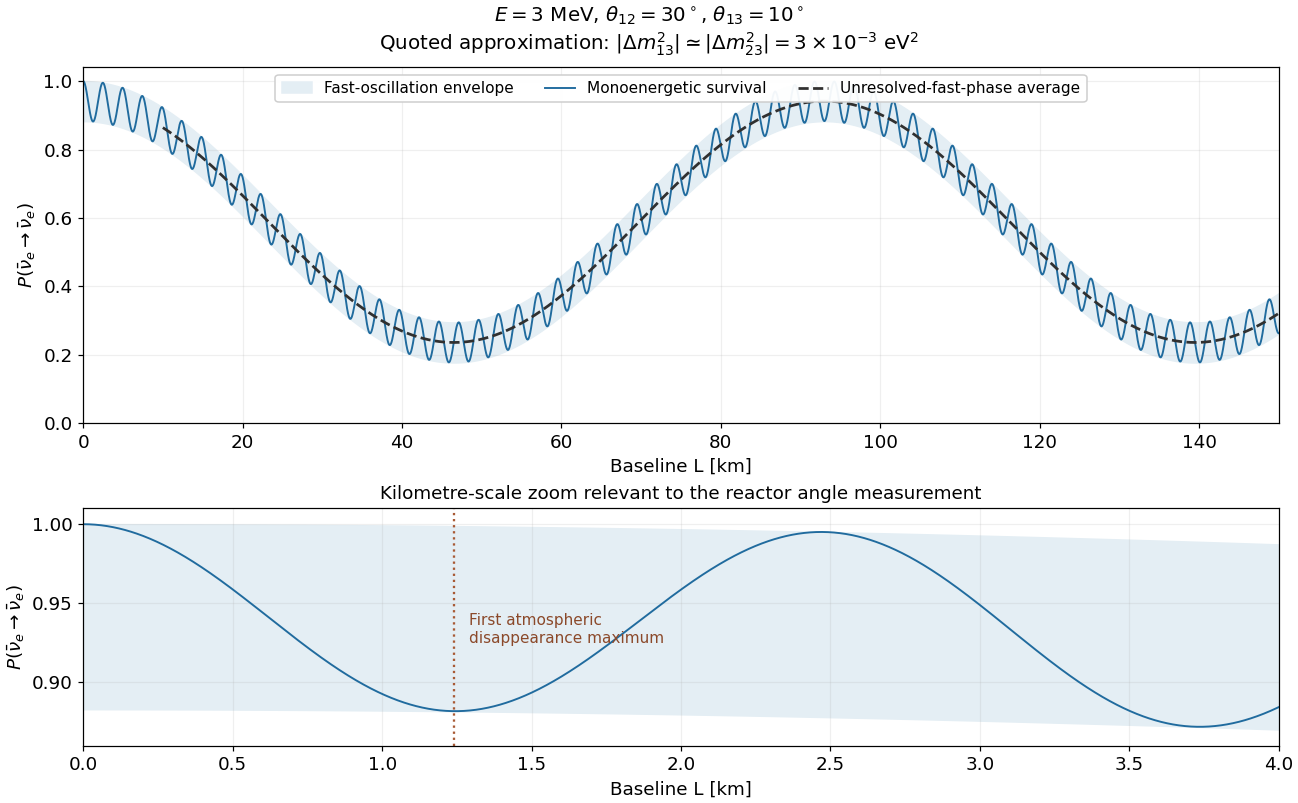

Place a far detector near the first atmospheric disappearance maximum, approximately for the source's monochromatic energy and splitting, and a nearly identical near detector a few hundred metres from the reactor complex. Their flux-corrected comparison largely cancels reactor power, emitted-spectrum and absolute-efficiency uncertainties. For a broad reactor spectrum one fits energy-dependent disappearance instead of treating that single baseline as a universal exact optimum.
Detect in a hydrogen-rich target, for example liquid scintillator with neutron-capture enhancement. The prompt Positron signal estimates neutrino energy; the delayed neutron-capture signal supplies a time-and-position coincidence that strongly reduces random backgrounds. Use sufficient target mass and exposure, low radioactivity, overburden and a muon veto to reduce cosmogenic backgrounds, calibrated relative energy response and efficiency, and monitored reactor powers and baselines. Account for multiple reactor cores, spent-fuel backgrounds and accidental coincidences. At kilometre baselines the slow solar phase is small, so the disappearance depth directly probes with little sensitivity to the CP phase or mass ordering.
Articles by others on the same topic
There are currently no matching articles.