Calorimeter calibration establishes the response of the actual measurement assembly to a known energy input. It determines a participating heat capacity, not just the empty vessel's mass. For an electrical calibration with an immersed resistor, measure voltage across that resistor and electric current through it. If that electrical work is deposited inside the chosen boundary, its input isFor a covered receiver at constant pressure, describes enthalpy storage; for a rigid fixed-volume assembly, use the matching heat capacity at constant volume. Negligible endpoint mechanical storage and no escaping material are assumed. Thus overestimates if outward loss is ignored. Account for lead losses outside the boundary and maintain the same water charge and immersed hardware in calibration and sample runs.
An alternative calibration mixes known hot and cold water portions. With the vessel initially at the cold portion's temperature , the mixing calorimetry balance givesThe previous synthetic water example returns . The sign matters: attributing room losses to the vessel makes this estimate too large. With both and the loss unknown, one final temperature supplies only one equation; separate cooling information or controlled independent runs are needed.
A calorimeter heat-loss correction can make the electrical balance quantitative. For a second synthetic example, stipulate of water with and immersed hardware with , so . Supply for , starting at a room temperature of , with loss coefficient . The model below gives , storage and outward loss . The uncorrected ratio gives about ; subtracting the loss recovers .
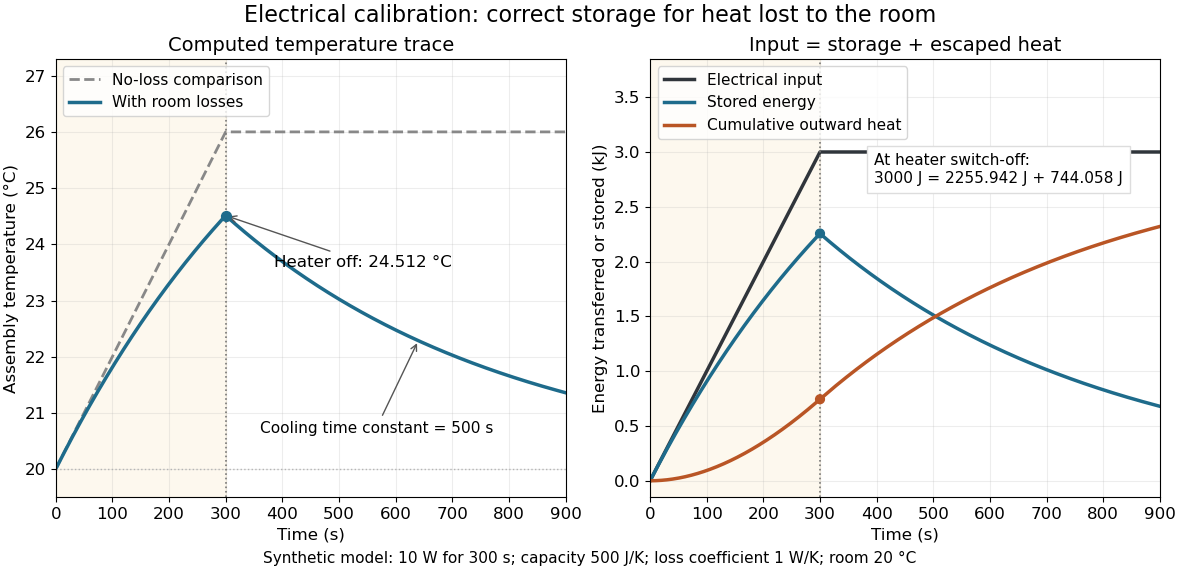
Electrical input splits into thermal storage and room losses during calibration
. Original synthetic computed traces for the stated constant-heat capacity, constant-loss model. The heater switches off at ; stored energy then declines while cumulative outward heat increases. The no-loss comparison reaches . No points represent experimental measurements. Details.
Articles by others on the same topic
There are currently no matching articles.