A leading valence-level process is , with the up quark supplied by the proton and the down antiquark by the antiproton. The same Feynman diagram works with replaced by . Both vertices are weak charged current vertices; the production scattering amplitude contains the CKM matrix element or its conjugate according to the chosen fermion-flow convention. The intermediate W boson is produced near its mass shell.
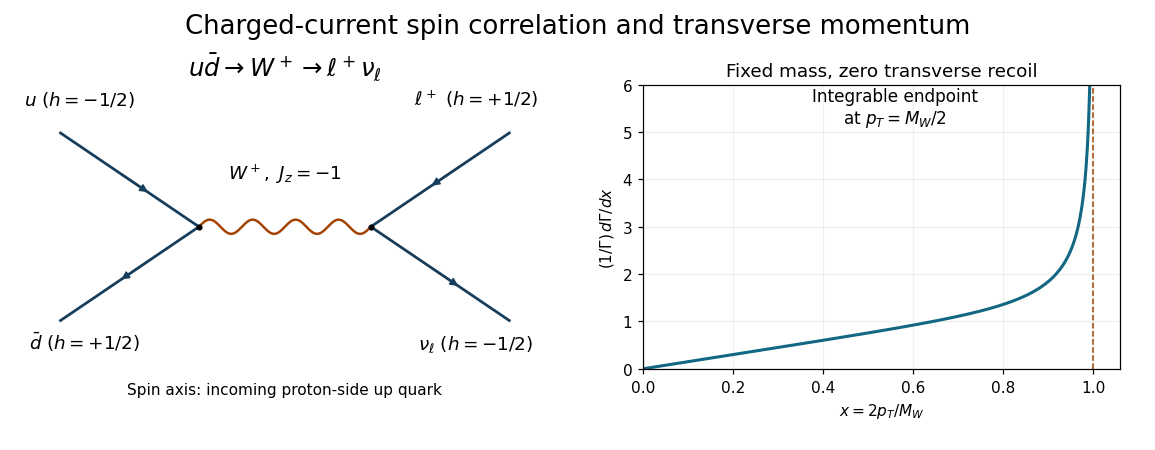
Original charged-current production diagram and the normalized ideal charged-lepton transverse-momentum density. The angular axis is measured from the proton-side incoming up quark.
Details. 
Neglect the participating quark and lepton masses, so that the weak charged current selects a left-helicity and a right-helicity . Choose along the proton beam in the partonic centre-of-momentum frame. Then the up quark moves along with spin projection , while the down antiquark moves along with helicity and also has spin projection along . ThusThe collinear two-body initial state has no orbital projection about its collision axis. In this approximation the produced W boson therefore has the indicated transverse polarization; its longitudinal spin state is absent. The unpolarized hadron beams contain other constituent spin states, but these do not participate in this massless charged-current subprocess.
In the final state the Positron has helicity and the electron neutrino has helicity . Along the outgoing charged-lepton direction their combined angular-momentum projection is , because the oppositely moving neutrino has spin projection on that axis. Finite masses, noncollinear production and sea contributions modify the ideal configuration.
Let be the angle from the incoming up quark, along the proton direction, to the outgoing charged antilepton in the W boson rest frame. The initial and final spin projections in ii are and . The Wigner small-d matrix therefore givesAfter squaring and normalizing over , the charged-lepton angular distribution isIts integral is one since . The charged antilepton is preferentially emitted toward the antiproton. Measuring the angle from the incoming down antiquark instead replaces by and produces ; the axis convention is part of the answer. Per unit solid angle the normalized density is .
Take an on-shell W boson of fixed mass , zero transverse recoil, negligible charged-lepton mass, and unrestricted angular acceptance. In its rest frame the charged lepton has momentum magnitude . A longitudinal Lorentz boost to the laboratory preserves transverse momentum, soBoth angular roots contribute to the same . Set and . The change-of-variable Jacobian determinant has , and the two-root angular weight is . ConsequentlyThis is the ideal W-decay Jacobian peak. The divergence at the endpoint is integrable; it is a change-of-variable effect, not an infinite decay probability. Reversing the polar axis does not change this transverse momentum density, because the sum of the two roots removes the term odd in .
Initial-state radiation of gluons gives the W boson nonzero transverse momentum. Its transverse Lorentz boost then changes the charged-lepton , washing out the sharp edge and permitting events above it. The recoil must be modelled with Quantum chromodynamics and constrained by measured hadronic activity. Independently, the finite W boson decay width spreads its actual invariant mass, also smearing the fixed-mass endpoint. Either is a theoretical broadening mechanism; neither is a detector-resolution effect.
The useful modes are and their charge conjugates. An electron gives an isolated track and localized electromagnetic shower; a muon gives an isolated penetrating track. Both allow a well-calibrated charged-lepton transverse momentum and a missing transverse momentum measurement for the neutrino.
The tau lepton decays before detection, usually adding further neutrinos. Its visible momentum is only part of the original tau momentum, so the simple two-body endpoint is lost. For the direct electron and muon modes, the transverse massalso has an ideal endpoint at and avoids needing the unmeasured neutrino longitudinal momentum. Fits to this distribution or the charged-lepton spectrum determine .
Choose . Important backgrounds include Quantum chromodynamics production of heavy-flavour hadrons with semileptonic decays, in-flight pion or kaon decays, and hadrons penetrating the calorimeters. These generally have accompanying jet activity; semileptonic decays can contain real neutrinos, while jet mismeasurement can fake missing transverse momentum. Heavy-flavour tracks can originate at a displaced decay vertex. Require a high- isolated muon, agreement between inner tracking and the external muon system, and substantial missing transverse momentum inconsistent with detector noise or a mismeasured jet.
The genuine electroweak backgrounds include with one muon lost and . Veto a second reconstructed opposite-sign muon and use the dimuon invariant mass when both are present to reject the Z boson channel. The tau-mediated spectrum is softer and contains extra missing particles; template fits and control samples estimate its residual contribution. Detector acceptance determines how much of the lost-muon background survives.
For the selected muon channel, finite curvature resolution in the magnetic tracking system broadens the reconstructed transverse momentum spectrum. A high- track has small sagitta, so spatial measurement errors, alignment errors and magnetic-field calibration errors become important; at high momentum an approximately fixed uncertainty in gives . Multiple Coulomb scattering contributes at lower momenta. If the transverse mass is fitted, finite hadronic-recoil resolution additionally smears the inferred missing transverse momentum. These are experimental effects, distinct from the physical recoil and width in ii.
Articles by others on the same topic
There are currently no matching articles.