Here is the gravitational constant, is the separation of the orbiting object from the central body's centre, and is the magnitude of the object's conserved orbital angular momentum, not angular momentum per unit mass. Approximate the much heavier central body as fixed, neglect other forces, and use the Newtonian gravitational potential energy , with zero at infinity.
A central force confines the motion to a fixed orbital plane. In plane polar coordinates its kinetic energy is . Conservation of angular momentum gives ; eliminating yieldsThe centrifugal term belongs to the radial effective potential; it is the eliminated transverse kinetic energy, not an additional physical interaction. If recoil of the central body mattered, the relative-coordinate reduction would use the reduced mass.
Write and let be the original circular orbital speed. An impulse leaves the orbital angular momentum unchanged if it is radial: its angular impulse is zero. The tangential velocity remains , and an added radial component givesThus kinetic energy increases even though angular momentum does not. For a Radial kick from a circular Kepler orbit, the new specific orbital energy and squared specific angular momentum areThe orbital eccentricity is , while the semi-latus rectum is . HenceFor the trajectory is a parabolic Kepler orbit and has no finite furthest radius; its periapsis is . For it is a hyperbolic orbit, with the same formula for but unbounded radius:One must not use the negative denominator in the bound-orbit expression as a negative physical apocentre. On a departing unbound branch the conic's periapsis may already lie in the past; the future minimum from the kick event is then . These are ideal conic orbits; a periapsis inside a real planet would cause impact before the ideal continuation.
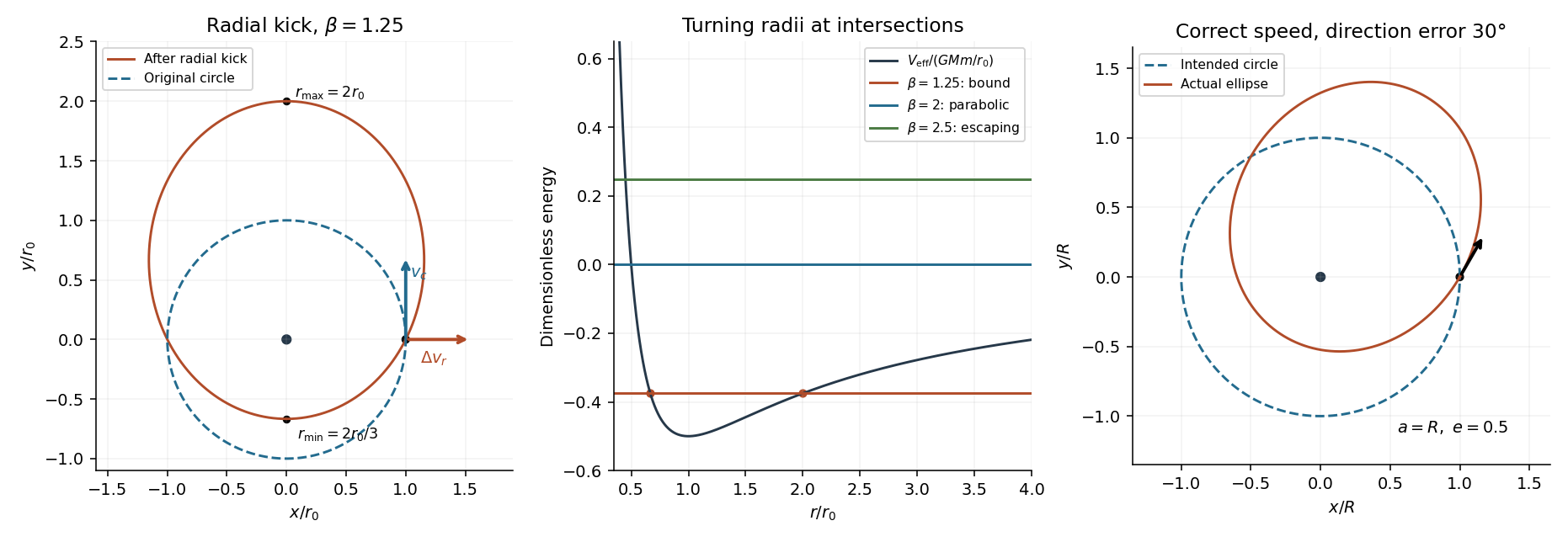

For a fixed-speed orbital launch-direction error, the initial radius and speed are correct, so the specific orbital energy is still and the new semi-major axis is still . Resolve the launch velocity into radial and tangential components, taking as the in-plane deviation from the intended tangent:For a nondegenerate orbit , the orbital eccentricity follows from :The intended circular orbit has radius everywhere, so the largest radial distance between the orbit curves occurs at either apsis:This is the geometric separation of the two orbit curves, not the distance between two satellites compared at equal elapsed times. The latter also depends on orbital phase. A purely radial launch is a degenerate zero-angular-momentum trajectory through the central body and requires separate treatment of the collision.
Articles by others on the same topic
There are currently no matching articles.