For the eccentric circular-hole disk inertia, let be the mass of the complete disc before removing material, the missing mass, and the wheel's remaining mass. Denote the complete disc's centre by C and the axle/hole centre by H; . Assume the hole fits inside the disc, . The parallel axis theorem gives the full disc's moment of inertia about H as . Subtract the absent little disc about its own centre H:The axle is a support, not part of the rotating wheel's stated mass. Its frictionless bearing does not alter this moment of inertia. For fixed-axis angular velocity ,The missing material must be subtracted with its actual displacement relative to the axis; treating the wheel as a concentric annulus would give the wrong result.
For a freely rolling rigid body, decompose the kinetic energy into translation of its centre of mass G and rotation about G. The centre of mass after removing material lies on the side opposite H:Another use of the parallel axis theorem givesThus at the same angular speed,This compares the rotational component, not the total rolling kinetic energy. The total also contains and need not be smaller than . Describing all rolling motion as instantaneous rotation about its contact point includes that translational contribution; it is not the rotational component intended by this comparison.
The supplied PDF labels this equation clarified from original for tutorial purposes. Use the model of an eccentric wheel with missing-mass kinetic energy neglected: neglect the missing disc's contribution to kinetic energy, while retaining its subtraction from gravitational potential energy. Do not silently replace the gravitational mass by the full-disc mass as well.
Choose as the clockwise angle of from the upward vertical, and set . The rolling without slipping constraint makes changes in equal changes in the distance C travels down the slope. Choose its additive origin so when the hole is vertically above C. Then, up to an irrelevant height constant,The approximate kinetic energy is that of the complete uniform disc rolling at :Subtracting the missing disc's gravitational potential energy givesApply the Euler-Lagrange equation to :ThereforeHere have dimensions of acceleration and has dimensions of inverse length. The initial conditions are under the vertical-above interpretation. If an initial orientation is instead specified relative to the slope normal, the same coordinate convention produces a different initial , not different constants. With the equation becomes , the familiar solid-disc result. Retaining the hole's exact kinetic energy would introduce coordinate-dependent inertia and extra terms; the printed neglect is what permits the requested constant-coefficient form.
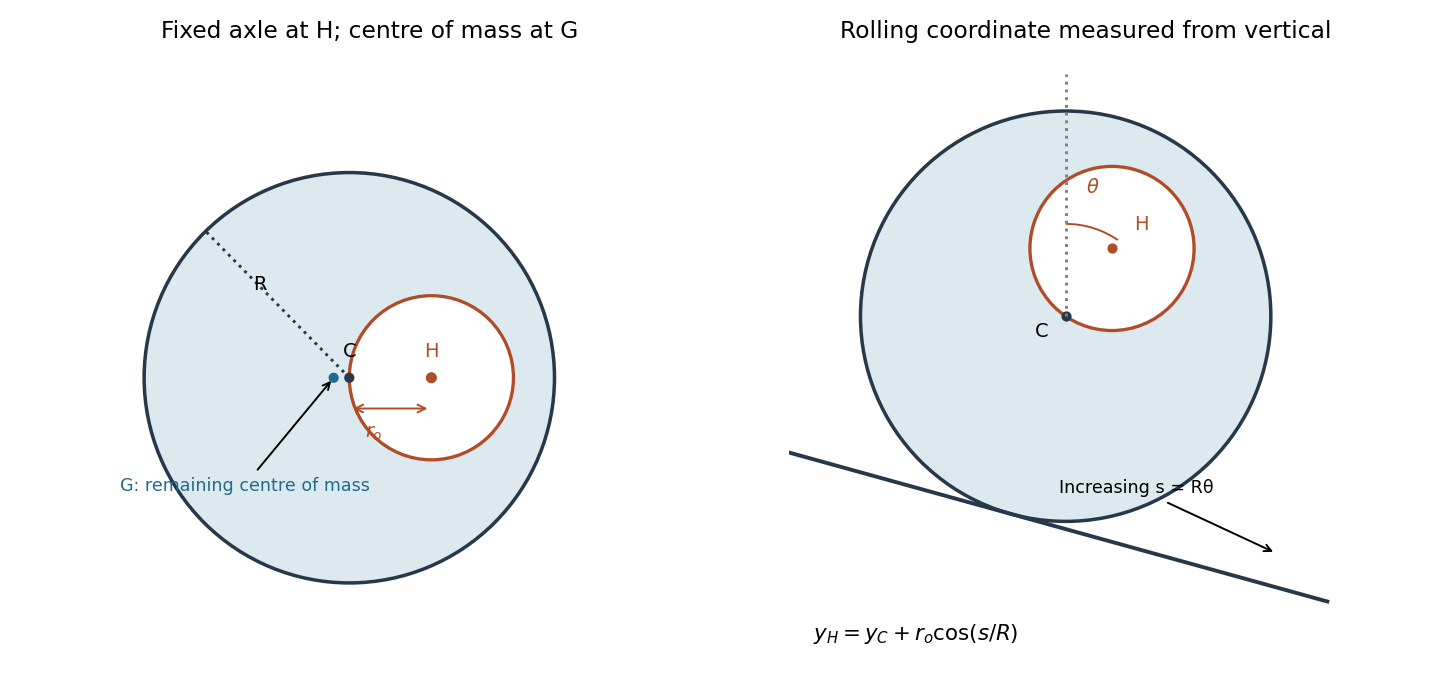
The axle, geometric centre and centre of mass of the perforated wheel
. Original geometric constructions. Left: fixed-axis inertia subtracts a missing disc about H. Right: the rolling coordinate is the hole angle from the upward vertical; the centre travels downhill by R times the angle, while the missing mass contributes a cosine to potential energy. Details.
Articles by others on the same topic
There are currently no matching articles.