Let be the equilibrium, so . For , the Taylor expansion of the potential givesAn ordinary small-amplitude simple harmonic motion therefore requires a nondegenerate local minimum, , with the quadratic term dominating the higher terms over the excursion. ThenA local minimum with , such as a quartic minimum, need not give small-amplitude harmonic motion with a nonzero limiting angular frequency. If , the equilibrium is unstable rather than oscillatory.
A central force confines nonradial motion to a plane. In plane polar coordinates, the Lagrangian for isThe azimuth is a cyclic coordinate, so is conserved angular momentum. The Lagrangian has no explicit time dependence, giving conserved energyAt fixed , the radial equation of motion is . The effective potential packages the transverse kinetic energy as a centrifugal term alongside the actual potential energy. It gives a one-dimensional radial problem without introducing an extra physical interaction.
A circular orbit of radius is a stationary point of the effective potential:For , and , this givesThe condition makes the radial force attractive. At , the equation instead requires the fine tuning ; then the centrifugal and potential terms cancel at every radius and there is no isolated restoring minimum. If that equality fails, there is no positive-radius circular orbit for this special power.
Write and keep fixed. The small radial oscillations in a power-law potential have squared angular frequencyThe circular orbital angular frequency has magnitude , so . HenceA restoring radial oscillation exists for , subject to the attractive-force condition in part (b). For the radial stationary point is unstable; is the degenerate boundary. This agrees with circular-orbit stability for a power-law central force, since the actual force is proportional to .
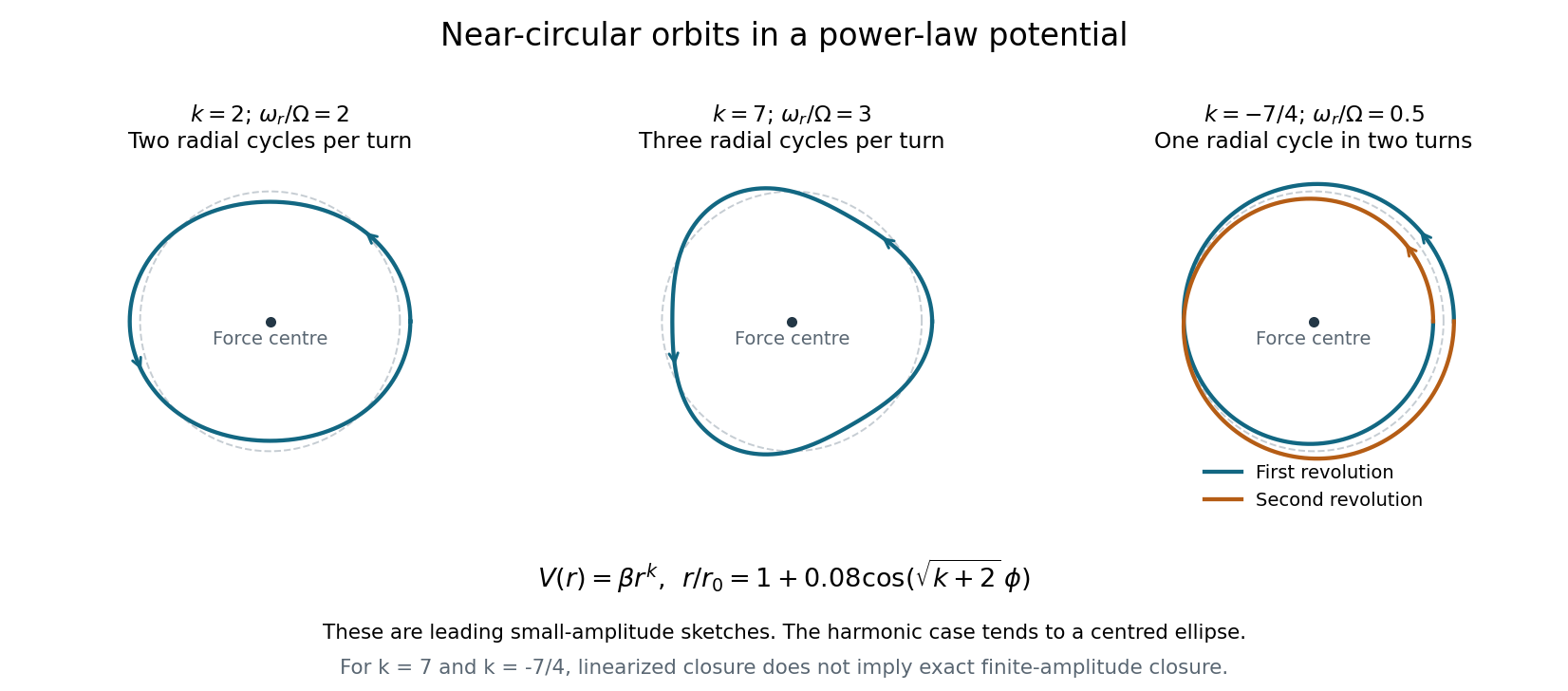
The two positive powers below require ; the negative power requires , so that the force is attractive. To leading order, . The azimuthal advance from one radial maximum to the next isFor , : there are two radial oscillations per revolution. The isotropic harmonic oscillator has orbits that are exact ellipses centred on the force centre, and the perturbed circle is such an ellipse.
For , : the leading perturbation has three radial lobes per revolution, with consecutive radial maxima separated by . Its small-amplitude sketch is a rounded three-lobed orbit.
For , : the radius completes one oscillation while the body makes two revolutions. The leading curve closes after , with a double-wound, generally self-crossing shape; the nearest and furthest points occur in the same spatial direction one revolution apart.
The rational ratios for and describe closure of the linearized near-circular curves. They do not imply that every finite-amplitude orbit closes exactly: higher-order changes in the radial-to-orbital frequency ratio generally produce apsidal precession. Bertrand's theorem identifies the harmonic potential and the Kepler potential as the exceptional attractive central potentials with all nearby bounded orbits closed.

Articles by others on the same topic
There are currently no matching articles.