Faraday's law of induction states that the induced electromotive force around a material electrical circuit equals the negative rate of change of its linked magnetic flux:The surface orientation and direction around its boundary are related by the right-hand rule. Lenz's law supplies the physical meaning of the minus sign: the induced electric current produces a magnetic field opposing the change in linked magnetic flux. For a stationary contour the local form is ; for this moving wire, the magnetic Lorentz force term is also needed in the electromotive force.
Write the wire diameter as to distinguish it from other geometric labels. Its cross-sectional area is , and the total wire length is . From the electrical resistivity, its electrical resistance isWhile the loop straddles the boundary, let be the height of each vertical side remaining in the magnetic field. The linked magnetic flux has magnitude , with . Faraday's law therefore gives . Neglecting the loop's self-inductance, Ohm's law givesThe into-page magnetic flux is decreasing, so Lenz's law requires a clockwise electric current as viewed in the diagram. If the loop is wholly inside a uniform magnetic field, or wholly outside it, its magnetic flux is constant and this induced electromotive force is zero. During a rapid transient one should instead solve ; at the assumed steady speed the same boxed relation holds.
Use for the magnetic Lorentz force on each wire segment. Let point right, upward and out of the page, so . With clockwise electric current, the four magnetic forces areThe upper side carries electric current to the right and experiences an upward force, opposing the fall. The bottom side lies outside the magnetic field and has no magnetic force. On the right side the electric current is downward and the force is outward to the right; on the left it is upward and the force is outward to the left. Each side's in-field vertical length is , so these horizontal forces cancel in the net force on the loop.
The wire's total mass is . Uniform wire gives each side a downward weight . Internal mechanical forces at the corners transmit the unequal loads and maintain the assumed square shape; they cancel for the loop as a whole. The total external vertical force is therefore downward.
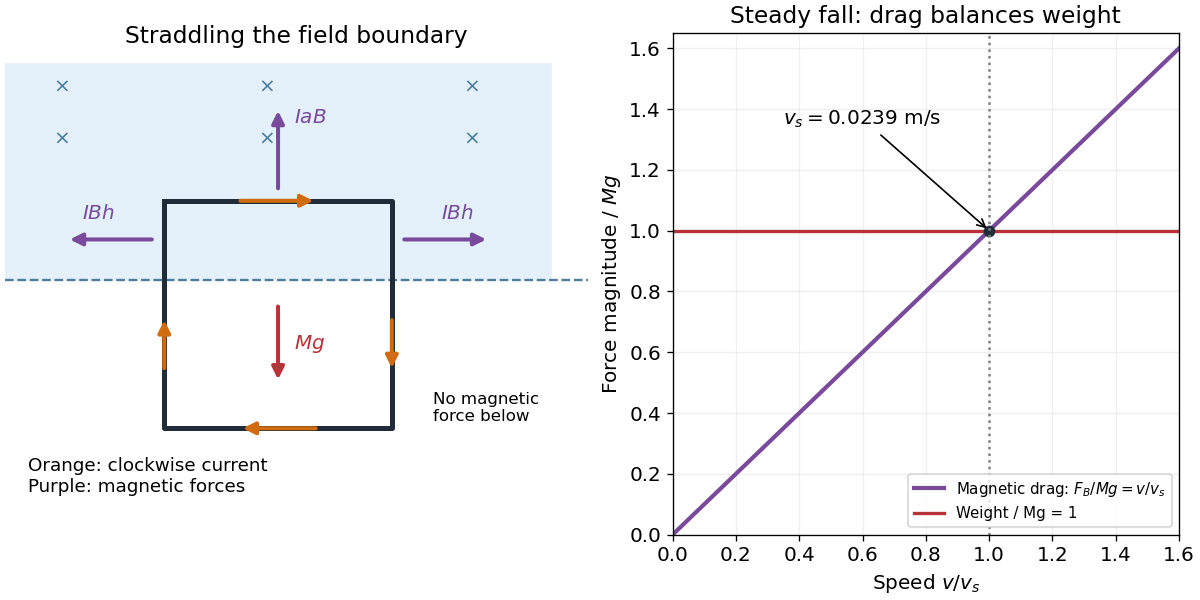

At terminal velocity, the upward magnetic force balances the weight. Substitute the electric current from the preceding solution:The geometric factors cancel, givingHere , , and . As numerical checks, the specified and give , and .
The gravitational power lost, , equals the Joule heating , consistent with energy conservation. This terminal velocity applies only while the top arm remains in the magnetic field; after it exits, the magnetic braking ceases, apart from any brief inductive transient.
Articles by others on the same topic
There are currently no matching articles.