The fixed point charge produces electric potential , where . The external quasistatic work is the increase in Coulomb potential energy:The endpoints have radii and , irrespective of their opposite coordinate signs. One must use a path avoiding the singular point charge at the origin. The electric field is conservative on such paths, so the endpoint calculation suffices; a literal straight path through the origin is inadmissible. The work done by the electric field has the opposite sign.
For the negative test electric charge, use the same change in the fixed point charge's electric potential:The external agent extracts energy, since the final Coulomb potential energy is lower. Again the path must avoid the fixed point charge, and the work done by the electric field is .
The electric dipole moment is . Write for the angle measured from , with pointing toward increasing . The exact electric potential isFor , expand the reciprocals to first order in . Their common terms cancel, giving the electric dipole approximationThe radial electric field follows from , and the tangential electric field from . The omitted terms are of relative order away from zeros of a component. Multiplying by the test electric charge gives the force componentsThe electric field lines emerge from the positive electric charge and terminate on the negative electric charge. They are mirror-symmetric about the electric dipole axis and bow out across its equatorial plane. In the point-electric dipole limit their meridional curves obey , hence .
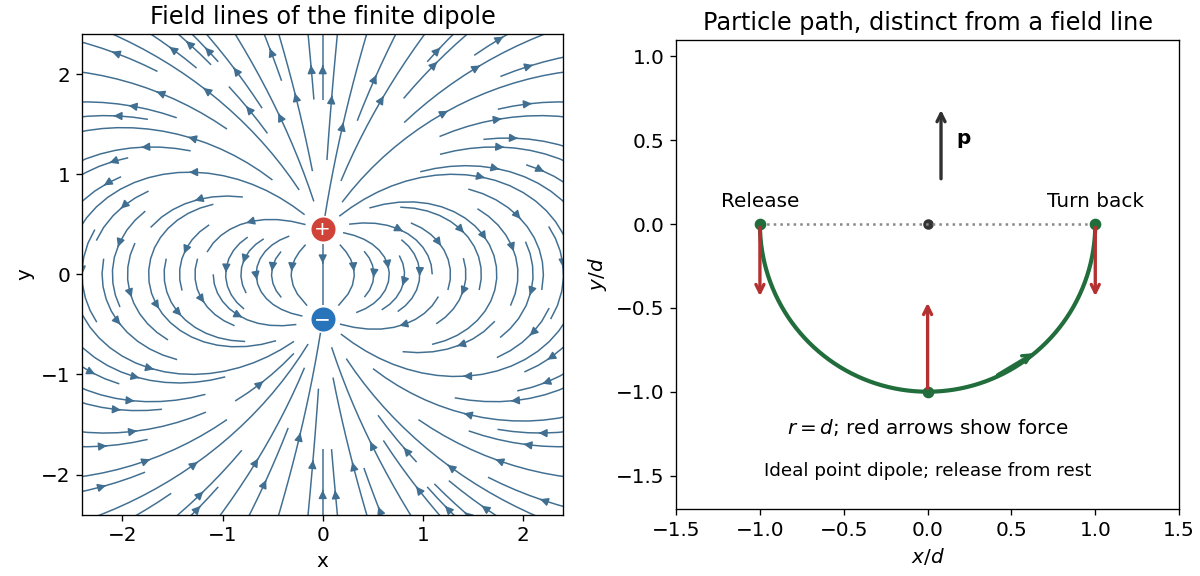

In a Cartesian coordinate system the leading electric dipole field givesThereforeThe force is downwards on the equator and upwards on the negative axial side. A free positive electric charge released from rest at the left-hand point initially accelerates downwards. As it moves into , the force also acquires a positive component. Its path bends toward the right; the force continually changes as its position changes. An initial velocity was not specified, so the following more precise trajectory assumes release from rest and neglects radiation reaction.
There is a useful exact result within the point-electric dipole approximation. Put ; the potential energy is , a homogeneous function of degree . Thus . For a particle of mass , Newton's second law and conservation of energy implyAt release, both kinetic energy and potential energy vanish, so ; also . Consequently throughout the motion. Parametrize the lower semicircle by , . ThenThe electric charge gains speed until the bottom point, where the force is inward and the speed is . It then slows, reaches at rest, and reverses. Thus, under these assumptions,Its trajectory is not an electric field line: the force determines acceleration, rather than velocity direction. For the finite two-charge electric dipole, corrections of order perturb the circular trajectory; an arbitrary nonzero initial velocity also changes it.
Articles by others on the same topic
There are currently no matching articles.