The characteristic impedance of a stretched string is , since its wave speed obeys . Put the endpoint at and use displacement complex amplitudes incident and reflected:At the massless end, the string's transverse force balances the damper's force . Thus , or . This viscous termination of a stretched string hasHalf the incident mean power is reflected when , giving two positive solutions:They are approximately and , in . The smaller coefficient produces no reflected displacement-phase reversal; the larger produces a reversal. Both dissipate the remaining half of the incident power. Choosing the impedance-matched value would instead absorb all of it.
For an object near the front focal plane, the objective's numerical aperture in air isThe Rayleigh criterion for a circular objective gives object-space diffraction-limited resolutionThe factor comes from the first zero of the Airy disk. Using the exact changes the result by less than . A coarser estimate gives ; the chosen criterion must be stated. This estimates the aperture limit, before aberrations and detector sampling.
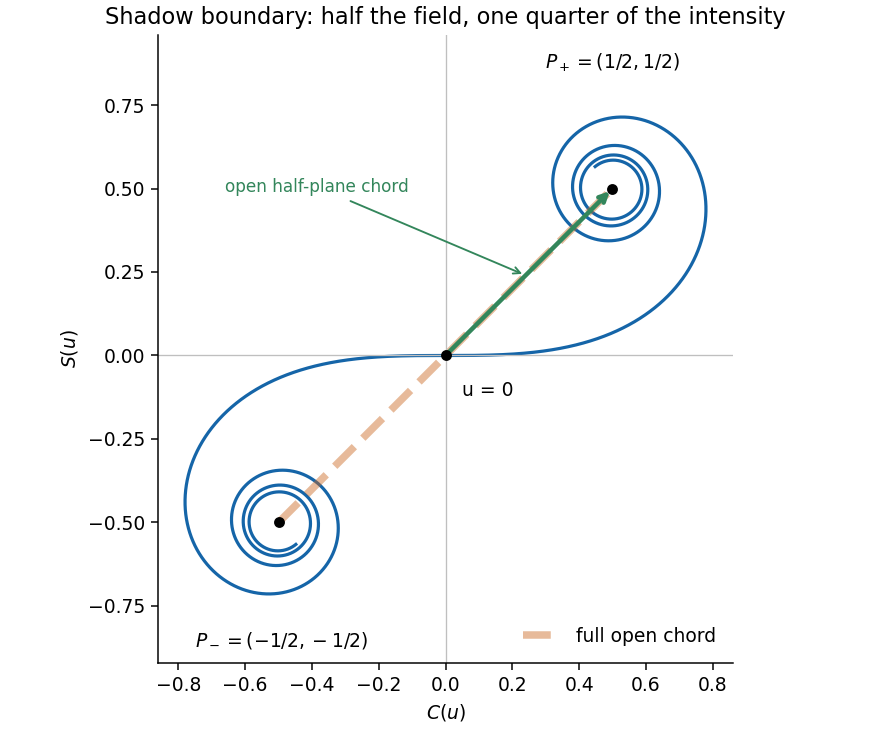
The original diagram puts the upper edge of the obstruction exactly on the straight line from source to detector. The detector is therefore at the geometric shadow boundary, not deep inside the shadow. In the optical convention, the Cornu spiral iswith limiting points and . The unobstructed Fresnel diffraction amplitude is the chord joining both endpoints, proportional to . The open half-plane supplies only the chord from to , proportional to . The coordinate perpendicular to the page contributes the same factor in both cases.This is the half-plane shadow-boundary intensity. The missing half of the aperture removes half the field here, so taking half the intensity would be incorrect.

In a conventional face-centered cubic lattice cell of side , touching nearest-neighbour hard spheres lie along a face diagonal. Four radii span that diagonal, so and . In a conventional body-centered cubic lattice cell, the contact lies on the body diagonal: , giving . ThereforeThese are the nonprimitive cubic unit cells requested. They contain four and two atoms respectively, so their volume ratio should not be confused with the volume-per-atom ratio, which is half as large, . The common sphere radius cancels.
For fixed Electron number , the specified electron degeneracy pressure scales as . Differentiating at fixed low temperature gives the degeneracy-pressure bulk modulus,A monovalent sample has one conduction Electron per atom. Its carrier density isusing the Avogadro constant . Substitution with reduced Planck constant and electron mass givesEquivalently, and for this free electron model. This is the assumed electronic contribution, not a calculation of the complete equation of state of real potassium: ionic cohesion and interaction corrections have been excluded as instructed. The supplied pressure is the zero-temperature form, appropriate to leading order for .
Articles by others on the same topic
There are currently no matching articles.