Use the convention for the harmonic force and displacement complex amplitudes. Substitution in the forced harmonic oscillator equation givesIts magnitude and phase relative to the force areAt zero frequency, and . At , ; at high frequency the phase approaches . For light viscous damping, the quality factor is large and there is a tall narrow displacement peak close to .
To find the displacement peak, minimize the squared denominator:The nonzero minimum givesFor stronger damping there is no positive-frequency displacement maximum. When and ,The inertia then dominates the restoring and damping forces.
The four supporting springs act in parallel, so their total spring constant is . The driving angular frequency is . The force-driven vibration isolation estimate givesAt this mass, , and , so the assumptions are consistent. The exact forced amplitude isIt is indeed close to , but it is slightly above the strict requested bound. Setting the exact expression to gives the high-mass thresholdChoose a mass strictly greater than this threshold for a strict inequality; is a suitable rounded choice. Simply rounding the high-frequency estimate down would not guarantee the bound.
Measure downward displacement relative to the former mean equilibrium. The added changes the equilibrium byAssume the load is deposited without a significant impact impulse and then moves with the table. The moving mass becomes . Ignoring the tiny pre-existing vibration in the sketch, the added-load step response of a supported table isFor the estimated mass, , the envelope time is , and the period is about . The table overshoots and rings about the new equilibrium, with the displacement starting continuously at zero and with zero initial slope. A real impact adds an initial-velocity transient; the problem gives no impact history. The residual driven vibration, of order a micrometre, can be superposed.
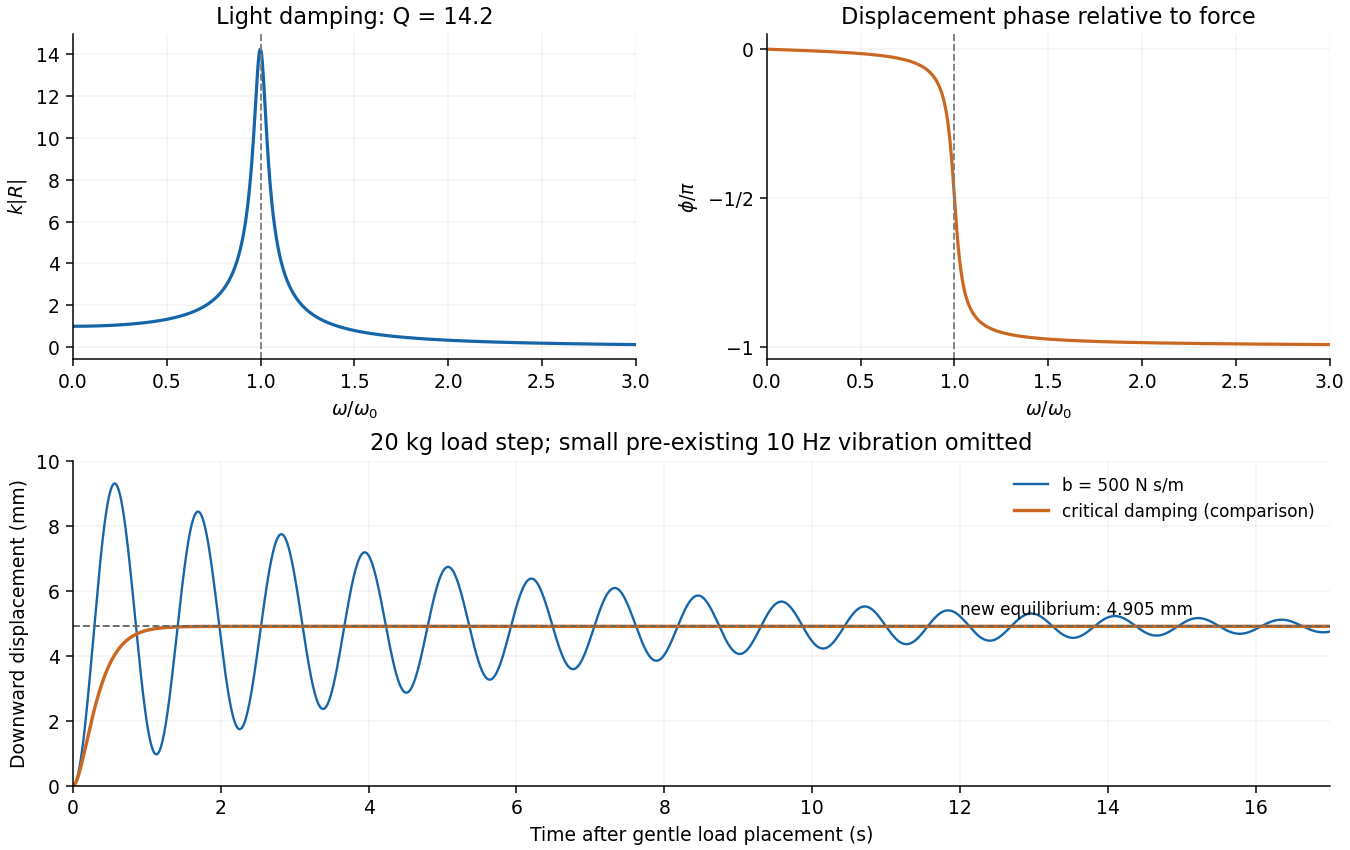
Lightly damped response amplitude and phase, followed by the table's load-step displacement and a critically damped comparison
. Details. 
To settle quickly after loading, critical damping is preferable to the supplied weak damper:Using the strict-bound mass instead changes this by less than . This eliminates free ringing while avoiding the slow tail of severe overdamping. In the stipulated external-force model, greater damping also reduces the steady forced amplitude; there is no finite optimum based solely on that amplitude. A critical or near-critical value is a practical compromise for rapid settling. If the disturbance were specified as floor displacement transmitted through the legs, damping would introduce an additional transmission tradeoff, but that is a different forcing model.
Articles by others on the same topic
There are currently no matching articles.