Write , with the Pauli matrices. Direct multiplication gives , and henceFor the products in the other order,Their difference gives the angular momentum commutation relationsThe first identity corresponds to the spin one-half value with .
In the eigenbasis, let a candidate eigenvector be . The eigenvalue equation is and , so a nonzero vector requires . Choosing normalized phases givesThe two spin eigenstates are orthogonal, as required for distinct eigenvalues of a self-adjoint operator.
Put , including its sign. The initial vector is the eigenstate of ; it is not an energy eigenstate of . In terms of the spin eigenstates found above, . Each energy eigenstate acquires its own unitary time evolution phase:Equivalently, follows from . The Born rule givesThe expectation value of the spin angular momentum is , a rotation around the axis. Its direction follows the specified sign of the Hamiltonian; changing the magnetic coupling sign reverses the precession.
A Stern-Gerlach experiment uses an oven and slits to produce a collimated atomic beam, conventionally of neutral silver atoms, and sends it through an inhomogeneous magnetic field onto a position-sensitive detector. The unpaired outer electron supplies the effective spin one-half magnetic dipole moment; neutral atoms avoid the ordinary Lorentz deflection of a charged beam. For an analysing direction , the spatial gradient produces a force approximately . The resulting separated beam positions measure the allowed projections of angular momentum. A spin one-half beam gives two branches, rather than the continuous distribution expected from classical dipoles with arbitrary orientations. A uniform magnetic field can rotate a spin but does not itself provide this spatial separation.
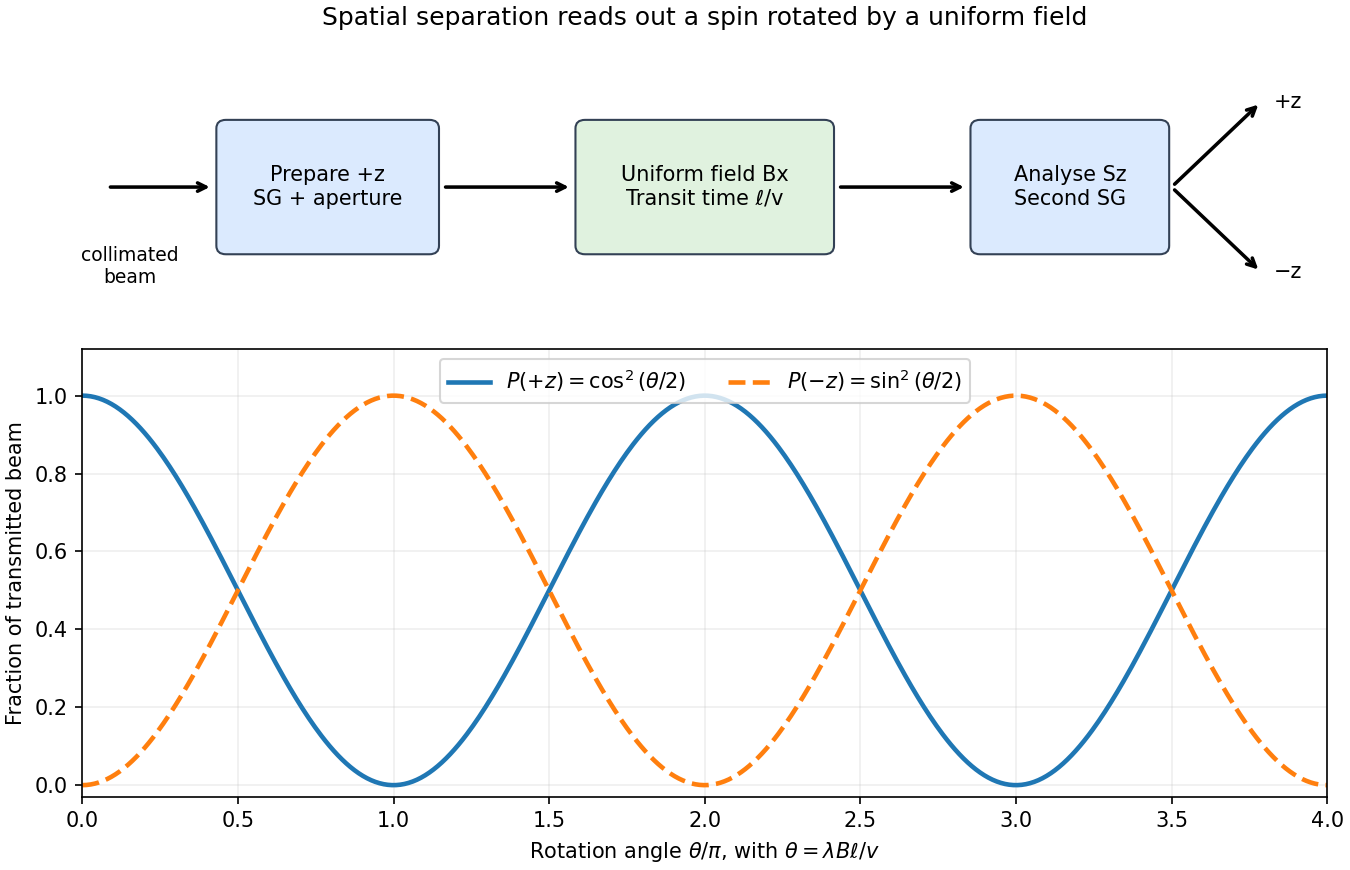
To measure the rotation, first use a -directed Stern-Gerlach experiment and an aperture to transmit only the branch. Pass this prepared spin eigenstate through a region of approximately uniform field in the direction, then use a second analyser to separate and count the two populations. For a field region of length and beam speed , the precession angle is , and the predicted fractions areVarying or the transit time gives complementary oscillations, demonstrating coherent Larmor precession. Velocity selection and a sufficiently uniform rotation field keep different particles from accumulating different phases and washing out the contrast. Detection should compare the branch fractions after allowing for losses and analyser efficiency.

Articles by others on the same topic
There are currently no matching articles.