Write , with the Pauli matrices. Direct multiplication gives , and henceFor the products in the other order,Their difference gives the angular momentum commutation relationsThe first identity corresponds to the spin one-half value with .
In the eigenbasis, let a candidate eigenvector be . The eigenvalue equation is and , so a nonzero vector requires . Choosing normalized phases givesThe two spin eigenstates are orthogonal, as required for distinct eigenvalues of a self-adjoint operator.
Put , including its sign. The initial vector is the eigenstate of ; it is not an energy eigenstate of . In terms of the spin eigenstates found above, . Each energy eigenstate acquires its own unitary time evolution phase:Equivalently, follows from . The Born rule givesThe expectation value of the spin angular momentum is , a rotation around the axis. Its direction follows the specified sign of the Hamiltonian; changing the magnetic coupling sign reverses the precession.
A Stern-Gerlach experiment uses an oven and slits to produce a collimated atomic beam, conventionally of neutral silver atoms, and sends it through an inhomogeneous magnetic field onto a position-sensitive detector. The unpaired outer electron supplies the effective spin one-half magnetic dipole moment; neutral atoms avoid the ordinary Lorentz deflection of a charged beam. For an analysing direction , the spatial gradient produces a force approximately . The resulting separated beam positions measure the allowed projections of angular momentum. A spin one-half beam gives two branches, rather than the continuous distribution expected from classical dipoles with arbitrary orientations. A uniform magnetic field can rotate a spin but does not itself provide this spatial separation.
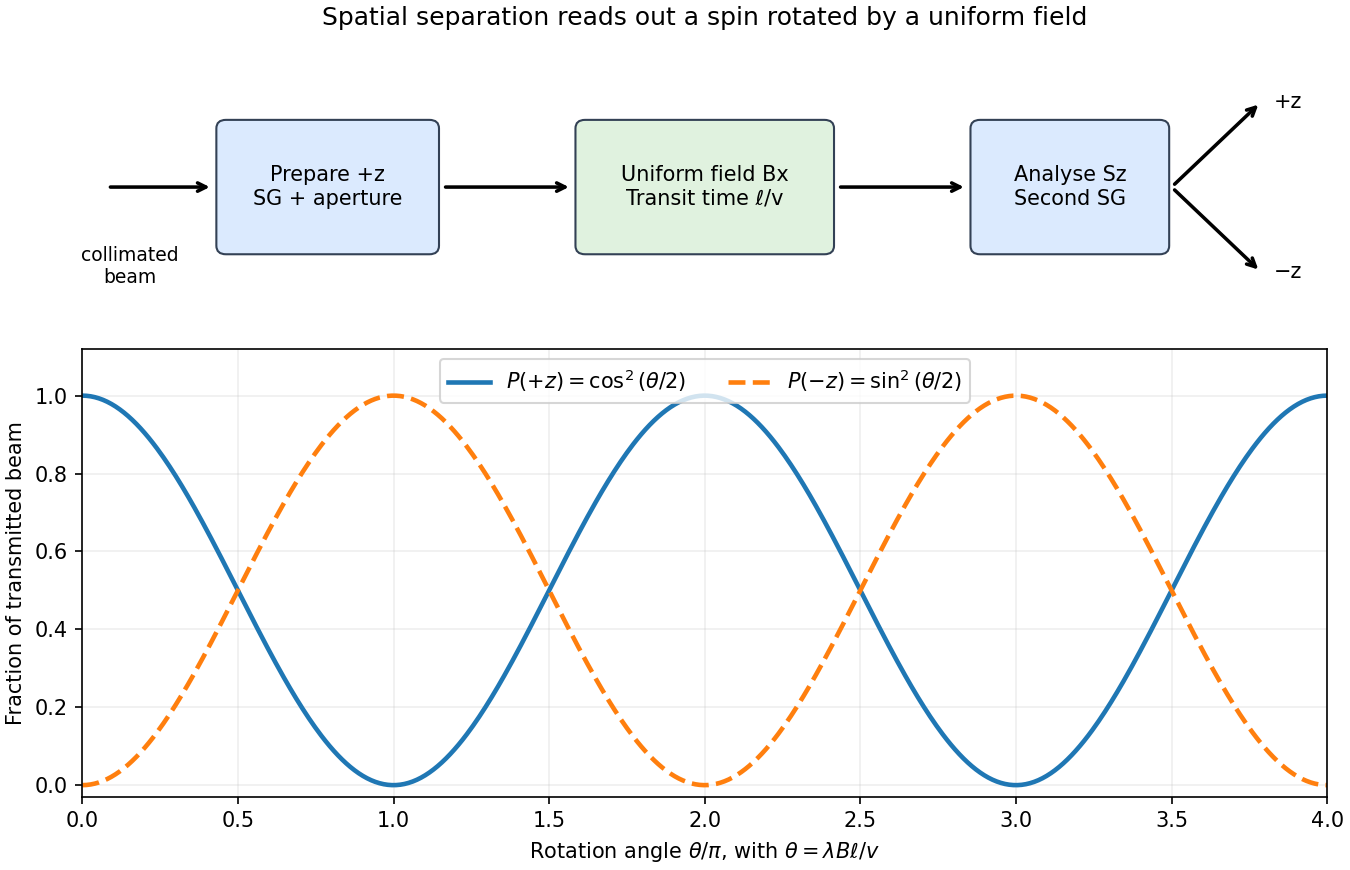
To measure the rotation, first use a -directed Stern-Gerlach experiment and an aperture to transmit only the branch. Pass this prepared spin eigenstate through a region of approximately uniform field in the direction, then use a second analyser to separate and count the two populations. For a field region of length and beam speed , the precession angle is , and the predicted fractions areVarying or the transit time gives complementary oscillations, demonstrating coherent Larmor precession. Velocity selection and a sufficiently uniform rotation field keep different particles from accumulating different phases and washing out the contrast. Detection should compare the branch fractions after allowing for losses and analyser efficiency.

Use the nonrelativistic Coulomb potential energy , with the nucleus treated as fixed. Since the wavefunction has zero orbital angular momentum, its Laplacian isSubstituting into the time-independent Schrödinger equation givesFor a constant energy eigenvalue, the coefficient of must vanish. Therefore , where is the Bohr radius. Wavefunction normalization then requiresChoosing the irrelevant overall phase so that is real and positive gives . The remaining constant term is the hydrogen ground-state energyReplacing by the electron-nucleus reduced mass gives the usual finite-nuclear-mass refinement.
The normalized radial probability density givesConsequently the expectation value of the potential energy isHere the last equality uses . Since this is an energy eigenstate, , and so . The kinetic energy is positive because , in agreement with the virial theorem for a Coulomb potential.
The probability of finding the electron in a spherical shell is , soThis radial probability density, rather than the density per unit volume, determines the most probable radius. Its expectation value isFor its interior maximum, differentiate . The stationary condition givesThe density per unit volume is instead largest at the nucleus; including the spherical-shell volume factor is essential to the requested radial mode.
The nuclear beta decay is fast compared with the electronic orbital timescale. In the sudden approximation, the electronic wavefunction does not have time to change during the increase from to . The subsequent probability of a particular daughter energy eigenstate is therefore its squared overlap with the initial state.
For the final state, write and . The sudden hydrogenic charge change gives the amplitudeThusThe final states have spherical harmonics , whereas the initial state is proportional to . Their angular overlap vanishes by orthogonality. Accordingly in the ideal spherically symmetric sudden-change model. Nuclear recoil or interactions with the emitted particles can produce small corrections. This is an overlap selection rule for a sudden change, not a photon-induced electric dipole transition.
The infinite walls impose , and the interior time-independent Schrödinger equation is with . Its general solution is . The first boundary condition gives , and the second gives . A nonzero normalizable state needs ; would give the zero function.
Wavefunction normalization, , gives the infinite square well states and their energy eigenvalues:The wavefunctions vanish outside the well, and their full time dependence is .
The first two probability densities areBoth vanish at the walls. The ground state has one maximum at and no interior node. The first excited state has a node at and equal maxima at and .
For a finite square well whose exterior potential is , the exterior wavefunction decays as , where and is distance from the relevant edge. Wavefunction matching at a finite potential step makes the wavefunction and, for constant mass, its first derivative continuous. Thus the probability density is nonzero at the edges and has evanescent tails outside, the interior wavelength increases, and the energy levels are lower than for infinite walls at the same positions. Reflection symmetry still gives an even ground state and odd first excited state about the center, when both are bound. A shallow well may not support that excited bound state at all.
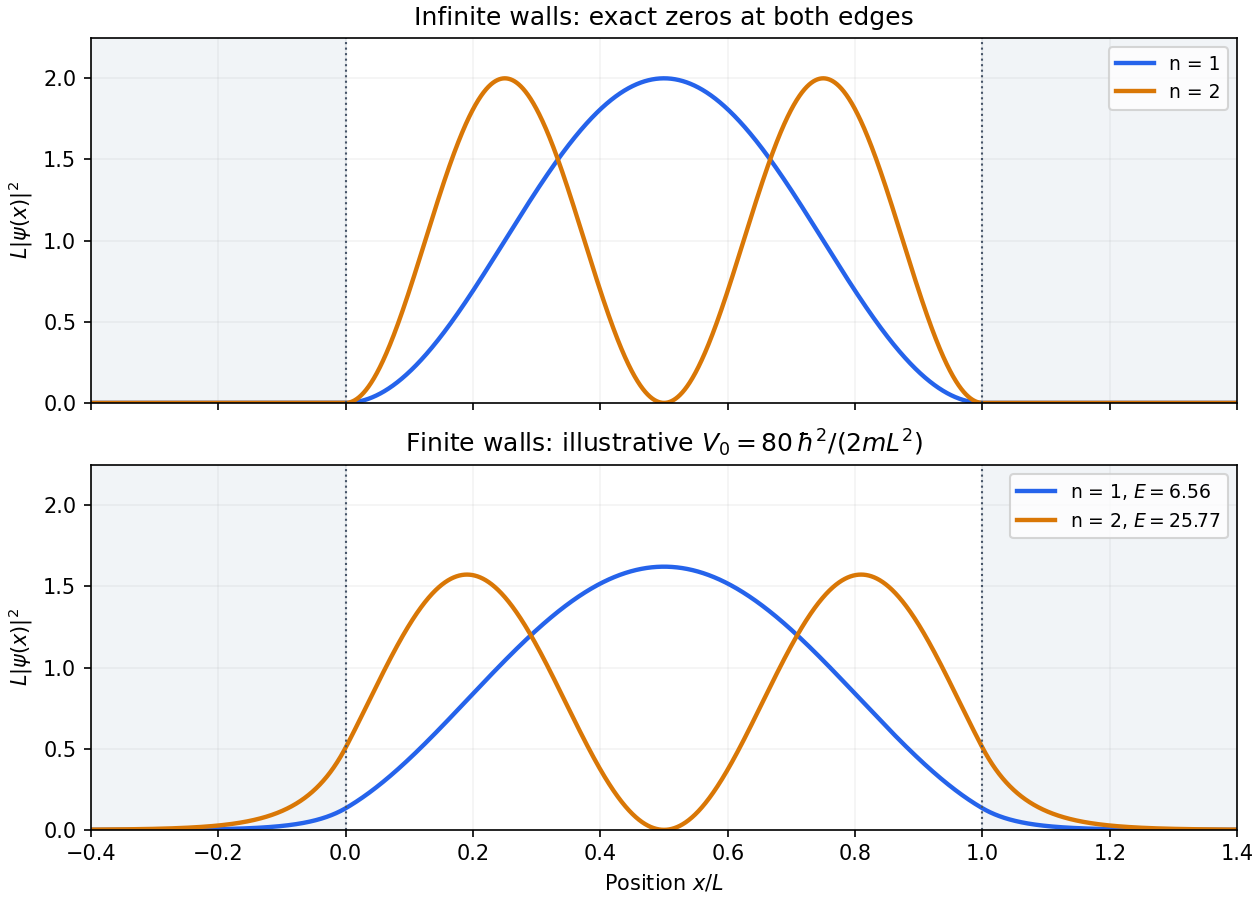
Lowest box-state densities and their evanescent tails for one finite-depth example
. Details. 
Choose the two real energy eigenstates in part (a) and take their coefficients to be in phase initially. A different initial relative phase only shifts the oscillation in time. The normalized quantum superposition isOrthogonality removes the cross terms in the energy expectation value, soFor position, the diagonal matrix elements equal by reflection symmetry, but the off-diagonal element is nonzero. Using the product-to-sum identity and givesTherefore the equal superposition of the first two box states hasThe amplitude is , and the ordinary frequency is . The motion of the mean position is an interference effect between distinct energies, while their populations, and hence the mean energy, remain fixed.
The boundary force in an infinite square well is obtained from the kinetic momentum flux at each wall. With , the derivatives of the state in part (c) areThe outward force magnitudes are . Taking positive force to mean rightwards, the forces exerted by the particle on the walls areBoth point outwards at all times, but their magnitudes oscillate out of phase. This force formula follows directly by differentiating the mean particle momentum and integrating the interior Schrödinger equation by parts: . As a check, the net force on the particle is , the opposite of the net force on the two walls.
A classical particle of energy transfers momentum in each collision with a particular wall, and returns to that wall after . Its mean outward force on that wall isThus the time averages agree separately at each wall, although the classical force consists of collision impulses and the quantum expectation varies continuously. Constant mean energy alone does not make the instantaneous quantum wall forces constant; their unequal instantaneous values supply the oscillation of .
Let and , so and . The canonical commutation relation givesHence . Similarly,Using the product rule for a commutator, , givesThus is the number operator, while and are the annihilation operator and creation operator.
The commutators implyThus any nonzero resulting vector is the adjacent energy eigenstate. Since and , their squared norms areChoosing consistent phases for the eigenstates yieldsThe vanishing last expression terminates the lowering sequence at the ground state, rather than introducing a negative-energy oscillator state.
In the position representation , so becomesIntegrating and using the Gaussian integral for wavefunction normalization givesThe creation operator gives , and thereforeIts norm is one since . Moreover is even and is odd, so the overlap integrand is odd and integrable. Integration over the whole real line gives , establishing orthogonality.
Inverting the definitions of the creation operator and annihilation operator gives . Their actions and the orthogonality of the oscillator energy eigenstates giveThus the electric dipole transition selection rule iswith the lower alternative absent for . The field exchanges one oscillator quantum in first-order dipole coupling. For a long weak monochromatic drive, its frequency must also be resonant with the level separation, here , to give a substantial transition probability. Higher-order multiphoton processes are beyond the stated single-position-matrix element approximation.
Articles by others on the same topic
There are currently no matching articles.