For an outward radial electric field, Gauss's law gives the enclosed chargeTaking the enclosing sphere to infinity gives . A nonzero local field is compatible with zero net charge. Indeed, for ,Positive inner charge is balanced by negative outer charge. There is no point charge at the origin, since . The field's magnitude does not specify its inward/outward sign, but reversing a globally radial direction leaves the zero total unchanged. This is net charge from the asymptotic radial electric field.
In steady state the incoming volumetric flow rate equals the discharge. Bernoulli's principle between a nearly stationary free surface and the atmospheric outlet gives the ideal Torricelli's law speed . The specified discharge coefficient multiplies the opening-flow rate, soThus, with and ,Neglect surface-speed and capillary corrections. The coefficient includes contraction and loss effects; it should not be applied a second time to the calculated height.
Take as the tensile force exerted on the band, so reversible stretching supplies work . At fixed other mechanical variables,Equality of mixed derivatives of the Helmholtz free energy yields the thermoelastic Maxwell relation for a stretched bandFor entropy-dominated rubber elasticity, increasing extension reduces configurational entropy, consistently giving a tensile force that increases with temperature at fixed extension. A force defined as the band's restoring force on its support has the opposite sign.
For a nonabsorbing interface at normal incidence, the Fresnel equations give the intensity reflectanceThe two air–glass interfaces each transmit a fraction of their incident power. Omitting all internally reflected paths,The power-transmission factors, rather than electric-field amplitudes alone, are multiplied. Absorption, coatings and interference are excluded by this approximation.
Use a local horizontal plane, constant gravity and first order in Earth's angular speed. Let point along the initial horizontal shot, to the gunner's left and upward. At the North pole, . Maximum unperturbed range at equal launch and landing heights requires a elevation, givingThe leading Coriolis acceleration is , while vertical motion has no first-order Coriolis correction. With zero initial lateral displacement and velocity,Here , and . The miss is to the right of the aiming direction, independent of its azimuth at the pole. The flight time is about , so . This polar projectile Coriolis deflection uses the usual flat, uniform-gravity approximation; planetary curvature and variation of gravity are beyond its accuracy. Using the polar gravity rather than changes the estimate by less than one percent. Earth's sidereal rotation period, rather than the solar day, sets .[ref]
Earth Fact Sheet by National Aeronautics and Space Administration. Orbital parameters: sidereal rotation period 23.9345 hours; bulk parameters: polar surface acceleration
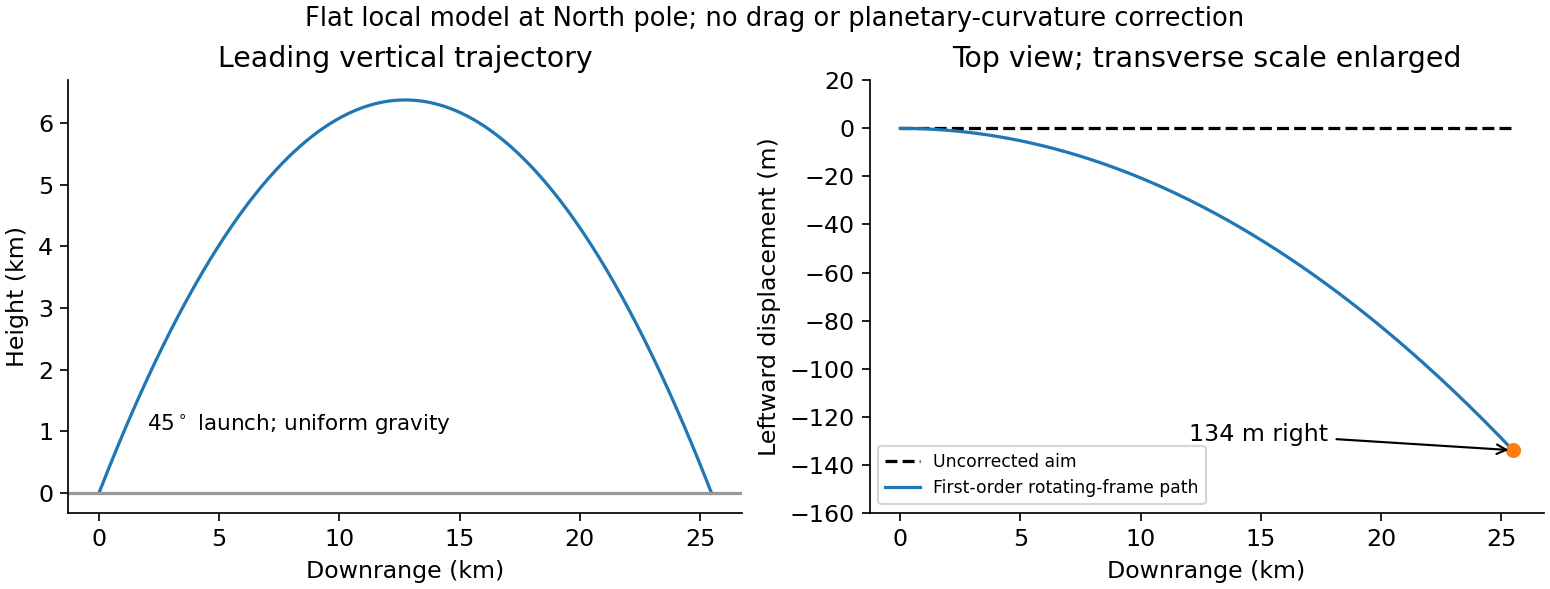
Polar projectile deflection
. Details. 
Articles by others on the same topic
There are currently no matching articles.