For a moving loop, Faraday's law of induction is , where is the local wire velocity, , and the oriented boundary and surface follow the right-hand rule. For a fixed loop the motional term vanishes. Lenz's law is the minus sign: the induced response opposes the change of linked flux, not necessarily the applied field itself.
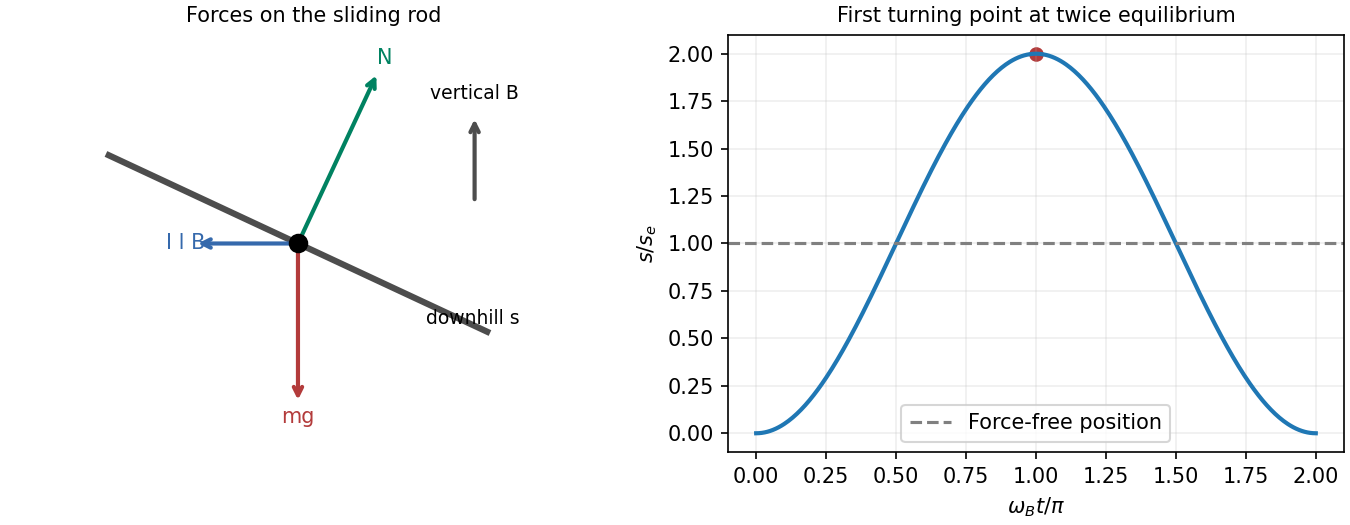
Let increase downhill and choose positive current to produce an uphill magnetic force. The normal component of the imposed field is , so the changing external flux is . With initially zero current and no resistance, conservation of flux linkage gives . The rod feels gravity vertically downward, a rail reaction normal to the slope, and magnetic force of magnitude horizontally uphill. Its downhill component is ; its normal component presses the rod into the rails, giving .
The inductive oscillation of a sliding rod on inclined rails follows fromThe magnetic force is not itself parallel to the rails. Defining and , release from rest givesThe first stop occurs at ; the rod then returns and oscillates between and . At the force is zero but the speed is maximal. Mechanical potential energy is reversibly exchanged with kinetic energy and ; a perfectly conducting circuit provides no damping.
For the resistive long-time drift of an inductive sliding rod, with loop resistance , useJoule heating damps the transient oscillation. On sufficiently long rails the asymptotic motion is steady sliding, not permanent rest:The zero-resistance model has persistent oscillations; its late-time limit cannot be interchanged with taking . These results assume , smooth contacts, negligible rod self-inductance and constant geometry.

Articles by others on the same topic
There are currently no matching articles.