A fictitious force is a term required when writing Newton's second law in an accelerating frame; it comes from the coordinate choice rather than a new interaction. For axes rotating at constant about a fixed inertial origin,Apply this identity twice to position to get . Moving the last two terms to the right of gives the stated Coriolis and centrifugal forces. An accelerating origin or changing rotation rate would add further terms.
A slowly rotating fluid planet follows an equipotential of gravitational plus centrifugal potential. The centrifugal potential is , most negative at the equator. An outward equatorial shift raises gravitational potential and restores the balance, producing an oblate figure. Self-gravity also changes with the shape; no flattening coefficient follows from rotation alone without a density model.
Using local north and radial-up unit vectors, the centrifugal acceleration on a stationary mass isIt points away from the rotation axis: upward and equatorward, at angle to radial up in the northern hemisphere. Its vertical fraction of gravitational force isusing a day for this approximate number. The resultant effective weight tilts equatorward relative to radial down. A plumb-defined local vertical already follows effective gravity; the component calculation uses the spherical radial vertical. A supported stationary mass of course has zero net acceleration.
For the Coriolis deflection of vertical launch and drop, retain only first order in , use effective constant , and neglect horizontal velocities in the Coriolis term as instructed. With east positive, vertical velocity gives and no northward acceleration. For launch, and the flight time is . Integrating with zero initial horizontal velocity givesThe landing is westward. The westward velocity accumulated on ascent is only recovered on descent, so the two displacement contributions do not cancel.
For release from rest at , , , and . ThusThe drop lands eastward with one quarter the launch-return displacement magnitude. North–south corrections from horizontal Coriolis coupling are beyond the retained approximation.
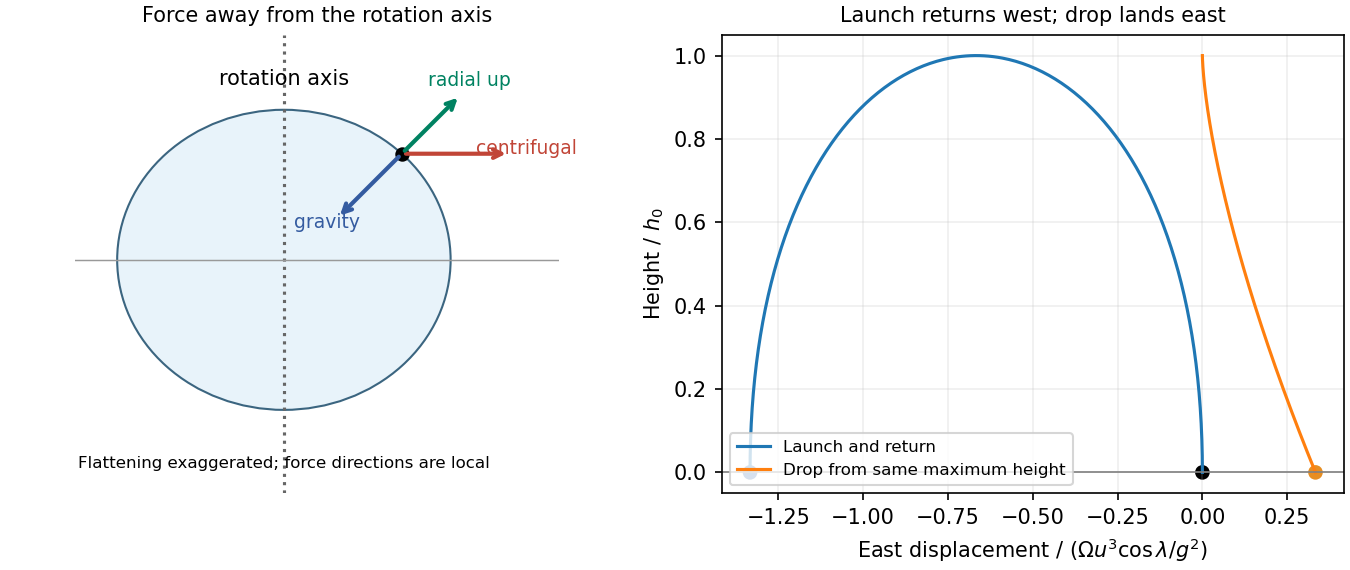
Original centrifugal geometry and opposite east–west deflections for launch-return and drop trajectories
. Details. 
Articles by others on the same topic
There are currently no matching articles.