A fictitious force is a term required when writing Newton's second law in an accelerating frame; it comes from the coordinate choice rather than a new interaction. For axes rotating at constant about a fixed inertial origin,Apply this identity twice to position to get . Moving the last two terms to the right of gives the stated Coriolis and centrifugal forces. An accelerating origin or changing rotation rate would add further terms.
A slowly rotating fluid planet follows an equipotential of gravitational plus centrifugal potential. The centrifugal potential is , most negative at the equator. An outward equatorial shift raises gravitational potential and restores the balance, producing an oblate figure. Self-gravity also changes with the shape; no flattening coefficient follows from rotation alone without a density model.
Using local north and radial-up unit vectors, the centrifugal acceleration on a stationary mass isIt points away from the rotation axis: upward and equatorward, at angle to radial up in the northern hemisphere. Its vertical fraction of gravitational force isusing a day for this approximate number. The resultant effective weight tilts equatorward relative to radial down. A plumb-defined local vertical already follows effective gravity; the component calculation uses the spherical radial vertical. A supported stationary mass of course has zero net acceleration.
For the Coriolis deflection of vertical launch and drop, retain only first order in , use effective constant , and neglect horizontal velocities in the Coriolis term as instructed. With east positive, vertical velocity gives and no northward acceleration. For launch, and the flight time is . Integrating with zero initial horizontal velocity givesThe landing is westward. The westward velocity accumulated on ascent is only recovered on descent, so the two displacement contributions do not cancel.
For release from rest at , , , and . ThusThe drop lands eastward with one quarter the launch-return displacement magnitude. North–south corrections from horizontal Coriolis coupling are beyond the retained approximation.
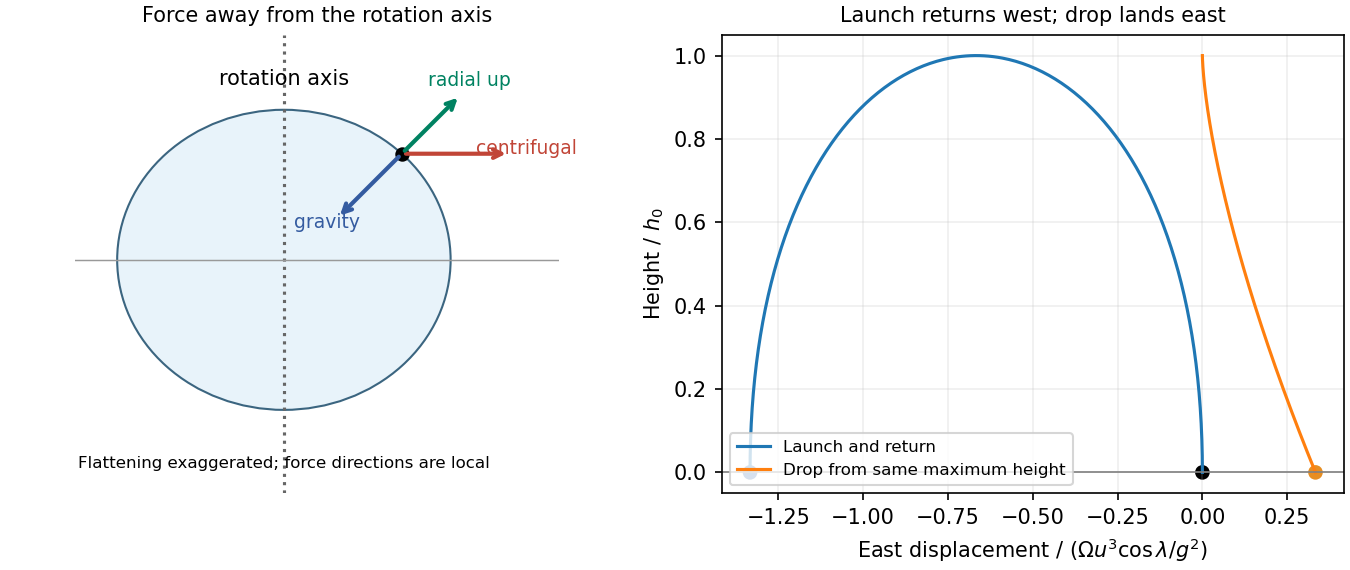
Original centrifugal geometry and opposite east–west deflections for launch-return and drop trajectories
. Details. The shell theorem gives enclosed halo mass . Define . Then . Interior to the uniform halo its potential energy may be writtenOuter shells alter the additive constant, not this interior force. An actually infinite uniform mass distribution has no finite potential referenced to infinity; only local potential differences are needed here.
The central force has zero torque, so is conserved and the motion is planar. With , the effective radial potential and equation areFor circular radius , givesSet at fixed . The derivative of the right-hand side at equilibrium is , soBoth frequencies are positive, but radial and azimuthal motion no longer close with the Kepler ratio. At first order in eccentricity , one may write and . For a weak halo this is a nearly Keplerian ellipse whose apsis rotates at angular rate .
Put and . Expansion yieldsThe precession is retrograde. In cycles per unit time the precession frequency is ; per radial period the apsidal shift is . This weak-halo interpretation avoids confusing a focus-centred Kepler ellipse with the centred ellipse of a purely harmonic potential.
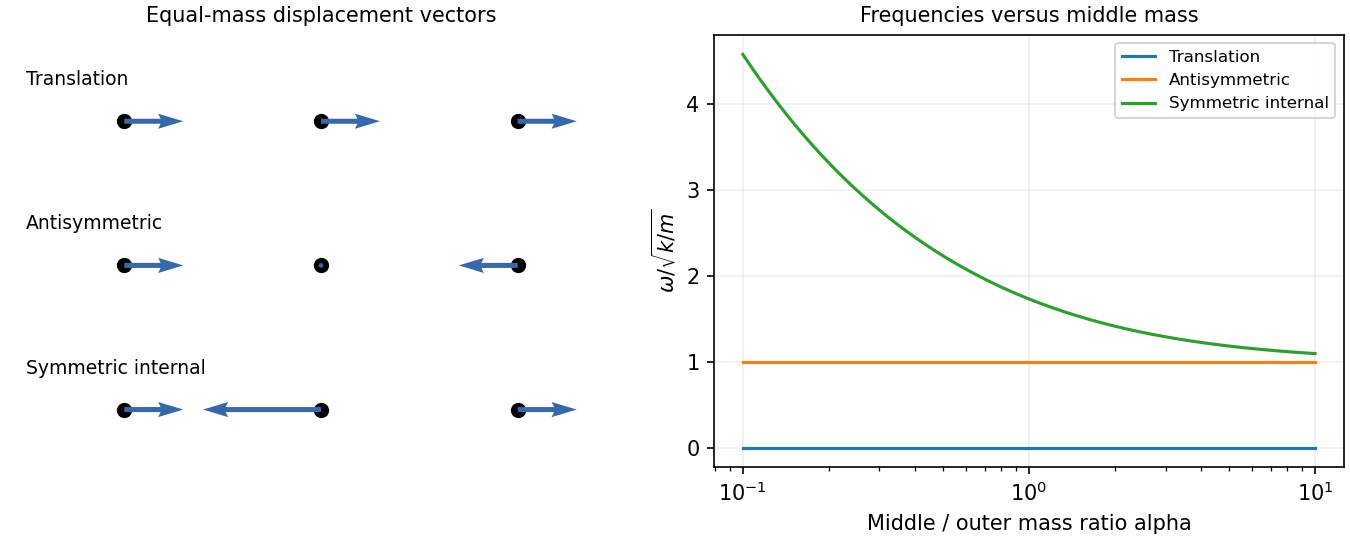
A normal mode is a pattern in which all coordinates share one frequency and fixed relative amplitudes. For a conservative linear system, it solves a generalized eigenvalue equation with stiffness matrix and mass matrix . For this free three-mass spring chain,Solving , for , givesTheir overall normalization is arbitrary; distinct modes are orthogonal in the mass inner product. The zero mode is rigid translation because neither end is fixed. In the antisymmetric mode the middle mass stays still, so changing its mass cannot alter the frequency. The symmetric internal mode keeps the centre of mass fixed through its middle displacement . Its frequency rises without bound as and approaches as , becoming degenerate with the antisymmetric frequency in that limit.
For equal masses put and . Positions are equilibrium positions plus displacementsThe translational mode needs the linear-in-time term; a cosine at zero frequency alone would miss arbitrary centre-of-mass velocity.
Taking the springs initially at equilibrium, the impulse gives . Their squared Euclidean norms are , so their initial kinetic energies are . Relative to total ,Subsequent motion conserves each mode's total energy, exchanging its kinetic and spring contributions. The zero-mode share remains centre-of-mass kinetic energy.
Locally, zero curl permits ; for a global single-valued potential the circulation around every noncontractible loop must also vanish. incompressibility gives . The exterior of a cylinder is multiply connected, so local irrotationality alone does not exclude a circulating solution.
For inviscid constant-density flow under conservative gravity, Euler's equation is . The identity gives, for irrotational flow,For steady flow, absorb the potential's time-only gauge term and obtain throughout the connected fluid region. Without irrotationality the steady constant need only be common along each streamline.
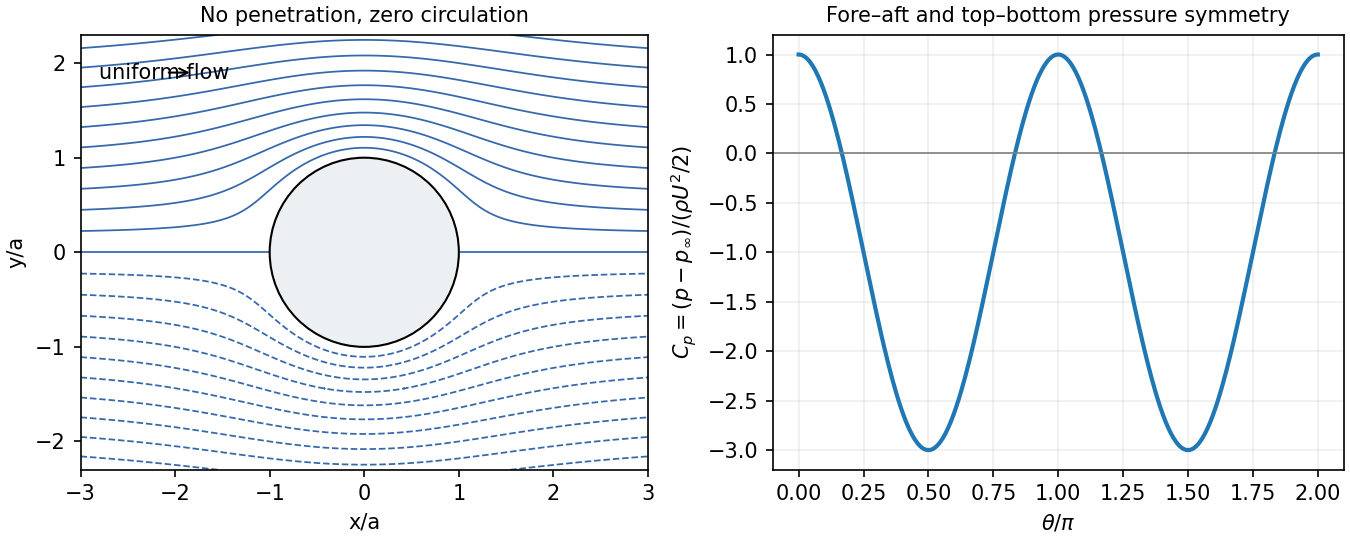
Use for the uniform upstream speed and take the flow along . The boundary conditions are and at infinity. A perfect inviscid model imposes no penetration, not no slip. For the intended no-circulation solution, require a globally single-valued potential, so the coefficient of is zero. The logarithmic term would be a net source and violates no penetration, so its coefficient is also zero. Growing terms with violate the uniform far field. For each remaining , the surface normal condition then forces its decaying coefficient to vanish. The terms satisfy and :An irrelevant additive potential constant is understood. At the same elevation, Bernoulli balance with the upstream stream givesThe force per unit height ispressure symmetry gives zero drag and zero lift in this zero-circulation idealization. D'Alembert's paradox is the failure of this inviscid model to represent real separated viscous wakes and their drag, not a claim that a real pole feels no force.
The zero-circulation assumption matters: leaves the stated velocity boundary conditions intact but adds to the surface tangential speed. It produces for positive counterclockwise circulation. Thus the boundary conditions alone do not justify excluding the angular term; an initially noncirculating inviscid start, or an explicitly single-valued potential, supplies the missing condition.[ref]
Flow Past a Cylindrical Obstacle by Richard Fitzpatrick. equations 5.73–5.81 and discussion after 5.83: circulation, force and the zero-circulation initial condition


Articles by others on the same topic
There are currently no matching articles.