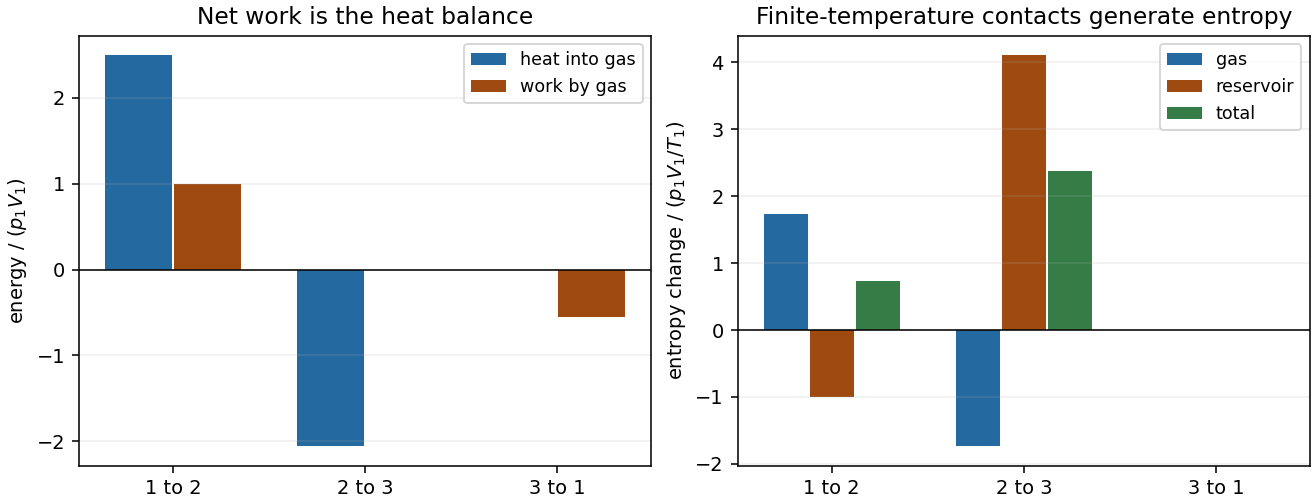
Put . For the specified ideal gas, , and . Isobaric expansion doubles temperature, so . Reversible adiabatic closure gives , henceThere is no heat input on that compression. The other stages giveTherefore andThe hot reservoir changes entropy by . The cold reservoir changes by . Since the gas completes a cycle,Although the mechanical paths can be quasistatic, heat flows across finite temperature differences in both contacts. This entropy generation explains why the efficiency is well below the Carnot value between these reservoirs.
For an isothermal final compression at , the preceding constant-volume cooling must instead end at ; keeping the old state 3 would not close the cycle. Compression then requires work , while the heat input remains . Thuswhich is lower: this isothermal compression occurs at a higher temperature throughout than the original adiabat and consumes more work. It also rejects heat during compression.

Articles by others on the same topic
There are currently no matching articles.