Use positive normal stress for tension. On a small rectangular material element, is the normal force per unit area on the face perpendicular to axis , and is the corresponding normal strain. Young's modulus is the ratio of axial normal stress to axial strain in uniaxial stress; Poisson's ratio is minus the transverse-to-axial strain ratio in the same test. Thus isotropic linear elasticity gives and cyclic permutations. The stress symbols here follow the question; denotes Poisson's ratio, not a stress component.
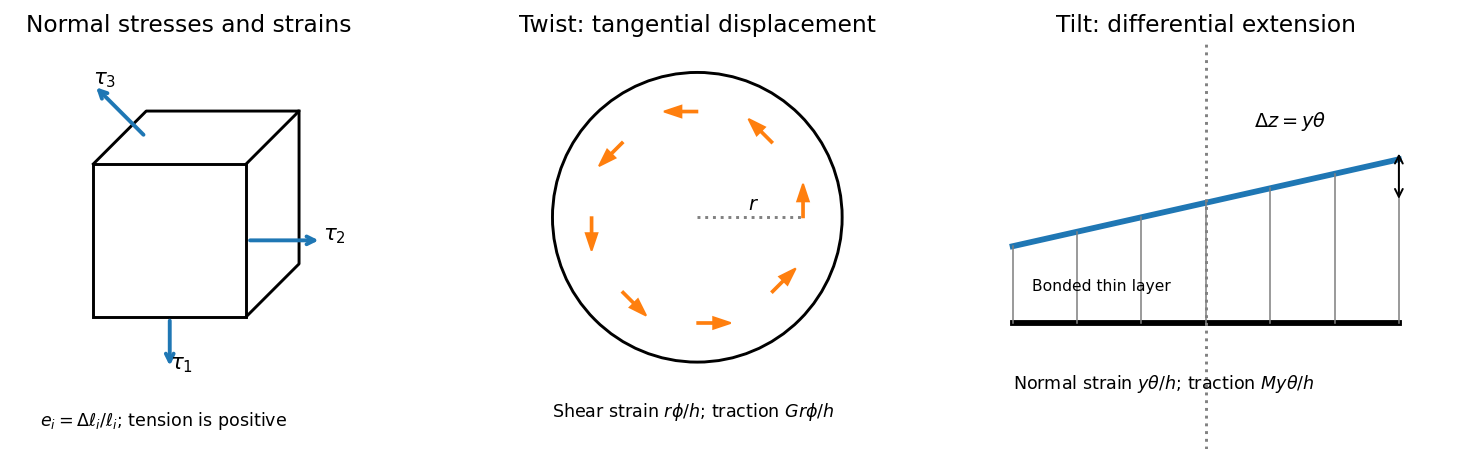

For , the two transverse compliance equations imply . Substitution into the first givesThis uniaxial strain modulus is greater than the uniaxial-stress Young's modulus for the positive Poisson's ratio of interest, because the lateral constraints prevent free Poisson contraction.
For a small twist , the bonded faces' relative tangential displacement at radius is . The layer's shear strain is , so the shear stress is . Integrating the torque givesThe minus sign denotes a restoring torque; the question quotes its magnitude. This uses the disk's polar second moment of area.
For tilt about H, choose in the plate perpendicular to H. The vertical displacement of the bonded top face is to first order, giving normal strain . The thin layer is constrained laterally by bonding, so its leading normal traction is , not . Integrating its moment about H givessince the diametric second moment of area is . This is the specified thin-layer approximation to the torsion and tilt stiffness of a bonded elastic disk. Relaxation near the free cylindrical edge is neglected; for a nearly incompressible layer it can limit quantitative accuracy unless the thinness is sufficient.
The thin square plate's moment of inertia about V is . Its two perpendicular in-plane central moments are equal and sum to , so the diagonal H has . Dividing the two angular stiffnesses by the appropriate moments of inertia givesThe geometry factors cancel in their ratio. Using the supplied relation between shear modulus and Young's modulus,The result lies just below the incompressible isotropic limit , as expected for a rubber with a large compression stiffness compared with its shear modulus. It is an inference within the bonded-layer model, rather than an independently measured material constant.
Articles by others on the same topic
There are currently no matching articles.