For a Newtonian fluid with velocity , is the component of traction on a plane whose normal points along . The opposite face has the opposite traction. The coefficient is dynamic viscosity, with units . Faster layers transfer positive momentum toward slower neighbours; the internal shear stress resists relative sliding.
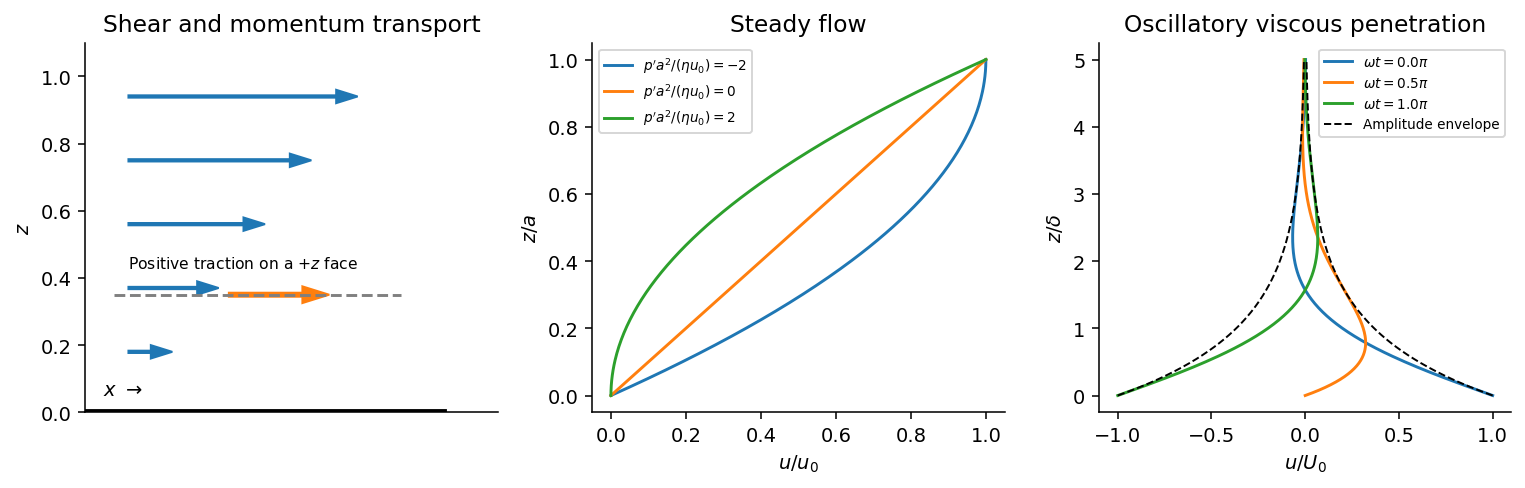
Shear-traction convention, Couette-Poiseuille profiles, and oscillatory viscous penetration
. Details. 
Take a thin fluid element with horizontal area and thickness . The difference between its upper and lower viscous tractions is . The pressure gradient supplies . Incompressibility is satisfied because has no dependence, and the convective acceleration vanishes: . Equating net force to mass times acceleration therefore gives the relevant component of the Navier-Stokes equation:For steady flow, integrate twice and impose the no-slip boundary condition at each plate, and . The Couette-Poiseuille flow profile isThe linear term is Couette flow and the parabolic term is plane Poiseuille flow. A negative drives flow in . Integrating the profile across the gap gives the volumetric flow per unit width,It has units ; multiplying by the plate width gives the actual volume per time.
With zero pressure gradient, substituting gives . Select the root that decays into fluid occupying :The other sign applies to decay in the opposite half-space. With a real wall velocity amplitude , the established periodic solution of Stokes' second problem isThe oscillation's amplitude decays exponentially and its phase lags with distance from the plate. This is diffusion of tangential momentum, not a freely propagating undamped elastic wave. Initial transients must have decayed before this purely periodic expression applies.
The fluid-displacement amplitude and the wall-displacement amplitude have the same ratio as their velocity amplitudes, since both are divided by the common . Thus for the specified amplitudes,Using the standard approximate water density , explicitly an approximation rather than another value printed on the paper, gives and from either face of a sufficiently large plate. The viscous penetration depth varies as if a more precise water density is used. The ideal parallel-flow solution ignores finite plate edges and tank walls.
Articles by others on the same topic
There are currently no matching articles.