For entropy gain from impact and thermal equilibration, let the large lake be a reservoir at an initially unspecified temperature , in kelvin, and take the final meteorite temperature to be . Its initial temperature is . The meteorite loses thermal energy , and its kinetic energy is also dissipated into the lake. ThusandBoth heat equilibration and dissipation contribute positively. TODO: the lake temperature is not supplied, so a unique numerical entropy change needs that input. As an explicitly assumed room-temperature estimate, gives . Taking – instead gives about –; this shows the estimate's sensitivity without asserting an unprovided lake temperature. The model uses the stated constant heat capacity, no phase change of the meteorite, and a lake large enough that its temperature change is negligible.[ref]
For the image force on a line charge above a conducting plane, with no imposed external electric field, use the method of images: replace the plane by a parallel image line of charge at height . The image is from the real line, and its field at the real line has magnitude . ThereforeHere points upward from the plane. The force is attractive and normal to the conductor, for either sign of . The image reproduces the induced surface charge field; it is not an extra physical charge, and no factor is inserted in the force on the actual line.
Interpret the two radial turning values as and ; the printed maximum/minimum order is reversed. The potential is . At either turning point,Equating these two energies gives . A radial impulse changes the radial velocity and energy but exerts no torque about the centre, so it preserves . For radial-impulse circularization of a harmonic central orbit, the circular orbit satisfies . HenceThe original orbit crosses this radius. Cancelling its radial velocity there leaves the tangential speed required for the circular orbit; the impulse is not applied at an original radial turning point.
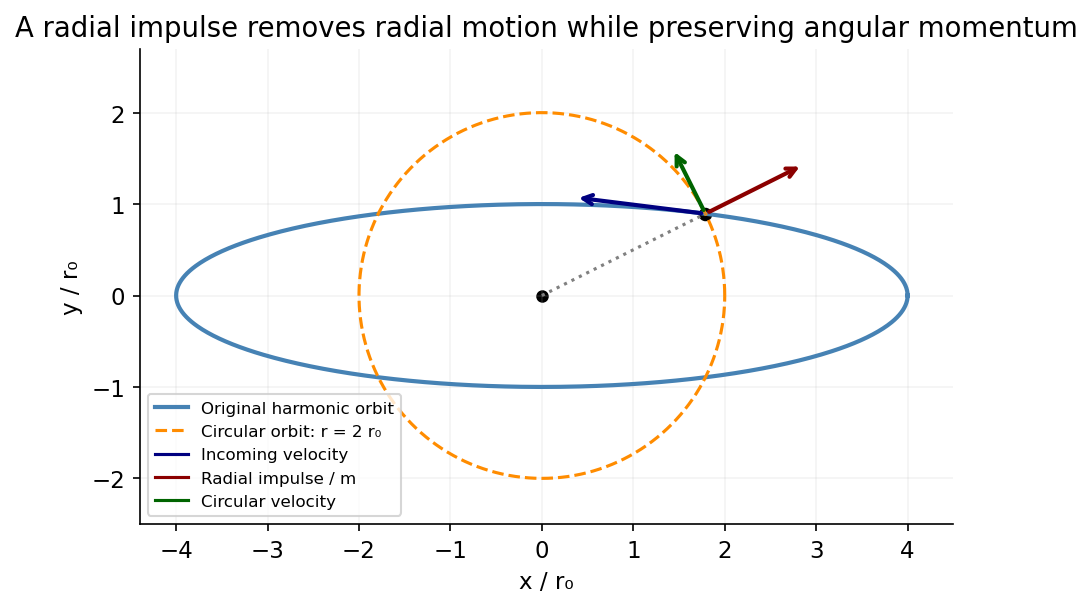
A radial impulse at the geometric-mean radius turns an elliptical harmonic orbit into a circular orbit
. Source. Details. 
For a thick good conductor in the normal skin effect regime, the skin-effect surface resistance is determined byIdentical guide geometry then giveswhere the numerical ratio assumes both coatings are nonmagnetic, with . A magnetic stainless-steel grade would require its magnetic permeability; conductivity alone does not fix that alternative.
Using , the gold skin depth at the stated frequency isThe metal coating thickness relative to skin depth sets the useful scale. Thus a layer of order begins to be useful, and a few skin depths, roughly –, substantially screen the poorer substrate. This is a thickness scale, not a specified attenuation threshold. It assumes a continuous coating thicker than the relevant microscopic surface scale.[ref][ref]
CODATA recommended values of the fundamental physical constants 2014 by National Institute of Standards and Technology. Vacuum permeability in the then-current SI convention
Take upward as positive and interpret the stated as the total mass immediately before launch, including the harpoon. The remaining probe mass is . Conservation of momentum during the short firing interval givesThe harpoon speed used here is relative to the comet, as printed. From , the near-surface gravitational acceleration isFor the near-surface recoil height with constant downward thrust, the upward motion has downward acceleration . ThereforeSince , treating gravity as constant is consistent. This uses only the stated gravity and thrust after firing; a taut tether could reduce this free-flight height, but no tether length or elasticity is specified. If instead meant the probe mass after firing, the pre-firing mass would be and its momentum would leave the probe still moving downward, with no upward excursion. This illustrates nearly cancelling recoil momenta in payload ejection. The mass convention matters because the launch momenta nearly cancel.
Articles by others on the same topic
There are currently no matching articles.