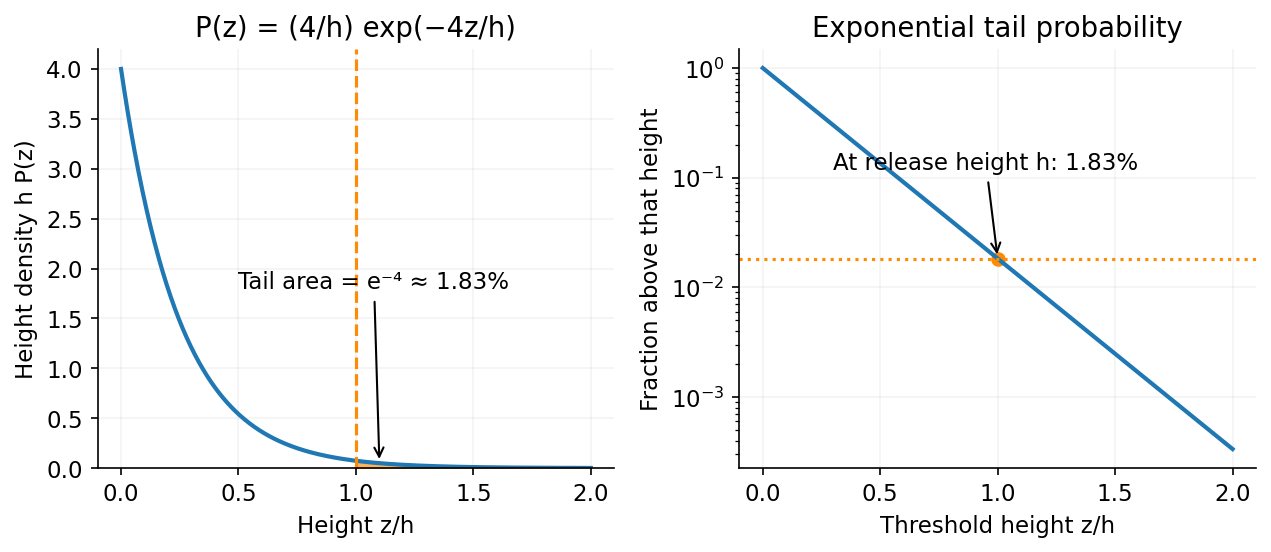
The Boltzmann distribution assigns probability to each microstate. For the equilibrium height distribution in a uniform gravitational field, take a dilute gas above a floor in a constant gravitational field. Uniform cross-section and no relevant upper boundary give the normalized height densityThusThe gravitational potential is linear in height, so its mean is not a quadratic-mode contribution of .
The equipartition states that each independent quadratic term in a classical equilibrium Hamiltonian contributes mean energy , provided the relevant degrees of freedom are thermally accessible. Equivalently, when the phase-space integration by parts has vanishing boundary terms. Three translational velocity components therefore contribute .
For rotational equipartition in a rough-ball gas, collisions exchange both translational and rotational energy. In the intended three-dimensional classical equilibrium model there are three translational and three rotational quadratic terms, giving in total kinetic energy per ball. Adding , and conserving the initial energy per ball, givesRoughness is relevant because it allows rotation to thermalize. The effective mechanical temperature of released rough balls describes the balls' mechanical degrees of freedom, not their internal material temperature; finite ball size and excluded-volume effects are neglected.[ref]
The height tail isThis can be nonzero because collisions redistribute energy between balls; an individual ball is not restricted to its original energy. The exponential distribution is the large-number statistical approximation under the stated effective-equilibrium assumption.

Articles by others on the same topic
There are currently no matching articles.